Introduction
Spring brings a familiar problem for pest control owners: the phones should be ringing, but bookings don’t match the demand. Part of the issue is seasonal and unpredictable — warmer temperatures arrive earlier, pest activity accelerates, and homeowners start searching before you’ve had a chance to prepare. The harder problem, though, is one you can control: most pest control websites aren’t built to convert high-intent visitors into booked jobs.
According to the National Pest Management Association’s 2026 Bug Barometer forecast, pests may emerge earlier and in greater numbers this spring and summer, creating a more urgent demand window for local pest-control companies.
This guide is a diagnostic framework. It walks through the three layers of a pest control website where leads most commonly slip away, identifies the fixes that matter most, and gives you a self-audit checklist you can run in under an hour. If you’re heading into a busy season, this is where to start.
Why Bookings Leak
Most pest control companies assume their website is fine because it looks decent and loads without errors. But looking fine and converting well are very different things.
When a homeowner spots something alarming — ants in the kitchen, a termite swarm in the attic — they don’t browse casually. They search, skim the first few results, and make a fast decision. Your website has seconds to reassure them, communicate clearly, and give them an easy way to act. Most pest control sites fail at all three.
The leaks tend to cluster around three problems. First, weak first impressions: generic copy, stock photography, and no immediate trust signals. A visitor who can’t quickly confirm you’re licensed, insured, and operating in their area will bounce. Second, unclear pathways: phone numbers that aren’t tappable on mobile, forms with too many fields, and no way to book outside business hours. Third, slow follow-up: even when a prospect does submit a form, many firms take hours to respond — long after the customer has moved on.
The fix isn’t a redesign. It’s understanding which layer of your website is failing and addressing it precisely.
A Diagnostic Framework: Three Layers, Three Jobs
Layer 1: The Home Page — First Impression and Brand Promise
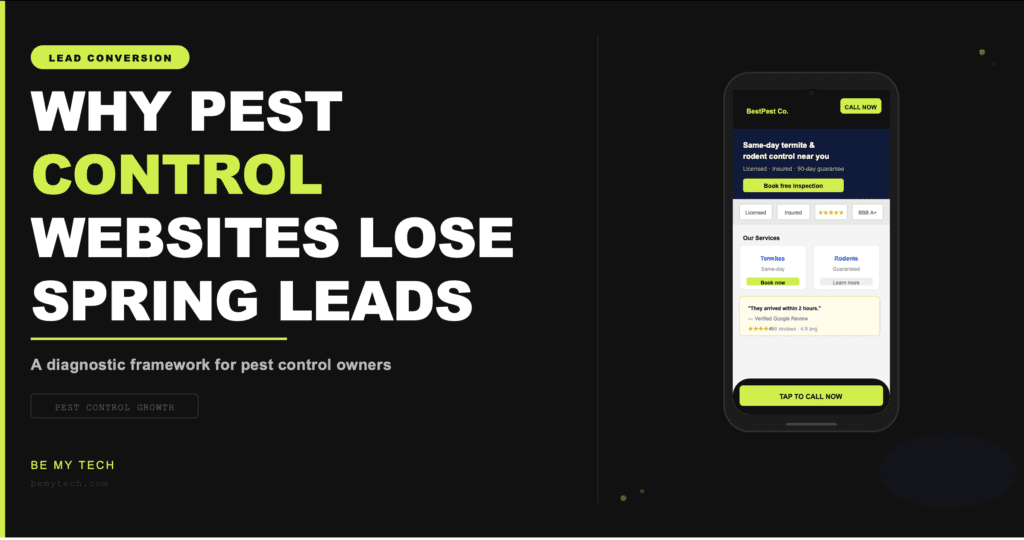
Your home page has one job: make the right visitor feel immediately confident they’ve found the right company. That means your hero section should answer two questions within three seconds — what do you do, and where do you do it? A headline like “Same-day termite and rodent control in [City]” does more work than anything clever.
From there, the page should build credibility quickly. Display your license number, insurance status, and any certifications visibly — not buried in the footer. Show real customer reviews, ideally pulled from your Google Business Profile, near the top. Include a clear service area, whether that’s a map or a list of cities you cover.
The single most overlooked element on a home page is a mobile-friendly click-to-call button. If a visitor has to squint to find your number, or if tapping it doesn’t dial automatically, you’re losing leads that cost you nothing to capture.
Layer 2: Service Pages — Educate and Persuade
Service pages are where pest control websites most commonly underinvest. A single generic “Services” page doesn’t rank for anything specific, doesn’t answer the questions real customers ask, and doesn’t convert searchers who are already primed to book.
The better approach is dedicated pages — one per pest type, ideally crossed with location where your market justifies it. A page targeting “bed bug exterminator in [City]” should walk the visitor through exactly what they need to know: how to identify the problem, why DIY approaches frequently fail, and what your treatment process looks like. Structure these pages around the questions people actually type into search, not the language your industry uses internally.
End every service page with a strong, direct call-to-action. Not “contact us for more information” — something more specific and immediate, like “Call now for a same-day inspection” or “Book online in under two minutes.” Add local schema markup so search engines can properly index the page for your service area.
Layer 3: Landing Pages — Campaign and Season-Specific
Landing pages serve a different purpose than service pages. Where a service page educates and covers a range of scenarios, a landing page is built around a single offer, a single audience, and a single action.
If you’re running paid ads for a spring termite inspection promotion, the landing page tied to that ad should mention nothing else. No navigation menu pulling visitors away to explore your other services, no multi-paragraph company history. Just the offer, the proof that you’re credible, and the mechanism to book. A clear guarantee — “We’ll retreat at no charge if pests return within 90 days” — can meaningfully improve conversion rates on these pages.
Landing pages are also ideal for email campaigns, seasonal promotions, and testing new offers without touching your main site structure.
Fix This First: High-Impact Improvements
Before the busy season arrives, these are the changes that move the needle fastest.
Make calling effortless. A sticky click-to-call button at the bottom of the screen on mobile is one of the highest-return changes you can make. On desktop, your phone number should appear in the header, the footer, and ideally mid-page on longer service pages — always as a tappable link.
Speed up your site. A slow site frustrates visitors and suppresses your search rankings. Compress images, reduce unnecessary third-party scripts, and make sure your hosting can handle a traffic spike during a busy season. Aim for under three seconds on a standard mobile connection.
Show proof of trust above the fold. License numbers, insurance badges, certifications, and genuine customer reviews should appear near the top of your pages — not on a separate “About” page that most visitors never find. Real team photos significantly outperform stock imagery for conveying legitimacy.
Offer online scheduling. Many homeowners search for pest control help outside of business hours. A simple booking tool that lets visitors choose a time slot — even just for a callback — captures demand that would otherwise disappear overnight.
Highlight emergency and same-day services. If you offer fast response, say so prominently. Create a dedicated page for emergency pest control and link to it from your main navigation and any paid campaigns.
Respond faster. Speed of follow-up is one of the strongest predictors of whether a lead converts. Set up a CRM or automation tool that immediately acknowledges form submissions and routes the lead to whoever on your team can call back quickly.
Self-Audit Checklist
Run through these questions against your current site:
- Does your home page clearly state what you do and where you operate, within the first few seconds?
- Is your phone number tappable on mobile and visible without scrolling?
- Do you have individual pages for each pest type and service area you cover?
- Are those pages structured around questions customers actually ask — not internal industry language?
- Do you display real, recent reviews and visible proof of licensing?
- How quickly does your site load on a mobile connection?
- Can visitors book or request a callback without calling during business hours?
- Do you have a clear response-time promise — something like “We’ll call you back within 15 minutes”?
- Are your campaign landing pages free of navigation distractions?
- Is your content written clearly enough that Google’s AI search summaries could accurately represent it?
If you answered “no” or “unsure” to more than three of these, you have identifiable leaks worth fixing before your next busy period.
Conclusion
Pest season doesn’t wait for your website to be ready. Homeowners searching in urgency make fast decisions — and they’re choosing between you and whoever else shows up in their results. The difference between a site that converts and one that leaks leads is rarely dramatic. It’s usually a missing click-to-call button, a vague service page, a slow load time, or a form that no one follows up on quickly enough.
The three-layer framework — home page, service pages, and landing pages — gives you a structured way to find those gaps and close them. Start with the checklist, fix the highest-impact items first, and you’ll be better positioned to turn seasonal demand into booked jobs.
Be My Tech builds growth systems for service businesses — combining conversion-focused web design, local SEO, and follow-up automation so high-intent leads don’t slip through. If you want a clear picture of where your site is losing bookings, book a free 15-minute strategy call and we’ll walk through it together.
FAQ
Why do pest control websites lose so many leads?
Most pest control websites are built to look professional, not to convert visitors. The most common failures are unclear calls-to-action, phone numbers that aren’t clickable on mobile, slow page load times, and slow follow-up after a form is submitted. Fixing these doesn’t require a full redesign — targeted changes to each layer of the site usually deliver the biggest results.
How quickly do homeowners choose a pest control company?
Homeowners dealing with an active pest problem tend to decide quickly — often within a few hours of searching. That makes first impressions and response speed critical. A site that builds immediate trust and offers an instant way to act will outperform one that’s visually polished but difficult to navigate.
Do mobile visitors really matter for pest control?
They’re the majority of your traffic. Most pest control searches happen on mobile devices, often when someone has just spotted a problem. Sites that load slowly, hide the phone number, or rely on non-tappable buttons lose those visitors before they ever read your copy.
What’s the difference between a service page and a landing page?
A service page educates visitors about a specific pest or service, answers common questions, and builds the trust needed to earn a booking. A landing page is built around one specific offer — like a seasonal inspection promotion — and is designed to eliminate distractions and drive a single action. Both are necessary, and they serve very different parts of the conversion path.
Ready to stop losing leads your competitors are capturing? Be My Tech builds growth systems for pest control owners — conversion-focused websites, local SEO, and automated follow-up that turns high-intent searches into booked jobs. Book a free 15-minute strategy call to find out exactly where your site is leaking and what to fix first.