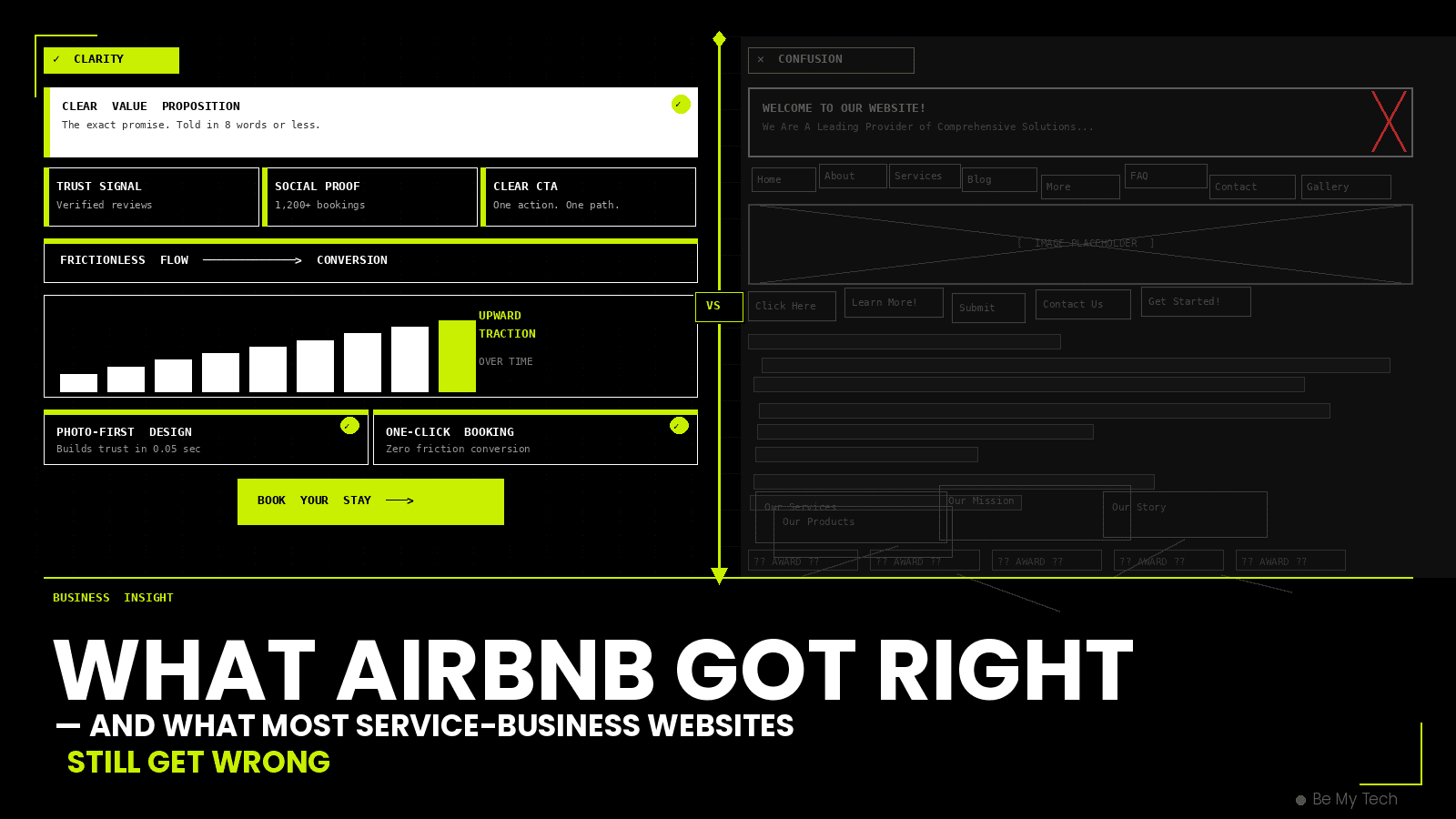
Most service-business websites do not underperform because the service is bad.
They underperform because the business is explained badly.
The message is vague. The offer is buried. The trust is thin. The next step feels heavier than it should. And the result is brutal: real businesses with real value end up looking smaller, weaker, and less credible online than they actually are.
That is why Airbnb’s early story still matters.
Not because every business should study startups for entertainment. Not because service businesses should imitate venture-backed tech companies. But because Airbnb got one foundational thing right early: it made the business easy to understand. Airbnb’s official history shows the business began by hosting its first guests in October 2007, recorded 80 bookings around the Democratic National Convention in August 2008, and officially changed its name from Airbed & Breakfast to Airbnb in March 2009 as it expanded beyond rooms into apartments, whole homes, and vacation rentals. Slidebean’s public teardown of the 2009 deck is one reason that early communication still gets studied today.
If you run a service business today, that lesson is still worth money.
Why Airbnb’s Early Story Still Matters
Airbnb’s early materials still get attention because they did not rely on hype. They relied on clarity.
The business was framed in a way people could quickly understand:
- there was a real problem
- there was a clear solution
- the story made sense
- the next step felt believable
That is what many service-business websites still miss.
They may have a decent logo. A modern template. A few service sections. A contact page. But once you look past the surface, the core communication often collapses:
- the headline says little
- the offer feels broad or fuzzy
- the proof is weak
- the call to action is generic
- the buyer has to work too hard
That is not just a copy issue. It is a conversion issue.
The Real Problem With Most Service-Business Websites
Most service-business websites are digital brochures pretending to be sales systems.
They look acceptable at a glance but do not do the hard work a serious website should do:
- clarify the problem
- sharpen the offer
- reduce doubt
- guide belief
- move a visitor toward action
This is exactly why so many businesses feel frustrated by their online presence.
The website is “live.”
The business is real.
The service is good.
But the site still does not generate enough qualified leads.
That usually means one thing: the website is not translating business value into digital trust.
If that sounds familiar, start with Be My Tech’s breakdown of why most business websites don’t convert.
Lesson 1: Clear Problem Framing Beats Clever Wording
One reason Airbnb’s early communication worked is that it made the problem and solution legible quickly. That is still the first job of any high-converting homepage.
Most service businesses do the opposite.
They open with generic language like:
- “Welcome to our website”
- “We provide quality solutions”
- “Trusted excellence for all your needs”
- “We offer many services for you”
That kind of copy fills space, but it does not create clarity.
A strong headline should make the visitor think:
Yes. This is for me. They understand the problem.
Compare these two examples.
Weak:
We provide complete digital solutions for modern businesses.
Stronger:
We help service businesses turn unclear websites into lead-generating assets.
Or:
Weak:
Reliable plumbing services for all your needs.
Stronger:
Need a plumber who shows up, communicates clearly, and fixes the issue before it becomes a bigger bill?
The difference is not style. It is precision.
Lesson 2: Simple Offers Convert Better Than Clever Language
A lot of service businesses try to sound advanced when they should be trying to sound clear.
They say things like:
- end-to-end transformation
- bespoke growth ecosystems
- integrated digital enablement
- full-spectrum strategic solutions
That language may impress internally. Externally, it often weakens trust because it forces the reader to decode basic meaning.
A visitor should be able to understand three things quickly:
- What you do
- Who you do it for
- What outcome they should expect
If your website cannot answer those in one pass, your offer is not sharp enough.
This is why strong digital brands do better: they make the business easier to buy from.
If you want a better framework for that, read Be My Tech’s 7-step process to launch high-converting digital brands.
Lesson 3: Trust Is Built in Layers, Not Slogans
Slidebean’s teardown of Airbnb’s deck points out that the deck was not just an idea dump. It used validation, proof, and supporting logic to make the business feel credible. That same principle applies to websites.
Most service-business websites ask for trust before they earn it.
They use adjectives like:
- trusted
- premium
- reliable
- professional
- industry-leading
But credibility is not built by adjectives. It is built by evidence.
A strong trust layer usually includes:
- specific testimonials
- reviews or ratings
- recognizable client types
- clear process explanations
- founder or team credibility
- response-time expectations
- before-and-after examples
- certifications or memberships
- real photos or real proof points
When those elements are missing, the site starts asking the visitor to make a leap.
And most people do not leap online. They compare, hesitate, and leave.
Lesson 4: Simplicity Makes a Business Easier to Buy From
One reason Airbnb’s early positioning worked is that the business model was understandable. People could grasp the logic quickly.
Many service-business websites fail the equivalent test.
A visitor lands on the site and still cannot tell:
- what is actually included
- how one service differs from another
- whether the company is premium or budget
- what happens after inquiry
- how the process works
- why they should choose this company instead of the next one
That confusion lowers momentum.
A better service structure might look like this:
- Starter Website — for businesses that need a clean, credible online presence
- Conversion Website — for businesses that need stronger messaging and better lead flow
- Authority System — for founders who need a website, content, positioning, and trust assets working together
Even without full public pricing, that kind of structure helps people orient fast.
And orientation matters more than most businesses realize.
Lesson 5: Friction Kills More Demand Than Most Owners Realize
A lot of business owners assume that if someone wants the service badly enough, they will figure the website out.
That assumption is expensive.
Small friction points compound:
- a vague headline slows comprehension
- weak proof creates doubt
- cluttered navigation breaks flow
- generic forms reduce intent
- soft CTAs weaken action
- poor structure makes the site feel less trustworthy
By the time the visitor leaves, it may look like a traffic problem.
Often it is not.
Often the business is losing people through unnecessary friction.
This is also where automation starts to matter. Once the website is clear, automation can support faster follow-up, better lead routing, and a smoother sales experience. But automation only works well when the foundation is already strong. That is exactly the distinction Be My Tech makes in its guide to AI automation for small businesses.
What Most Service-Business Websites Still Get Wrong
If you strip away the visuals and look at the mechanics, the same mistakes keep repeating:
1. They lead with themselves instead of the customer
The homepage talks about the business before it talks about the problem.
2. They confuse breadth with strength
They list many services instead of presenting one sharp value proposition.
3. They under-invest in proof
There are too few trust signals, or they appear too late.
4. They make the next step feel generic
“Contact us” is not always enough. Specificity matters.
5. They treat design as decoration instead of persuasion
The site may look modern, but it does not guide belief.
6. They fail to build authority
They publish little or no useful insight, analysis, or educational content that proves they understand the buyer’s world deeply.
That last point matters even more now because content quality, structure, and clarity influence not just human trust but also discoverability.
Why This Matters for Google and AI Search
Google’s own guidance says its ranking systems are designed to prioritize helpful, reliable, people-first information, not content created mainly to manipulate rankings. Google also says people-first content should clearly demonstrate first-hand expertise and depth of knowledge, and warns against summarizing what others say without adding much value.
That matters here.
A vague, generic service page struggles with people.
It also struggles with search.
Google’s Article structured-data documentation says that adding Article markup to blog pages can help Google understand the page better and show better title text, images, and date information in search. Google’s general structured-data guidelines also say the markup must be visible, relevant, and a true representation of the page content.
That is why this kind of content matters:
- it builds authority
- it improves relevance
- it creates stronger internal linking opportunities
- it gives AI systems clearer, more quotable material to work with
For a practical BMT companion piece on this, link readers to Google AI Overviews for small businesses.
What Service Businesses Should Steal From Airbnb’s Early Clarity
Not the startup mythology.
Not the valuation story.
Not the brand aura that came later.
The thing worth stealing is the communication discipline.
Steal this: make the problem obvious
Do not force visitors to infer why your service matters.
Steal this: explain the offer in plain English
If the offer needs translation, it needs rewriting.
Steal this: support claims with proof
Trust is built by specifics, not adjectives.
Steal this: structure the journey
A visitor should know what they are reading, why it matters, and what to do next.
Steal this: reduce friction relentlessly
Every weak CTA, vague section, and buried proof point lowers momentum.
Steal this: publish useful insight
If your website teaches nothing, proves little, and says what everyone else says, it becomes harder to trust, harder to remember, and harder to rank.
A 30-Day Fix Plan for a Typical Service-Business Website
Week 1: Fix the message
- rewrite the homepage headline around pain, audience, and outcome
- sharpen the main CTA
- simplify service-page language
- remove filler copy
Week 2: Fix the trust layer
- add stronger testimonials
- surface reviews more clearly
- add proof blocks or case snapshots
- strengthen founder or company credibility
Week 3: Fix the flow
- reduce navigation clutter
- improve section order on the homepage
- make inquiry paths more obvious
- replace weak CTA labels with stronger action language
Week 4: Fix the authority layer
- publish one strong insight piece
- add internal links between service and blog pages
- create one practical lead magnet or audit offer
- tighten metadata and article structure
That is not glamorous.
It is just what works.
And it is how a website starts behaving like a business asset instead of a placeholder.
Frequently Asked Questions
Why is Airbnb relevant to service-business websites?
Because the lesson is not about travel. It is about clarity, trust, and making a business easy to understand.
What is the biggest mistake most service-business websites make?
They lead with vague messaging, weak proof, and no clear next step.
Do service businesses need a fancy website to convert better?
No. They need clearer positioning, better trust signals, less friction, and a stronger conversion path.
Should this blog use FAQ schema?
You can keep the FAQ content on-page because it helps readers and covers real long-tail questions. But Google announced in 2023 that FAQ rich results would generally only be shown for well-known government and health websites, so for a commercial BMT blog this section should be treated as reader value, not as a rich-result play.
Final Takeaway
The most valuable thing Airbnb got right early was not just the idea.
It was the clarity.
The business became easier to understand, easier to talk about, and easier to believe in.
That is still the edge.
A service-business website does not need to be flashy to outperform. It needs to be clear, credible, well-structured, and easy to act on.
That sounds simple.
It is not.
And that is exactly why so many businesses still get it wrong.
Want a Real Website Teardown Instead of Another Guess?
If your website looks “fine” but still is not generating enough qualified leads, the problem is usually not just design.
It is messaging.
It is trust.
It is offer clarity.
It is friction.
It is the gap between what your business actually delivers and what your website makes people believe.
This article is educational and does not describe an active Be My Tech service.
Start here: