Why One Generic Dental Services Page Is Costing Your Practice Implants, Invisalign, and Veneers Patients

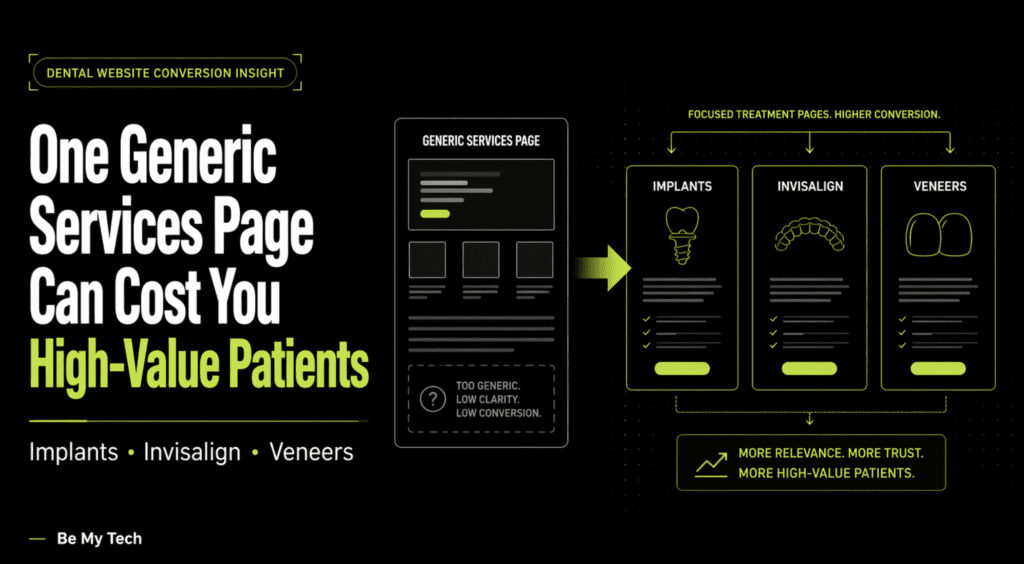
Diagram showing how one generic dental services page can lose high-value patients, while focused treatment pages for implants, Invisalign, and veneers improve trust and conversion.

A generic dental services page often looks harmless. For a private general/cosmetic dental practice, it can quietly cost implant, Invisalign, and veneers patients because it fails to convert treatment intent into booked consultations.

That is the real issue.

Most practices do not lose high-value cases because the website is ugly, broken, or obviously outdated. They lose them because the part of the site that should help a patient decide is too vague, too broad, and too weak.

When a prospective patient is searching for dental implants, Invisalign, or veneers, they are not casually browsing. They are trying to answer practical, emotional, and financial questions before they ever call your office.

They want to know:

  • Do you actually do this often?
  • Is this the kind of case your practice is known for?
  • What should I expect?
  • What will the process feel like?
  • Am I a candidate?
  • What happens next?

Too many dental websites try to answer all of that with one broad services page and a short summary under each treatment.

That is where the leak starts.

Why a Generic Dental Services Page Fails High-Value Cases

A generic dental services page creates a false sense of completeness.

From the practice owner’s side, it feels logical. Everything is listed. The website “covers” the treatments. Patients can click around. Nothing appears missing.

From the patient’s side, the experience is very different.

An implant patient is not thinking like a veneers patient. An Invisalign prospect is not processing risk the same way as someone researching restorative work. These are different concerns, different motivations, different hesitation points, and different buying decisions.

When all of those treatments are compressed into one page, the page becomes too broad to feel relevant and too shallow to build confidence.

This is the part many practices miss:

A homepage creates interest. A treatment page has to close uncertainty.

If the treatment page does not do that job, serious prospects hesitate. They compare other offices. They leave. They delay. And eventually, many of them book somewhere else.

The Expensive Problem Is Not Just SEO. It Is Decision Friction.

A lot of people frame this as an SEO issue only.

It is not.

Yes, a generic dental services page can weaken search visibility for treatment-specific intent. But the deeper problem is decision friction. The page does not make it easy for a serious patient to feel understood, reassured, and ready for the next step.

That is expensive because the most valuable cases usually come with more hesitation, not less.

Patients considering implants, Invisalign, or veneers tend to care about:

  • trust
  • pain or discomfort
  • cost expectations
  • candidacy
  • cosmetic outcome
  • time commitment
  • confidence in the dentist
  • whether this feels worth taking the first step

A broad services page usually touches these issues too lightly or ignores them completely.

So even when the right traffic lands on the site, the page does not convert treatment intent into real action.

What High-Value Dental Patients Are Actually Looking For

Infographic showing what high-value dental patients need before booking, including fit, trust, clarity, and action on a dental treatment page.

When someone lands on a treatment page for implants, Invisalign, or veneers, they are not just looking for information. They are trying to self-qualify.

In plain language, they are trying to answer four questions.

1. Is this for someone like me?

The patient needs to feel that the treatment fits their specific concern. They do not want a broad lecture on services. They want clarity about their case.

2. Can I trust this practice with a decision this important?

High-value cases are trust-heavy. The patient wants reassurance that your office is credible, experienced, and serious about this treatment.

3. What will happen if I take the next step?

Uncertainty kills conversion. If the page does not explain the consultation path, patients imagine friction, awkwardness, or wasted time.

4. Why should I contact this office instead of continuing to compare others?

That is the real conversion moment. If your page does not reduce comparison, it encourages more of it.

The Original Judgment: Most Dental Sites Force Patients To Do Too Much Work

This is the pattern I keep seeing across service-business websites, and dental sites are no exception:

The biggest leak is often not traffic. It is forced patient labor.

The website makes the patient do too much interpretation.

They have to guess whether you are strong in the treatment they want.
They have to infer whether you handle cases like theirs.
They have to search for reassurance.
They have to piece together what happens next.
They have to work harder than they should to feel ready.

That is where conversion drops.

The practice that wins is usually not the one saying the most. It is the one reducing uncertainty the fastest.

What a Better Treatment Page Actually Does

A focused treatment page should not exist just to rank. It should exist to move the right patient from uncertainty to consultation.

That means your implants page should do a different job than your Invisalign page. Your veneers page should not read like a generic general-dentistry summary. And none of them should feel like a thin subsection copied out of one broad services page.

Every high-value treatment page should do five things clearly.

1. State the treatment and patient fit immediately

The patient should know within seconds what the page is about, who it is for, and whether they are in the right place.

2. Reduce emotional hesitation early

Patients do not only need information. They need relief. The page should address uncertainty around pain, embarrassment, complexity, or whether they waited too long.

3. Show treatment-specific trust

Generic reviews are not enough. High-value pages need signals that this practice is credible for this exact type of decision.

4. Explain the path, not just the procedure

A surprising number of dental pages describe the service but do not explain the consultation journey. That is a mistake. Patients want to know what happens first, what happens next, and how the process unfolds.

5. Use a CTA that matches real treatment intent

“Contact Us” is weak. A strong treatment page needs a more specific next step, such as booking a consultation, requesting an assessment, or asking about candidacy.

What We Audit First on a Generic Dental Services Page

When we review a private dental website, we do not start by asking whether it looks modern.

We start with a much harder question:

Can a serious treatment-intent patient self-qualify and feel confident within the first 60 to 90 seconds?

That is the test.

Inside that, we look for the following:

  • whether implants, Invisalign, and veneers have dedicated pages or are buried inside one broad summary
  • whether the page has one clear conversion job
  • whether the copy builds confidence or only describes services
  • whether the CTA matches the patient’s stage of intent
  • whether trust signals are treatment-specific or generic
  • whether the page reduces friction on mobile
  • whether the patient can understand what happens next without guessing

This is the difference between a website that merely exists and a website that helps bring in better cases.

A Simple Real-World Comparison

Imagine two private dental practices.

The first has one generic services page. Veneers appear halfway down the page in a short paragraph, followed by a small button that says “Contact Us.” There is no treatment-specific reassurance, no consultation pathway, and nothing that helps a patient feel more ready.

The second has a focused veneers page. It explains who veneers are for, what concerns they address, what the consultation involves, what kind of outcome the patient should discuss, and what to do next.

Both practices may offer the same service.

But only one page is built to convert a serious prospect.

This is the gap.

It is not always the prettier site that wins. It is usually the clearer one.

Why This Matters So Much for 1–3 Location Private Practices

If you run a private general/cosmetic dental practice with one to three locations, you are in a harder position than large multi-location groups with bigger brand recognition and larger media budgets.

That means your website has to do more real conversion work.

You cannot afford vague treatment architecture. You cannot afford pages that look complete but fail to close confidence. And you especially cannot afford to let implant, Invisalign, or veneers prospects arrive with intent and leave with uncertainty.

A generic dental services page may seem efficient from an internal content standpoint.

Commercially, it is often the opposite.

It creates message dilution at the exact point where specificity matters most.

The Practical Move Most Practices Should Make Next

This is the simplest next step.

Identify your most commercially important treatments. For many private general/cosmetic practices, that usually includes some version of:

  • implants
  • Invisalign or clear aligners
  • veneers
  • smile makeover or cosmetic dentistry
  • restorative treatment with strong consultation value

Then ask one hard question:

Does each of these treatments have a page strong enough to convert a serious prospect on its own?

If the answer is no, that is likely where your next growth leak is hiding.

Because once the patient lands on the site, the job is no longer just to inform.

The job is to make the decision easier.

Final Thought

A generic dental services page does not always look broken.

That is what makes it dangerous.

It quietly turns serious intent into hesitation, comparison, and drop-off. And for a private general/cosmetic practice trying to grow more implant, Invisalign, and veneers consultations, that is not a small issue. It is expensive.

The practices that win more of these cases are not always the loudest. They are the ones that reduce uncertainty, build treatment-specific trust, and give the patient a cleaner path forward.

That is the real job of the page.

And that is why one generic dental services page can cost your practice high-value patients.

Request a Focused Dental Website Conversion Audit

If you run a private general/cosmetic dental practice and want a second set of eyes on your website, Be My Tech offers a focused dental website conversion audit.

We review the pages that matter most for booked treatment intent, identify the trust and conversion leaks, and show you where your site may be losing implant, Invisalign, and veneers opportunities.

Request a focused 8–12 minute diagnostic teardown.

We will look at your homepage, treatment-page structure, CTA flow, trust signals, and mobile conversion path.

About Be My Tech

Be My Tech helps service businesses turn websites into clearer, stronger conversion systems. For private dental practices, that means improving the path from search to trust to consultation, especially for higher-value treatments where hesitation is expensive.


FAQ section

Do dental practices need separate pages for implants, Invisalign, and veneers?

In most cases, yes. Separate treatment pages usually create better relevance, clearer messaging, and a stronger path to consultation than one broad services page.

Why does a generic dental services page convert poorly?

Because it often fails to answer treatment-specific questions around fit, process, trust, and next steps. The result is more hesitation and more comparison.

What should a high-converting dental treatment page include?

A clear treatment focus, patient-fit messaging, treatment-specific trust signals, a simple consultation path, and a CTA that matches real patient intent.

Ready to build a system that converts?

Let's discuss how to turn your website into a growth engine.

Related Post :

Scroll to Top