
Author Marketing
Self-Published Author Websites: The 5 Problems We See Most Often
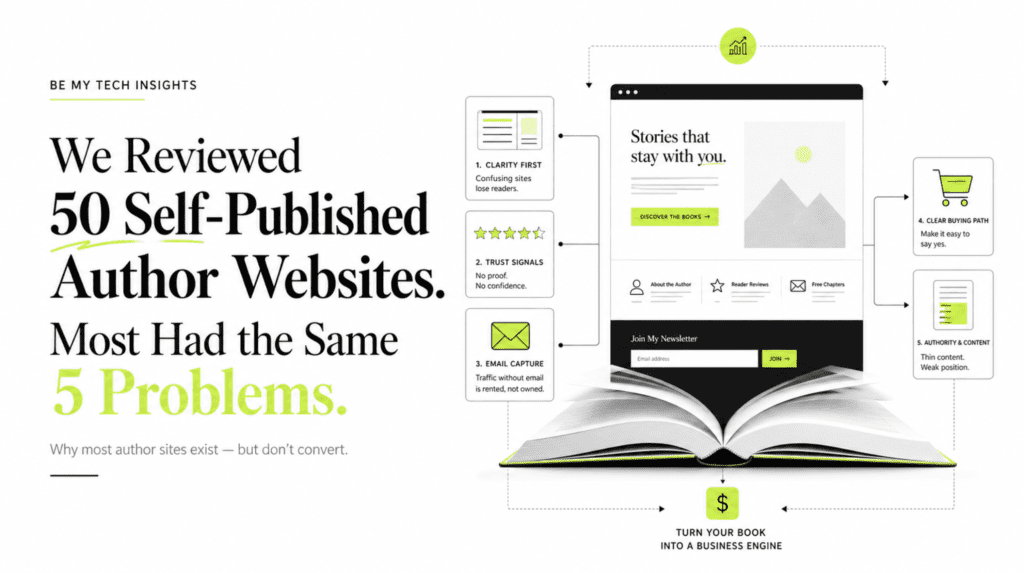
We’ve studied many author websites over the years while building our review process.
Many look perfectly respectable at first glance: professional headshots, atmospheric imagery, a short bio, and links to buy on major retailers.
Yet the visitor often leaves without subscribing, without buying, and without any clear sense of why this author — or this book — matters to them.
That is the problem.
Most self-published author websites are not failing because they look unprofessional. They are failing because they were built to exist, not to convert.
At Be My Tech, our author website work focuses on conversion-ready author platforms for select self-published writers, scoped case by case. To ground our work in current reality, we studied a practical sample of self-published author websites across fiction, nonfiction, memoir, and expert-led niches.
We were not judging taste. We were looking for something more important: conversion architecture.
That means the structure behind how a website helps a visitor:
- understand the author’s promise
- trust the work
- join the audience
- find the right book
- take the next step
- eventually become a reader, subscriber, or direct buyer
A book page proves the book exists.
An author platform builds the system around the book.
That difference matters more than most authors realize.
Key Takeaways
- Most self-published author websites are not failing because they look unprofessional. They are failing because they were built to exist, not to convert.
- The strongest author websites are built around conversion architecture: message clarity, trust signals, email capture, buying path, mobile usability, and platform depth.
- A passive newsletter form is one of the biggest missed opportunities. Written Word Media’s 2025 Indie Author Survey shows a strong relationship between email lists and author income.
- Direct-to-reader sales are becoming more important. About 30% of authors already sell direct from their own site or store, and another 30% plan to start soon.
- The strongest strategic model is the Platform Homepage: clear promise → featured book → trust signals → email capture → buying path → authority layer.
- Authors who want sustainable careers need more than a book page. They need a platform that builds trust, audience ownership, and long-term commercial leverage.
How We Reviewed the Websites
We evaluated each site across six practical conversion dimensions:
- Message clarity — Does the homepage quickly communicate the reader-facing promise?
- Trust signals — Are proof elements placed where they can reduce hesitation?
- Email capture — Is there a compelling reason to subscribe?
- Buying path — How easy is it to purchase or start with the right book or series?
- Mobile usability — Does the experience hold up where many readers discover and browse?
- Direct-sales readiness — Does the site support reader relationship ownership beyond retailers?
We did not use this review to rank authors or produce statistical claims. We used it to identify repeated conversion patterns across a practical sample of author websites.
To keep the review ethical and useful, we are not naming or publicly scoring individual author websites. The goal is not to shame creators doing difficult, valuable work. The goal is to surface patterns that self-published authors can learn from and fix.
The 5 Recurring Problems We Observed
Several patterns appeared again and again.
Not every site had every problem. But the same five issues showed up often enough to matter.
Problem 1: The Homepage Promise Is Missing or Muddled
Readers form an impression in the first few seconds.
They are silently asking:
- What does this author write?
- Is this for me?
- Why should I care?
- What should I do next?
Many homepages opened with generic lines like:
- “Welcome to my website”
- “Official site of [Author Name]”
- “Explore my books”
- “Award-winning author of…”
Those lines are not automatically wrong. But they usually do not create enough clarity.
Fiction sites sometimes prioritized mood over genre and stakes.
Nonfiction and memoir sites often foregrounded the author’s credentials before the reader’s transformation.
Expert-led authors frequently buried their core promise deep in menus, long bios, or scattered service pages.
The gap:
The site tells the reader who the author is, but not why the reader should stay.
The fix:
Lead with a sharp, reader-facing promise.
Examples:
- Thriller author: “High-stakes stories where ordinary people confront impossible moral choices.”
- Memoir author: “A story of loss, faith, and rebuilding a life after everything changed.”
- Business author: “Practical systems that help solopreneurs build profitable businesses without sacrificing their health.”
- Self-help author: “Books and tools for people rebuilding confidence after burnout.”
A strong homepage promise does not need to sound clever.
It needs to be clear.
The reader should understand within seconds:
“I know what this is. I know who it is for. I know whether I want to keep reading.”
Problem 2: The Newsletter Offer Is Too Passive
Many author websites included a newsletter signup.
That is a good start.
But in many cases, the form was hidden in the footer, buried in a sidebar, or paired with weak copy like:
- “Join my mailing list”
- “Subscribe for updates”
- “Stay in touch”
- “Get news”
That is not an offer.
It is an ask.
Readers do not owe an author their email address. They need a reason to believe subscribing will give them something useful, interesting, personal, or valuable.
This matters because email is not just another marketing channel. For authors, it is one of the few audience assets they truly own.
Written Word Media’s 2025 Indie Author Survey found a strong relationship between email lists and author income: published authors with an email list earned a median of roughly $300/month, while those without one earned about $15/month. High earners also rated their newsletters as one of their most effective marketing tools.
This does not prove the email list alone caused the income gap. Authors with email lists may also be more experienced, more consistent, and more commercially mature.
But the relationship still matters.
The authors treating audience ownership seriously appear to be building stronger writing businesses.
The gap:
The site asks for the reader’s attention without offering a strong value exchange.
The fix:
Offer a specific reader magnet.
That could be:
- a free short story
- a deleted scene
- the opening chapter
- a companion workbook
- a checklist
- a reading guide
- a character map
- a private author note
- a “start here” email sequence
- exclusive launch updates
For fiction authors, the reader magnet can deepen the world of the book.
For nonfiction authors, it can extend the value of the idea.
For expert-led authors, it can become the bridge between the book and a larger business: speaking, consulting, coaching, workshops, or courses.
The goal is simple:
Give the reader a reason to subscribe before asking them to subscribe.
Problem 3: Trust Signals Are Buried Where They Cannot Help
Readers feel risk when they land on an unfamiliar author’s website.
They want to know:
- Has anyone else read this book?
- Do readers trust this author?
- Is this worth my time?
- Does this feel credible?
- Is this author serious?
Many of the websites we reviewed had some form of trust signal.
The issue was placement.
Reviews were hidden on separate pages.
Blurbs were disconnected from the book section.
Podcast appearances were buried under the author bio.
Media mentions existed, but not near the point where a visitor was deciding whether to buy or subscribe.
That is a conversion problem.
The proof exists, but it does not support the reader’s decision at the moment it matters.
The gap:
Trust signals are present, but not positioned near action.
The fix:
Place your strongest proof close to your primary calls to action.
Use:
- one strong reader review near the book CTA
- a short endorsement near the signup form
- Amazon or Goodreads snippets beside the book section
- podcast or media mentions near the author bio
- relevant credentials near speaking or consulting inquiry sections
- “as featured in” logos only if they are real and relevant
Trust should not live in one isolated “Press” page.
It should support the reader’s journey.
A simple rule:
If you are asking the reader to act, place proof nearby.
Problem 4: The Buying Path Creates Too Much Friction
Many author websites make the reader work too hard at the exact moment the reader is ready to act.
The visitor is interested.
They like the book.
They may even be ready to buy.
Then the site slows them down.
Recurring issues included:
- hidden “Books” pages
- vague navigation labels
- too many retailer buttons with no hierarchy
- unclear series reading order
- generic Amazon author-page links instead of specific book links
- weak mobile buttons
- buried direct purchase options
- no “Start Here” path for new readers
Even when direct purchase options existed, they were often not clearly explained.
That matters because attention is fragile.
Every extra click is another chance for the reader to leave.
The gap:
The reader has interest, but the site creates friction.
The fix:
Create one clear primary path.
For many authors, that means:
- feature one primary book or series on the homepage
- use a clear Start Here section
- link directly to the specific book page
- prioritize the most important buying option
- explain direct purchase benefits if selling from your own store
- make buttons large and easy to tap on mobile
- give series readers a clear reading order
A strong author website does not throw every option at the reader.
It guides them.
Problem 5: The Website Does Not Support a Larger Author Platform
This was the most significant strategic gap.
Too many sites functioned as static catalogs rather than dynamic business hubs.
They showed the book.
They introduced the author.
They linked to retailers.
But they did not build a system around the book.
That matters because self-publishing is moving toward more ownership, not less.
Written Word Media’s 2025 Indie Author Survey found that about 30% of authors already sell direct from their own site or store, and another 30% plan to start within the next 12 months. Among authors earning over $10,000/month, roughly half sell direct.
Joanna Penn’s 2026 trends and predictions also highlight direct sales as a major direction for indie authors, including Shopify, Kickstarter, local/in-person sales, and other direct channels.
ALLi’s self-publishing facts page also supports the broader movement toward independent author business models and direct reader relationships.
This does not mean Amazon is irrelevant.
It still matters. For many authors, it remains essential for reach, discovery, and volume.
But Amazon should not be the entire platform.
The stronger model is:
- use retailers for reach
- use your website for ownership
- use email for relationship
- use content for authority
- use direct sales for leverage
- use data to understand your readers
The gap:
The website exists, but it does not compound.
The fix:
Treat your website as the headquarters of your author business.
Ask:
- Does the website grow the email list?
- Does it build trust?
- Does it support direct sales?
- Does it guide new readers?
- Does it help existing readers go deeper?
- Does it support future launches?
- Does it create opportunities for speaking, coaching, consulting, courses, or community?
A book page helps someone buy.
An author platform helps someone stay connected.
That is the difference.
The 3 Author Homepage Structures We Saw
During the review, three homepage structures appeared repeatedly.
None is automatically right or wrong. The best structure depends on the author’s genre, goals, audience, and business model.
But some structures create more strategic leverage than others.
A. The Bio-First Homepage
What it looks like:
Large author photo, personal story, social links, then books lower on the page.
Best for:
Memoirists, public speakers, personal-brand authors, and writers whose life story is central to the reader’s interest.
The risk:
It can feel too self-focused before delivering reader value.
The reader may see the author, but not the promise.
Better approach:
Lead with the reader-facing idea first, then introduce the author as the credible guide behind it.
B. The Catalogue Homepage
What it looks like:
Book-cover grids, series links, release dates, and retailer buttons.
Best for:
Authors with substantial backlists, established series, or loyal genre readers who already know what they want.
The risk:
Choice overload.
New visitors can face analysis paralysis when they see too many books, too many buttons, and no clear starting point.
Better approach:
Add a Start Here section.
Examples:
- “New to the series? Start with Book One.”
- “Want the darkest thriller? Start here.”
- “Looking for the practical guide? Start here.”
- “Start with the author’s latest release.”
A catalogue is useful.
A guided catalogue is stronger.
C. The Platform Homepage — The Strongest Strategic Model
What it looks like:
Clear reader promise → featured book or series → trust signals → email capture → frictionless buying path → deeper authority/content layer.
Best for:
Serious nonfiction authors, expert-led authors, coaches, consultants, speakers, and career-minded fiction authors building long-term businesses.
Why it works:
It guides the visitor through a logical journey:
Understand → Trust → Explore → Join → Buy
The platform homepage does not simply show the book.
It shows why the author matters, why the reader should care, and what the next step should be.
For serious authors, this is not just a website structure.
It is the foundation of a commercial platform.
The Author Platform Stack
A resilient author business rests on interdependent layers.
1. The Book
This is the core product.
The book must deliver on its promise. No website can rescue a weak reader experience forever.
2. The Website
This is the owned digital headquarters.
It should not just display information. It should guide attention, build trust, and move readers toward a meaningful next step.
3. The Email List
This is the author’s most direct relationship channel.
Social platforms can reduce reach. Retailer platforms control customer data. Email gives the author a direct line to readers who chose to stay connected.
4. Trust Signals
Reviews, blurbs, reader praise, podcast appearances, media mentions, credentials, and endorsements reduce risk.
But they only work when placed where decisions happen.
5. Direct Sales Capability
Direct sales infrastructure allows authors to sell on their own terms, learn from their best readers, and retain more control over the customer relationship.
This can include signed copies, bundles, special editions, companion resources, workshops, or courses.
6. Authority Content
Articles, newsletters, videos, interviews, essays, and resources help the author become more discoverable, more credible, and more memorable.
For nonfiction and expert-led authors, this layer is especially important.
When these layers reinforce one another, the platform compounds.
When they are disconnected, even strong books underperform.
The Author Platform Checklist
Use this to evaluate your own site.
Message Clarity
- Does the headline immediately tell the visitor what they will gain?
- Is the genre, niche, or transformation obvious within seconds?
- Is the tone aligned with your brand and reader expectations?
- Does the homepage lead with the reader’s reason to care?
Trust
- Are your strongest endorsements or reviews near buying or subscription CTAs?
- Do you show relevant credentials or experience?
- Is there credible social proof from readers or respected peers?
- Are trust signals placed near decision points?
Email Capture
- Do you offer a specific, high-value reader magnet?
- Is the signup form prominent and easy to use on mobile?
- Does the welcome sequence deliver immediate value?
- Is the opt-in framed around the reader’s benefit?
Buying Path
- Is there a clear Start Here recommendation?
- Are purchase options easy to find?
- Are retail and direct purchase paths clearly explained?
- Does the entire path work smoothly on mobile?
Mobile Experience
- Do pages load quickly?
- Are buttons and forms easy to tap?
- Is text readable without zooming?
- Is navigation simple on a real phone?
Platform Depth
- Does the site support email list growth?
- Does it support direct-sales readiness?
- Is there a content or resource section that builds authority?
- Can you track visitor behavior and learn from it?
- Does the site support future launches, not just the current book?
The Authors Who Will Win the Next Phase
The self-publishing landscape rewards ownership and intentional systems.
Amazon still drives discovery and volume for many authors. But the authors building durable careers are the ones who own more of their audience, their data, and their economics.
The winners will not necessarily be the authors with the prettiest websites.
They will be the ones with the clearest platforms.
A pretty website can create a good first impression.
A strong platform creates something more valuable:
- trust
- audience
- authority
- direct relationships
- repeat buyers
- future launch power
- commercial leverage
If your current site feels more like a static brochure than a business engine, a strategic review can reveal high-leverage improvements.
If you are not sure whether your site is a brochure or a platform, that is exactly what the audit is designed to clarify.
At Be My Tech, our author website work is built around conversion-ready platforms that support direct-to-reader sales, email list growth, and genuine platform ownership — scoped individually for each project.
We do not just design websites.
Our goal is to help serious authors run sustainable writing businesses through better-structured platforms.
Ready to move from “exists” to “converts”?
Check fit for an Author Platform Audit.
We will review your website through the same six-dimension lens and deliver clear, prioritized recommendations.
Free 30-minute review. Clear recommendations. No obligation.
Sources & Further Reading
- Written Word Media — 2025 Indie Author Survey Results
- Written Word Media — 2026 Author Trends You Need to Know
- Joanna Penn — 2026 Trends and Predictions for Indie Authors
- Alliance of Independent Authors — Self-Publishing Facts
FAQ Section
Why do so many self-published author websites underperform?
Most are built as static showcases rather than conversion systems. They prove the book exists but often lack clear messaging, strategic trust signals, strong email offers, and low-friction buying paths.
How important is direct-to-reader sales for indie authors in 2026?
It is becoming increasingly important. Current author survey data shows many indie authors are already selling direct, while many others plan to start soon. Direct sales can support better margins, customer ownership, and stronger reader relationships.
What is conversion architecture for an author website?
Conversion architecture is the intentional design of message clarity, trust signals, email capture, buying path, mobile usability, and platform depth. Its purpose is to turn visitors into subscribers, buyers, and long-term readers.
Do I need a perfect website to succeed as a self-published author?
No. You need a functional platform that supports your goals. Clarity, trust, and low friction matter more than visual polish alone.
What homepage structure works best for most authors?
The Platform Homepage model is often the strongest strategic foundation for authors building long-term businesses because it combines clarity, trust, email capture, and buying flow.
How can I quickly improve my author website?
Start with the checklist in this article. Prioritize a clear reader promise on the homepage, a valuable email magnet, strategic placement of trust signals, and a simplified buying path.