
AI Visibility
AI Visibility for Authors: How to Get Your Book and Expertise Found by ChatGPT, Perplexity, and Google AI in 2026
By Shahab Shabbir, Founder of Be My Tech
Last updated: May 2026
Reading time: ~20 minutes
Introduction: Publishing Is No Longer the Hard Part
In 2025, more than 4 million books received ISBNs in the United States alone, a 32.5% increase in a single year. Self-published works led much of that growth, with self-published print and ebooks rising to more than 3.5 million titles, according to Bowker data reported by Publishers Weekly. (PublishersWeekly.com)
That means thousands of books were published every single day by nonfiction authors, consultants, coaches, speakers, entrepreneurs, and thought leaders with ideas genuinely worth sharing.
Most of them were never discovered.
This is the defining problem of modern authorship.
Not talent.
Not effort.
Not even writing quality.
The problem is discovery.
The system that connects the right book to the right reader, client, podcast host, journalist, or speaking bureau has fundamentally changed. For two decades, author visibility meant Amazon rankings, Google search traffic, book reviews, email lists, and social media following. Those channels still matter. But in 2026, the most valuable people in an author’s ecosystem are increasingly doing something different:
They are asking AI tools.
They ask ChatGPT, “Who are the best experts on leadership for first-time managers?”
They ask Perplexity, “Which nonfiction authors write about supply chain strategy?”
They ask Google AI Overviews, “What book should I read to understand negotiation?”
They ask Copilot or Gemini to recommend speakers, podcast guests, consultants, and subject-matter experts.
If your name, book, positioning, content, and website are not structured for AI retrieval, and AI systems cannot clearly understand who you are, what you stand for, and why you are credible, you may be published and still invisible.
A book can make you credible. In 2026, AI visibility is what makes that credibility discoverable.
This guide explains what AI visibility means for nonfiction authors, expert authors, consultants, speakers, coaches, and thought leaders who want their book to generate authority, leads, speaking opportunities, and business growth, not just Amazon reviews.
Section 1: What AI Visibility Actually Means for an Author
AI visibility means your name, book, ideas, and expertise are easy for AI systems to understand, verify, summarize, trust, and recommend.
That definition matters because many people treat AI visibility as a purely technical SEO problem.
It is not.
For authors, AI visibility is primarily a clarity and authority problem with a technical component.
AI tools like ChatGPT, Perplexity, Google AI Overviews, Gemini, and Bing Copilot increasingly act as answer engines. They do not simply return a list of links. They synthesize information, compare sources, evaluate credibility, and deliver a recommended answer.
For nonfiction and expert authors, AI visibility can show up in several ways:
- Conversational recommendations: Someone asks, “Who writes well about organizational culture?” and an AI tool names an author.
- Cited sources: Perplexity answers a business question and references your book, article, or framework.
- Google AI Overviews: Someone searches a topic and your content appears as part of the AI-generated summary.
- Podcast research: Producers use AI to find guests in a niche and your name surfaces.
- Journalist sourcing: Writers and newsletter curators use AI to identify credible expert voices.
- Buyer research: A potential client asks, “Who are the top experts on executive onboarding?” and gets directed toward you.
- Speaker discovery: Conference organizers use AI tools to shortlist experts for a panel or keynote.
In each case, the AI is running a fast credibility audit.
It is asking:
- Is this person clear about their area of expertise?
- Do independent sources confirm their authority?
- Is their website structured for information extraction?
- Do they have original content that directly answers the questions users ask?
- Is there enough evidence to recommend this author over others?
If the answer is yes, you are easier to surface.
If the answer is no, you are skipped, even if you have written a better book than the person who gets recommended.
Section 2: Why Most Expert Authors Are Invisible to AI Systems Right Now
Most nonfiction and expert authors are invisible to AI because their digital presence was built for a human audience browsing a 2015 internet, not for AI systems making fast credibility judgments in 2026.
The typical author platform still looks like this:
- An Amazon author page with a generic third-person bio
- A basic website built like a digital brochure
- Social media profiles that describe the author differently on every platform
- A blog that was last updated months or years ago
- No structured data or schema markup
- No clear single area of topical expertise
- No strong external mentions beyond the book’s launch week
- No lead capture pathway
- No content hub around the author’s core ideas
That kind of footprint may be enough for someone who already knows your name.
It is not enough for AI discovery.
There are five common failure patterns.
1. Vague positioning
AI cannot recommend a vague author.
“Leadership expert, speaker, coach, consultant, and thought leader” describes thousands of people. It does not tell an AI system when to recommend you, who you serve, or what problem you solve better than others.
Clear positioning gives AI systems a category to place you in.
2. Amazon-only presence
Amazon is useful, but it is not a complete author platform.
If the only meaningful information about you exists on Amazon, you are asking AI systems to trust one commercial platform as your entire authority footprint. That is weak.
AI visibility requires your own source of truth.
3. Unstructured websites
Many author websites look polished but communicate very little to machines.
They have beautiful hero images, poetic copy, generic book descriptions, and inspirational quotes. That may create a mood, but it often fails to give AI systems clear, extractable information.
AI systems need structured headings, clear entity signals, FAQ sections, schema markup, author bios, book pages, topic clusters, and visible proof.
4. No content cluster
One book page is not enough.
If you have a published book but no supporting articles, frameworks, interviews, guides, or topic-specific resources, AI systems have limited evidence of your authority.
One book is a credibility asset.
A content cluster is an authority pattern.
5. No external corroboration
AI systems do not only evaluate what you say about yourself.
They look for external signals:
- podcast appearances
- guest articles
- interviews
- citations
- reader reviews
- speaking pages
- professional profiles
- community mentions
- industry references
If the only person calling you an expert is your own website, the signal is weak.
If your entire author platform is an Amazon page, a basic bio, and a few social posts, AI systems have limited material to work with and no clear reason to recommend you over other voices in your category.
Section 3: Traditional Author SEO vs. AI Visibility: What Changed
For years, author SEO meant optimizing for search engine traffic: keywords, metadata, backlinks, page speed, and blog articles.
That still matters.
Traditional SEO is not dead. In fact, AI systems often draw from well-structured, authoritative, discoverable sources. But SEO alone is no longer enough.
AI-generated answers increasingly sit between the user and the search result. A person may get a complete summary from ChatGPT, Perplexity, Gemini, or a Google AI Overview without ever scrolling through ten blue links.
That changes the author’s goal.
The goal is no longer only:
“How do I rank?”
The new goal is:
“How do I become a source AI tools can understand, trust, summarize, and recommend?”
Here is the difference.
| Dimension | Traditional Author SEO | AI Visibility / GEO for Authors |
|---|---|---|
| Primary goal | Rank for keywords and drive clicks | Be cited, summarized, or recommended in AI answers |
| Content strategy | Keyword-optimized articles | Clear, structured, quotable expertise |
| Authority signal | Backlinks and rankings | Entity credibility plus cross-platform corroboration |
| Website structure | Optimized pages | Extractable, schema-supported authority hub |
| Metrics | Traffic and rankings | Branded search, AI mentions, inbound inquiries |
| Content style | Long-form SEO content | Answer-first, framework-driven, citable content |
| Platform focus | Google search results | Google, ChatGPT, Perplexity, Gemini, Copilot |
| Ideal outcome | Visitors who browse | Recommendations that send ready readers, buyers, or producers |
Traditional SEO and AI visibility are not enemies.
They are sequential.
Authors who ignore organic search will struggle with AI visibility. But authors who only do traditional SEO may find their content summarized without getting the click, lead, subscriber, or client relationship.
The new goal is to become the source AI summarizes, names, and recommends, not just another article ranking on a search results page.
Section 4: The Seven-Layer Author Visibility Stack
Before AI systems recommend an author, they need more than a book. They need a layered visibility stack that proves the author exists, explains what they are known for, demonstrates expertise, confirms trust, and gives readers or buyers a clear next step.
At Be My Tech, we call this the Seven-Layer Author Visibility Stack.
| Layer | What it gives AI | Most authors’ current status |
|---|---|---|
| Book | Credibility asset | Usually present |
| Clear positioning | Category clarity: what you are the expert on | Usually vague |
| Author website | Source of truth: structured and machine-readable | Usually a brochure |
| Content hub | Topical authority: depth of expertise | Usually thin |
| External mentions | Trust corroboration: others confirm your authority | Usually sparse |
| AI-readable structure | Retrieval: schema, headings, summaries, FAQs | Usually missing |
| Conversion pathway | Commercial relevance: what readers, clients, or producers do next | Usually unclear |
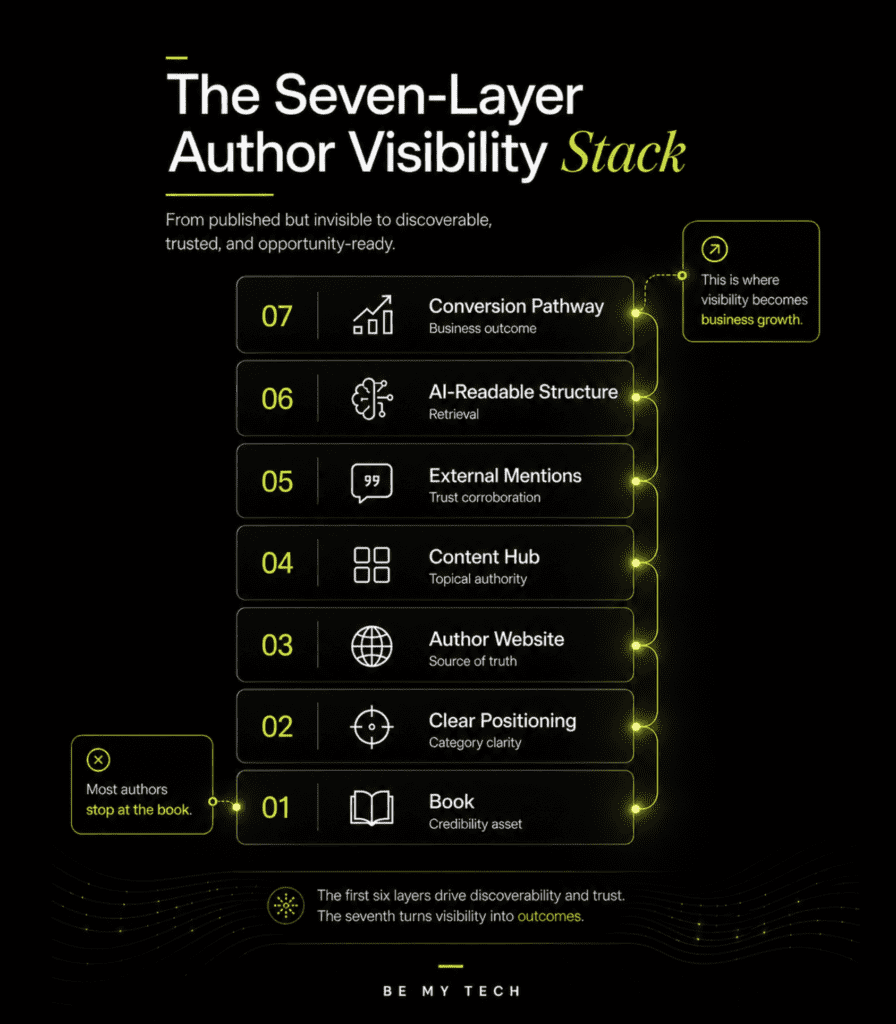
A book alone puts you in the first row and almost nowhere else.
That is why thousands of excellent nonfiction authors remain invisible. They have expertise. They have a book. They may even have a decent website.
But they do not have a complete visibility stack.
The first six layers focus on discoverability and trust: helping AI systems understand, verify, and retrieve your expertise. The seventh layer, conversion pathway, turns that visibility into business outcomes. Without it, an author may become easier to find but still fail to capture readers, subscribers, speaking inquiries, or consulting opportunities.
All seven layers work together.
The strongest author platforms connect the book, positioning, website, content, proof, technical structure, and conversion pathway into one coherent system.
That is where AI visibility begins to compound.
Section 5: The Be My Tech AUTHOR Visibility Framework
AI visibility for nonfiction authors is not a single tactic. It is a system with six connected components, and the sequence in which you build them is as important as the components themselves.
Be My Tech uses the AUTHOR Framework to audit and build author visibility systems.
The practical build order is:
A → H → U → T → O → R
Clarity and originality come before structure.
A technically optimized website with vague positioning gives AI systems nothing worth recommending.
A: Authority Positioning
Authority positioning answers: What should this author be known for?
This is the foundation of AI visibility. If AI tools cannot quickly understand your category, audience, and area of expertise, they cannot confidently recommend you.
Weak:
“I help people become better leaders.”
Strong:
“I help first-time managers build trust, decision clarity, and team accountability in their first 90 days.”
The second version gives AI systems a much clearer context: who the author helps, what problem they solve, what timeframe they specialize in, and what kind of query they should appear for.
Without authority positioning, every other visibility tactic becomes weaker.
H: Human Originality
Human originality is the part of your expertise that AI cannot manufacture from generic internet summaries.
It includes:
- your lived experience
- your frameworks
- your stories
- your opinions
- your contrarian beliefs
- your field observations
- your unique way of explaining a problem
For example, two authors can both write about productivity. But one may have a unique framework for helping ADHD entrepreneurs design workdays around energy patterns instead of time blocks.
That framework is citable.
That perspective is memorable.
That angle is harder to replace.
AI systems encounter endless generic content. The authors who stand out are the ones whose ideas have a distinct shape.
U: Useful Structured Content
Useful structured content turns your expertise into pages, articles, guides, and resources that AI systems can extract and summarize.
This does not mean publishing random blog posts.
It means creating content that directly answers the questions your audience, readers, buyers, podcast hosts, and journalists are already asking, with clear headings, direct answers, examples, and internal links.
For example, instead of publishing a generic article titled “Leadership Tips,” a management author could publish “What First-Time Managers Should Do in Their First 30 Days,” with a clear answer, checklist, and examples from their book.
AI systems need enough structured material to understand your expertise as a pattern, not a one-off claim.
T: Trust Signals
Trust signals help AI systems and human readers verify that you are credible.
These include:
- testimonials
- reader reviews
- podcast appearances
- media mentions
- speaking engagements
- professional credentials
- certifications
- client results
- case studies
- human-authorship signals where relevant
For example, a negotiation author with podcast interviews, client testimonials, book reviews, and a university guest lecture page gives AI systems more corroboration than an author whose only proof is a self-written bio.
For nonfiction authors, trust is not built only by claiming expertise. It is built by showing that other credible people, platforms, readers, and organizations recognize your expertise too.
O: Optimized Author Website
Your author website is the central source of truth.
Be My Tech doesn’t build author websites as a packaged service. What we do is review your website and positioning and recommend the clearest next step, one that supports human trust, AI retrieval, and commercial conversion at the same time.
That means the site should not only look good.
It should be easy for humans and machines to understand, navigate, and extract information from.
For example, a consultant-author’s website should connect the book, keynote topics, services, case studies, articles, newsletter, and consultation CTA into one coherent authority journey.
R: Retrieval-Friendly Structure
Retrieval-friendly structure makes your content easier for AI systems and search engines to parse.
This includes:
- clear H2 and H3 headings
- FAQ sections
- schema markup
- internal linking
- descriptive page titles
- concise summaries
- author bylines
- updated source references
- topic hubs
- structured book pages
- clean navigation
For example, an article with clear H2 headings, FAQ schema, internal links, an author bio, and a short summary is easier for search engines and AI systems to parse than a long essay with no structure.
This is the technical layer.
It matters, but it should come after positioning and substance.
If the strategy is unclear, schema will not save it.
AUTHOR Framework Summary
| Letter | Component | Key Action | AI Visibility Benefit |
|---|---|---|---|
| A | Authority Positioning | Define one clear expert category | Helps AI understand when to recommend you |
| H | Human Originality | Surface unique stories, frameworks, and opinions | Makes your content harder to replace with generic AI summaries |
| U | Useful Structured Content | Publish direct-answer articles and topic hubs | Gives AI systems extractable source material |
| T | Trust Signals | Add reviews, media, citations, certifications, and testimonials | Helps AI verify credibility beyond self-claims |
| O | Optimized Author Website | Build a structured source-of-truth website | Gives humans and AI one authoritative home base |
| R | Retrieval-Friendly Structure | Use headings, schema, FAQs, internal links, and summaries | Improves machine understanding and content extraction |
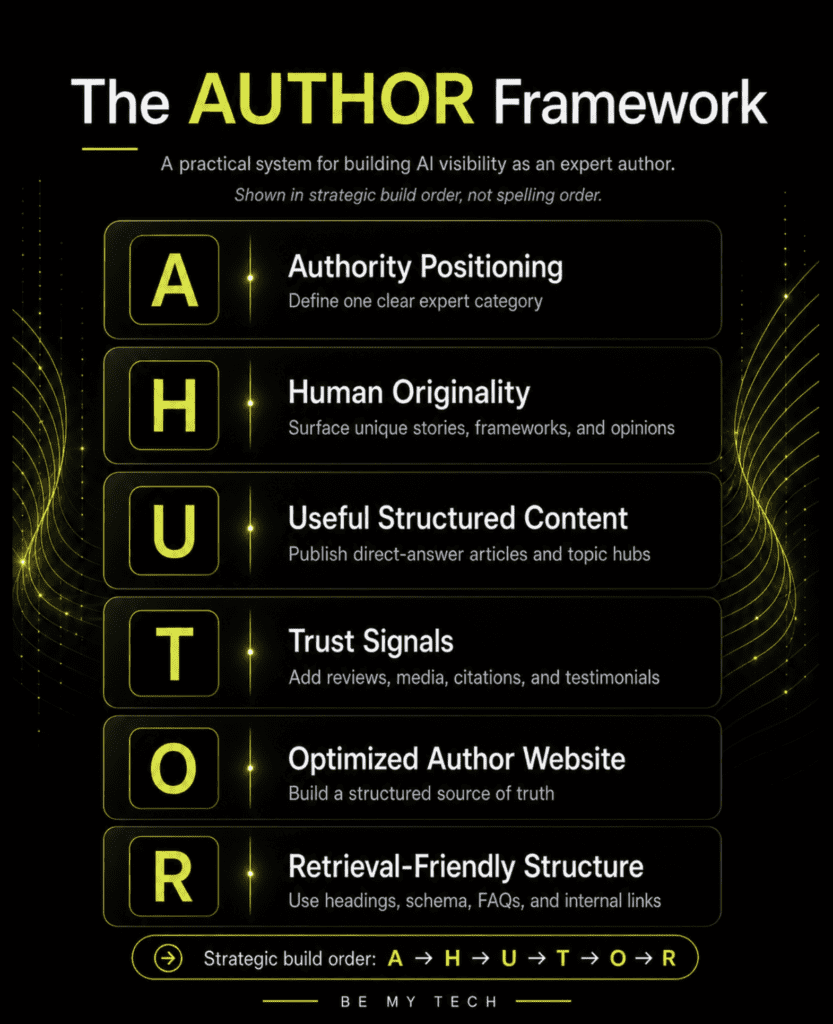
Build in sequence.
An O without an A is a beautiful website with nothing clear to say.
A U without an H is structured content with nothing original inside it.
Section 6: Authority Positioning: Become Clear Before You Become Visible
The most effective thing a nonfiction author can do for AI visibility is become impossible to ignore in one specific area.
AI systems make fast judgments.
When they encounter an author, they ask:
“What is this person specifically known for?”
If the answer is “leadership, wellness, entrepreneurship, speaking, coaching, and mindset,” the AI has no confident basis for recommending the author for any specific query.
Compare these two examples.
Weak positioning
Jennifer is an author, speaker, certified coach, entrepreneur, and thought leader who helps people reach their full potential and live their best lives.
Strong positioning
Jennifer helps first-generation corporate professionals navigate salary negotiation and advancement politics in financial services firms without sacrificing authenticity.
The second version feels narrower.
But that is exactly why it is stronger.
A sharp category helps AI systems know which queries you belong to.
Vague positioning creates diluted visibility.
Sharp positioning creates targeted, repeated visibility.
A strong positioning statement answers three questions precisely:
- Who specifically do I help?
- What specific outcome, transformation, or problem do I address?
- Why am I credibly different from others who work on the same thing?
If an AI system cannot answer those three questions from your bio, website, and content within thirty seconds, your positioning is incomplete.
And your AI visibility will reflect that.
Section 7: Your Author Website Is No Longer a Brochure. It Is Your AI-Readable Source of Truth.
Your author website should be the structured, credible, comprehensive place AI systems go to verify who you are and why you are worth recommending.
Most author websites are built backward.
They are designed first as visual experiences:
- large hero photo
- inspirational headline
- book cover
- short bio
- retailer buttons
That can look professional, but it is rarely enough.
In the AI search era, your website has a bigger job.
It needs to function as your authority database.
Be My Tech doesn’t build author websites as a packaged service. What we do is review your website and positioning and recommend the clearest next step, one that supports human trust, AI retrieval, and commercial conversion at the same time.
Aesthetic quality still matters. Readers, media producers, clients, and event organizers judge trust visually.
But beauty without structure is fragile.
Heavy visuals, slow-loading pages, vague poetic copy, hidden credentials, and unclear CTAs may impress a visitor for a few seconds while giving AI systems very little to extract.
The strongest author websites balance:
- premium design
- fast loading
- clear positioning
- structured pages
- schema markup
- visible proof
- direct CTAs
- useful content
- human voice
Technical priorities also matter
AI visibility is not only about words and schema.
Technical quality also supports discoverability.
Expert author websites should load quickly, work cleanly on mobile, use simple URL structures, avoid bloated visual effects, and make key pages easy to crawl.
Core Web Vitals, mobile-first design, compressed images, clean navigation, and descriptive page URLs all help create a better experience for both human visitors and search systems.
A slow, confusing, heavy website weakens trust.
A fast, structured, mobile-friendly website supports both visibility and conversion.
Key Pages Every Expert Author Website Needs
Homepage
Your homepage should immediately state who you are, what specific topic you own, and who you help.
Avoid vague copy like:
“Welcome to my world.”
Use direct positioning instead:
“Helping first-time managers build trust, accountability, and decision clarity in their first 90 days.”
The homepage is not just a welcome page.
It is the first authority signal.
About / Author Page
Your About page should establish:
- credentials
- lived experience
- specific expertise
- professional background
- media or speaking proof
- why your book exists
- who your work is for
Include a professional photo and a clear author bio.
Google’s E-E-A-T framework (Experience, Expertise, Authoritativeness, and Trustworthiness) is a useful lens for understanding what high-quality expert content needs. Your author bio should support that.
Book Page
Each book deserves its own structured page.
A strong book page includes:
- title and subtitle
- full book description
- who the book is for
- what readers will learn
- key ideas or frameworks
- reviews or testimonials
- purchase links
- author commentary
- related articles
- lead magnet or newsletter CTA
Use Book schema markup where appropriate so search engines can better understand the relationship between the author, the book, and the topic.
Media and Speaker Page
If your book is connected to speaking, consulting, coaching, or expert positioning, a media page is essential.
Include:
- podcast appearances
- press mentions
- interviews
- speaker topics
- professional headshots
- short and long bios
- past speaking engagements
- event testimonials
- contact information
This page helps journalists, podcast producers, and event organizers evaluate you quickly.
It also gives AI systems a stronger external proof layer.
Topic Hub / Resource Library
A topic hub gives AI systems depth.
Instead of publishing random blog posts, organize content around your core expertise.
For example, a leadership author might create hubs around:
- first-time managers
- decision-making
- team trust
- accountability
- difficult conversations
- leadership onboarding
This creates topical authority.
A book proves you wrote something.
A topic hub proves you understand the subject deeply.
FAQ Section
FAQ sections help both humans and AI systems.
They answer common questions directly and create clean, extractable content.
FAQ schema can help search engines understand the page structure, but it does not guarantee rich result visibility. Google states that structured data can help content become eligible for rich results, but it does not guarantee display in search results. (Google for Developers)
Use FAQ sections because they improve clarity, not because they magically guarantee rankings.
Testimonials and Proof
Specific testimonials are stronger than generic praise.
Weak testimonial:
“Amazing book. Highly recommended.”
Strong testimonial:
“John’s framework helped our sales leadership team reduce onboarding confusion and clarify decision ownership within the first month.”
Specificity creates credibility.
Contact and Conversion Pathway
AI visibility without a next step is incomplete.
Your site should make it clear how people can:
- buy your book
- invite you to speak
- book a consultation
- subscribe to your newsletter
- request an interview
- download a lead magnet
- inquire about workshops
Visibility should create opportunity.
Different Authors Need Different Website Structures
Not every author needs the same type of website.
| Author type | Website priority |
|---|---|
| First-time nonfiction author | Clear positioning, book page, email capture, credibility proof |
| Multi-book author | Separate book pages, topic hubs, internal linking between books |
| Consultant-author | Services, case studies, lead magnet, consultation pathway |
| Speaker-author | Media kit, speaker topics, testimonials, video clips |
| International / South Asian author | Global credibility signals, clear market positioning, international contact pathway |
| Tight-budget author | One strong homepage, one book page, one authority article, one lead capture CTA |
The point is not to build the biggest website.
The point is to build the clearest source of truth.
Section 8: Create Content That AI Can Cite
AI systems do not cite vague content. They cite specific, structured, original insights that directly answer recognizable questions.
Most author content fails because it sounds like a motivational essay.
It may be thoughtful. It may be well-written. But it is not always extractable.
AI systems prefer content that is clear, structured, and useful.
Strong AI-citable content usually has six traits.
1. It leads with a direct answer
Every major section should begin with a direct answer before expanding.
Example:
“AI visibility for authors means your book, expertise, and digital presence are structured so AI tools can understand, trust, and recommend you.”
That sentence is extractable.
It can stand alone.
2. It is specific
Generic sentence:
“Leadership is important because teams need trust, communication, and alignment to perform well.”
Stronger, more citable sentence:
“For first-time managers, the first 30 days should focus less on motivation and more on reducing ambiguity around priorities, communication norms, and decision rights.”
The second version is stronger because it:
- defines a specific audience
- includes a timeframe
- identifies concrete problems
- gives AI systems a useful summary
3. It is original
AI tools encounter thousands of articles on every topic.
If your article only repeats common advice, there is no reason to cite it.
Originality can come from:
- your framework
- your field experience
- your methodology
- your story
- your counterintuitive point of view
- your analysis of a specific audience
For authors, named frameworks are especially useful.
Examples:
- The First 90 Days Trust Model
- The Founder-Led Sales Reset
- The Author Visibility Stack
- The Calm Negotiation Framework
- The Post-Book Authority System
A named framework gives your idea a structure AI can recognize.
4. It is clearly authored
Every article should show:
- author name
- credentials
- short bio
- date updated
- relevant expertise
- links to About page
- source references where appropriate
Anonymous or faceless content is weaker for expert authors.
Your expertise is part of the asset.
5. It includes references
For major articles, include credible references.
These can include:
- industry research
- publishing data
- platform documentation
- reputable journalism
- institutional reports
- original examples
- client observations
- expert commentary
References help separate thoughtful content from unsupported opinion.
6. It is updated
AI visibility favors current, maintained information.
A blog post from 2021 about author marketing may still have value, but it may not reflect AI search, BookTok, newsletter ecosystems, podcast discovery, or generative search behavior.
Use visible “last updated” dates and update major pillar content regularly.
Before and After: What Citable Content Looks Like in Practice
Before: vague and uncitable
There are many ways that authors can improve their online presence. It is important to have a good website and to be active on social media. Posting regularly and engaging with your audience can help build a following over time. SEO is also very important for authors.
After: specific, structured, and citable
The single most important first step for an expert author building AI visibility is to rewrite their positioning. AI systems cannot confidently recommend an author whose bio says “speaker, author, coach, and thought leader” because the category is too broad to cite for any specific query. A positioning statement that names a specific audience, a specific outcome, and a specific differentiator gives AI systems a clear, citable category to associate with your name.
The second version opens with a direct answer, makes a specific claim, and can be extracted meaningfully without the surrounding paragraphs.
Framework Example: Weak vs. AI-Citable
| Weak framework description | Strong AI-citable framework description |
|---|---|
| “My system helps authors grow online.” | “The Author Visibility Stack is a seven-layer system that helps expert authors move from published but invisible to discoverable, trusted, and conversion-ready across search, AI tools, media, and their own website.” |
The stronger version names the framework, defines the outcome, identifies the audience, and explains where the framework applies.
That is what makes it easier to remember, quote, summarize, and cite.
Formats That Produce Citable Content for Expert Authors
- Named frameworks: A proprietary, step-by-step system with your name on it is uniquely citable because only one source defines it.
- Contrarian positions: “What most experts get wrong about [your topic]” signals genuine depth of thinking.
- Book implementation guides: Articles helping readers apply your book’s ideas in specific situations sit naturally between your book and your services.
- Direct answer pieces: Articles framed as explicit questions with clean, immediate answers before elaboration.
- Structured comparisons: Tables or lists comparing approaches, strategies, or tools. AI systems extract structured information more reliably than flowing prose.
Section 9: Build External Credibility Signals That Corroborate Your Authority
AI systems do not evaluate your website in isolation. They look for independent corroboration: multiple credible sources confirming that your expertise is real, recognized, and consistent.
A well-optimized author website with no external presence tells AI:
“This person claims to be an expert.”
A website supported by podcast appearances, guest articles, interviews, speaking pages, reader reviews, and media mentions tells AI:
“Multiple independent sources recognize this person’s expertise.”
That second signal is stronger.
Practical external credibility strategies include:
Podcast appearances
Podcast transcripts can become useful source material for AI systems.
When a host introduces you by your positioning and the conversation demonstrates expertise, that transcript becomes an external corroboration asset.
Do not appear on podcasts only during launch week.
Build consistent podcast presence around your core topic.
Guest articles and expert contributions
Writing for credible industry publications, author platforms, or niche websites places your expertise in third-party contexts.
For expert authors, this may include:
- publishing platforms
- business publications
- industry blogs
- association websites
- topic-specific newsletters
- professional communities
The goal is not random backlinks.
The goal is credible context.
Community engagement
Relevant communities can create distributed mentions.
Examples:
- Reddit communities
- LinkedIn conversations
- Goodreads discussions
- niche forums
- professional groups
- newsletter communities
- podcast communities
But this only works if the contribution is genuine.
Link-dropping does not build authority.
Helpful, specific answers do.
Speaker profiles and directory listings
Speaker bureau profiles, conference pages, association directories, and professional profiles create structured third-party confirmation.
These pages often include:
- author bio
- speaker topics
- professional credentials
- book references
- audience focus
- contact pathways
That information helps AI systems understand and verify your entity.
Interviews and media mentions
Being quoted, interviewed, or referenced by others adds credibility that your own site cannot manufacture.
Even small but relevant mentions can help if they are consistent around the same expertise.
The principle:
AI visibility is not built by spraying links. It is built by creating a coherent pattern of credible mentions around the same expertise, consistently, over time.
Section 10: Human Authorship in the AI Era: Why It Matters for Visibility and Trust
Authors who use AI to amplify their unique voice and expertise can become more visible. Authors who use AI to replace their thinking risk becoming harder to distinguish from generic output.
This distinction is not only ethical.
It is commercial.
Readers, publishers, institutions, and author organizations are increasingly paying attention to transparency around AI-generated books and human-authored work.
The Authors Guild introduced a Human Authored certification initiative to help authors identify work created primarily from human intellect, with limited AI assistance allowed for uses such as grammar checks or research support. (AP News)
The UK’s Society of Authors also launched a Human Authored logo scheme in March 2026 to help readers identify books written by humans rather than AI-generated works. (The Guardian)
For nonfiction authors, this matters because trust is part of visibility.
Your readers, clients, podcast hosts, journalists, and event organizers do not only want content.
They want judgment.
They want lived experience.
They want a point of view.
They want a real person behind the ideas.
AI can help authors with:
- research
- outlining
- editing
- idea organization
- headline testing
- repurposing content
- summarizing interviews
- creating social variations
- preparing marketing assets
But AI should not replace the author’s core thinking.
Your frameworks, stories, lived experience, field observations, and hard-earned judgment are what make your work worth recommending.
In the AI era, the authors who win will not be the ones who use AI to sound like everyone else. They will be the ones who use AI to clarify and amplify what only they can say.
A Note for International Authors
For authors outside the U.S. and UK, including South Asian authors publishing for global audiences, AI visibility can be especially important.
Traditional publishing access, media access, distribution networks, and speaking opportunities may be harder to secure internationally. That makes digital authority even more valuable.
A clear author website, structured expertise, global positioning, original content, and credible external proof can help international expert authors compete by topic relevance and not only by geography.
AI search does not remove every distribution barrier.
But it does create a new opening for authors whose expertise is clear, useful, structured, and globally discoverable.
For many international authors, the strongest strategy is not digital visibility instead of local networks. It is digital visibility combined with regional podcasts, author communities, industry groups, and local credibility signals that help global audiences verify trust faster.
Section 11: How to Know If AI Tools Are Starting to Recognize You
AI visibility is harder to measure precisely than traditional SEO, but meaningful signals are trackable, and the trend over three to six months matters more than any single data point.
You will not always get a clean dashboard that says, “ChatGPT now recognizes you.”
But you can track directional signals.
Branded search growth
Use Google Search Console to track searches for:
- your name
- your book title
- your name + topic
- your book + topic
- your framework name
- your company or author brand
Growing branded search is a useful signal that people are becoming aware of you.
Some AI visibility studies have found brand search volume to be a strong observed correlate of AI mentions, but this should be treated as directional research rather than a guaranteed ranking factor.
Direct prompt testing
Once a month or once a quarter, test prompts across AI tools.
Ask:
- “Who are the best experts on [your topic]?”
- “What books should I read about [your niche]?”
- “Recommend nonfiction authors who write about [your area].”
- “Who speaks about [your topic]?”
- “What are the best frameworks for [your problem area]?”
Record:
- whether you appear
- how you are described
- which sources are cited
- which competitors appear
- what information is missing or inaccurate
This is not perfect science, but it is useful visibility intelligence.
AI referral traffic
In Google Analytics 4, monitor referral traffic from platforms such as:
- ChatGPT
- Perplexity
- Gemini
- Copilot
- other AI tools
AI referral volume may start small, but the quality can be high because the visitor often arrives after receiving a recommendation or answer.
Inbound inquiries
Track whether you receive more:
- podcast invitations
- media requests
- speaking inquiries
- consultation requests
- newsletter replies
- collaboration offers
- book club or community invitations
For expert authors, these signals may matter more than raw traffic.
Lead magnet and newsletter conversions
If your book supports a larger business model, your website should capture interest.
Track:
- newsletter signups
- lead magnet downloads
- consultation requests
- audit requests
- speaking inquiries
- book page visits
- form submissions
Visibility without conversion is incomplete.
External mention frequency
Use tools such as Google Alerts, Mention, Brand24, or manual search to monitor:
- your name
- your book title
- your framework
- your company
- your topic association
The more consistently your name appears around the same expertise, the stronger your authority pattern becomes.
Measure monthly.
Test prompts quarterly.
Update content regularly.
AI visibility compounds over time.
Section 12: Your 30-Day AI Visibility Action Plan for Expert Authors
This plan assumes you already have a published book and at least a basic online presence.
Work through the phases in order.
If you only have five hours per week, do not try to complete everything. Prioritize positioning, homepage clarity, one strong book page, one direct-answer article, and one external credibility action.
AI visibility compounds from consistent clarity, not from trying to complete every tactic at once.
Week 1: Clarity and Audit
Estimated time: 4 to 6 hours
- Write a single positioning sentence: who you specifically help, what specific outcome you address, and what makes your perspective different.
Estimated time: 60 to 90 minutes - Rewrite your author bio in two versions: 50 words for social bios and AI extraction, and 300 words for your About page.
Estimated time: 90 minutes - Run a prompt audit across ChatGPT, Perplexity, Gemini, and Google AI. Record whether you appear and how you are described.
Estimated time: 30 minutes - List your five most defensible topical authority areas, meaning the questions you can answer more specifically and originally than most others.
Estimated time: 30 minutes - Audit your existing website against the Seven-Layer Author Visibility Stack: book, positioning, website, content hub, external mentions, AI-readable structure, and conversion pathway. Rate each one from 1 to 5.
Estimated time: 60 minutes
Priority: If you only have two hours, spend them on the positioning sentence and prompt audit. Those two outputs drive every subsequent decision.
Week 2: Website Structure
Estimated time: 5 to 8 hours
- Rewrite your homepage headline to lead with clear expert positioning instead of a vague welcome message.
Estimated time: 60 minutes - Create or improve your book page with full description, ideal reader, key insights, purchase links, and reviews.
Estimated time: 90 minutes - Build or update your Media/Speaker page with podcast appearances, press, interviews, speaker topics, and event testimonials.
Estimated time: 60 to 90 minutes - Add a FAQ section to your homepage, book page, or dedicated FAQ page.
Estimated time: 60 minutes - Implement Person schema and Book schema where appropriate. If using WordPress and Yoast SEO, check what schema is already generated before adding custom schema to avoid duplication. Test with Google Rich Results Test and Schema Markup Validator before publishing.
Estimated time: 60 to 90 minutes - Ensure every article has a clear author byline linking to your About page.
Estimated time: 30 minutes
Priority: Homepage headline rewrite and FAQ section deliver the most impact per hour.
Week 3: Content Authority
Estimated time: 5 to 7 hours
If publishing two articles in one week is unrealistic, publish one excellent article and outline the second. Quality and clarity matter more than volume.
- Publish one authority article of 1,500 to 2,500 words introducing your primary framework or most counterintuitive insight. Open every major section with an answer capsule.
Estimated time: 3 to 4 hours - Publish one direct-answer article targeting a specific question in your expertise area. Lead immediately with the answer.
Estimated time: 2 to 3 hours - Create one lead magnet that extends your book’s core ideas and captures email subscribers.
Estimated time: 1 to 2 hours if built from existing book content - Repurpose both articles into LinkedIn posts with your positioning clearly anchored in the first two lines.
Estimated time: 30 minutes - Internally link both articles to your book page, About page, and each other.
Estimated time: 15 minutes - Add a “last updated” note to your major articles.
Estimated time: 15 minutes
Priority: Write the authority article first and build the lead magnet from it. Two assets from one writing session.
Week 4: External Signals
Estimated time: 3 to 5 hours
- Pitch five relevant podcasts with a concise expert pitch connected to your specific positioning.
Estimated time: 90 minutes - Submit one guest article to a relevant industry, author, or topic-specific publication.
Estimated time: 60 to 90 minutes if repurposed from Week 3 content - Make three substantive, non-promotional contributions to relevant Reddit, LinkedIn, Goodreads, or niche communities.
Estimated time: 45 minutes - Update all social media bios so your positioning is consistent across platforms.
Estimated time: 30 minutes - Request one testimonial from a reader, client, event organizer, or podcast host and publish it with attribution.
Estimated time: 15 minutes to request; 15 minutes to publish - Run a second prompt audit at the end of Week 4 and note any changes from Week 1.
Estimated time: 30 minutes
Priority: Podcast pitches and bio updates deliver the broadest long-term return. If you only have 90 minutes, start there.
Frequently Asked Questions About AI Visibility for Authors
What is AI visibility for authors?
AI visibility means your name, book, expertise, and positioning are easy for AI tools like ChatGPT, Perplexity, Google AI Overviews, Gemini, and Copilot to understand, verify, summarize, and recommend.
The goal is to be named or cited in an AI-generated answer when someone asks about your area of expertise, not only to rank on a traditional search results page.
Can any author get cited by ChatGPT or Perplexity?
No AI platform guarantees citations or recommendations.
However, authors with clear positioning, structured websites, original content, topic authority, and credible external mentions are in a stronger position than authors with vague bios, thin websites, and no third-party validation.
The goal is not to manipulate AI systems.
The goal is to make your expertise easier to understand and verify.
Does FAQ schema guarantee Google AI Overview inclusion?
No.
FAQ structured data can help search engines understand your content, but it does not guarantee rich results, AI Overview inclusion, or higher rankings. Google states that structured data can make content eligible for certain search features, but it does not guarantee display. (Google for Developers)
Use FAQ schema as a clarity tool, not as a shortcut.
Do authors still need a website if they already have an Amazon author page?
Yes.
An Amazon author page is useful, but it is not a complete authority platform.
Your own website gives you control over:
- positioning
- content
- lead capture
- schema
- media proof
- book pages
- topic hubs
- email list growth
- consultation or speaking pathways
For AI visibility, your website functions as the source of truth that connects your book, expertise, content, and credibility signals in one place.
Is AI visibility only for nonfiction authors?
The strategies in this guide are most directly useful for nonfiction authors, expert authors, consultants, coaches, speakers, and thought leaders whose books support a larger authority or business model.
Fiction authors face a different discoverability challenge, usually centered on genre communities, reader platforms, BookTok, series-building, reviews, and emotional reader connection.
Some principles still apply, but the commercial structure is different.
Should authors use AI tools to write their books?
AI tools can help authors with research, outlining, editing, repurposing, and marketing.
But the core argument, stories, frameworks, and lived experience should remain human-led.
For expert authors, originality is not only an ethical issue. It is a visibility and trust advantage.
If your book sounds like everything else AI can generate, it becomes harder to recommend, harder to remember, and harder to trust.
How long does AI visibility take to develop?
There is no fixed timeline.
Authors who improve positioning, build a structured website, publish useful content, and grow external credibility may begin seeing stronger recognition over several months.
AI visibility is cumulative.
It usually compounds through consistent clarity, content, and corroboration rather than one quick technical fix.
What is the single most important first step?
Fix your positioning.
If AI systems cannot clearly understand what you are specifically the expert on within thirty seconds of encountering your digital presence, no amount of technical optimization will compensate for that foundational gap.
Conclusion: The New Author Advantage
Publishing is more crowded than it has ever been.
More books.
More voices.
More noise.
More tools deciding which experts, books, and ideas are worth recommending.
In that environment, visibility is not guaranteed by quality alone.
It is built through clarity, structure, originality, and consistent external credibility.
The nonfiction authors and expert authors who build lasting careers in this decade will not simply be the ones who publish more.
They will be the ones whose ideas are easy to find, easy to trust, and easy for both humans and AI systems to understand.
The book is no longer the finish line.
It is the credibility asset.
The real opportunity is building the visibility system around it.
The authors who win the next decade are the ones who make it easy to be recommended by readers, journalists, podcast hosts, clients, and the AI tools millions of people now use to decide who to trust.
Get a Written Recommendation for Your Author Platform
Be My Tech reviews author websites, book pages, positioning, and AI/Google discoverability, then provides a written, context-based recommendation for the clearest next step. It isn’t a sales pitch.
It’s a three-minute fit check. No manuscript upload. No sales call required. You receive the written recommendation first, and a paid service is considered only if it fits your stage, goals, and scope.
Start the Author Intake Review →
Be My Tech is a practical technology and research company (Wyoming LLC) that provides source-cited Prospect Research for businesses and written, context-based next-step recommendations for authors. Contact: hello@bemytech.com | +1 929 577 2369
About the Author
Shahab Shabbir is the founder of Be My Tech, a practical technology and research company that reviews author and book positioning and provides source-cited Prospect Research for businesses.
Be My Tech works with nonfiction authors who want a clear, evidence-based next step for their book and platform, not a guessed one.
Recommended Reading on Be My Tech
- Why Your Author Website Isn’t Generating Leads, and What to Fix First
- Author Branding in 2026: Book Covers, Websites & Social Media That Actually Sell
- How to Publish and Sell a Book in 2026: A Practical Guide for Authors
Sources
- Publishers Weekly: “Book Output Topped Four Million in 2025,” March 17, 2026.
https://www.publishersweekly.com/pw/by-topic/industry-news/publisher-news/article/99943-book-output-topped-4-million-in-2025.html - Google Search Central, “FAQPage Structured Data.”
https://developers.google.com/search/docs/appearance/structured-data/faqpage - The Authors Guild, “Human Authored Certification.”
https://authorsguild.org/human-authored/ - The Authors Guild, “Human Authored Certification Expands to All Authors,” March 2, 2026.
https://authorsguild.org/news/human-authored-certification-expands-to-all-authors/ - The Guardian: “UK Society of Authors launches logo to identify books written by humans not AI,” March 10, 2026.
https://www.theguardian.com/technology/2026/mar/10/uk-society-authors-logo-identify-books-written-by-humans-not-ai