
Book Writing and Publishing
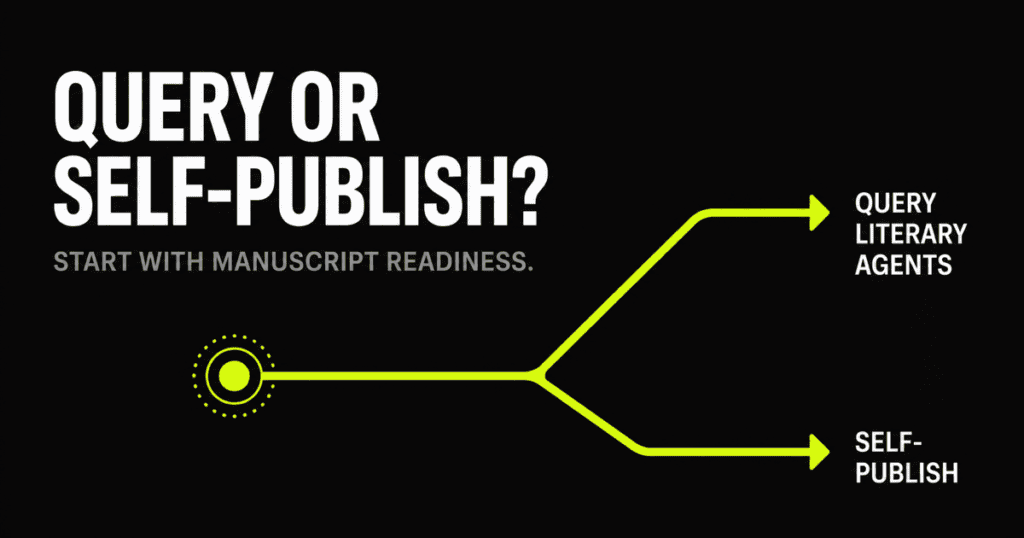
Should You Query Literary Agents or Self-Publish? A 2026 Manuscript-Readiness Framework
By Shahab Shabbir, Founder of Be My Tech. Last updated August 2026.
Finishing a manuscript creates a new kind of uncertainty.
You are no longer asking, “Can I finish this book?” Now the questions become more expensive:
- Should I query literary agents?
- Should I self-publish?
- Should I revise again before I do either?
The short answer is this:
If the manuscript is still changing materially at the story, argument, structure, pacing, character, chapter or sequence level, the publishing route is probably not the first decision to make. Stabilize the manuscript first.
If the manuscript is genuinely stable, then the route decision becomes a trade-off between time, control, external gatekeeping, production responsibility, distribution goals and your willingness to manage the business side of publishing.
That distinction sounds simple. It is also where authors can save months of frustration and avoid paying for work in the wrong order.
At Be My Tech, recent Author inquiries have repeatedly combined two kinds of uncertainty: “What does this manuscript still need?” and “What should I do with it when it is ready?” That is a small first-party signal, not a market survey, but it points to a useful principle: manuscript readiness and publishing strategy should be diagnosed together, not treated as unrelated decisions.
Here is a practical way to do that.
Quick decision: Which question are you actually trying to answer?
Before comparing publishing routes, identify your real decision.
If your question is “Does the book itself work yet?” you are still in manuscript-readiness territory.
If your question is “Is the book stable enough to put in front of agents?” you are in query-readiness territory.
If your question is “Am I willing and able to own production, distribution and marketing decisions?” you are in self-publishing-readiness territory.
If you cannot answer which of those three questions is primary, choosing a route now may be premature.
The first gate: Is the manuscript actually stable?
A finished draft is not automatically a submission-ready or publication-ready manuscript.
Ask:
- Are you still moving, adding or deleting major scenes, chapters or sections?
- Are beta readers consistently identifying confusion in the same part of the book?
- Do you still expect substantial changes to plot, argument, pacing, character motivation or chapter order?
- If someone line-edited the manuscript today, would a later revision make much of that work obsolete?
If the answer to any of those is a strong yes, it is usually more responsible to diagnose the manuscript before committing to a publishing route or a later-stage editorial purchase.
That does not mean every author needs the same kind of editing. Developmental, line, copy and proofreading work solve different problems. Our separate decision guide explains that sequence in more detail: What Type of Editing Does My Manuscript Need?
Once the manuscript is stable enough that the book’s core architecture is not likely to change, the route decision becomes much more useful.
What the traditional or agent route actually asks of you
For authors pursuing major traditional publishers, literary agents remain a central gateway. Jane Friedman’s current publishing guidance describes agents as industry experts who know editors and publishers, negotiate deals and advise authors through the publishing process. Poets & Writers’ July/August 2026 agent-search guidance emphasizes researching agents who fit the project and checking their current submission behavior. Some smaller or independent presses accept direct submissions, so always verify the rules of the specific publisher rather than assuming one universal path.
A traditional route can make sense when you value:
- access to established publishing and distribution infrastructure;
- external editorial and commercial gatekeeping;
- a publisher carrying the direct production cost after acquisition;
- broader traditional bookstore or media access as an important objective;
- having an agent negotiate rights and advocate for the project;
- and you are willing to accept a slower, uncertain submissions process with less control over timing and some publishing decisions.
The critical word is “ready.”
Agents do not need a draft that is merely promising. Your submission package and manuscript pages have to create confidence that the project is ready, or close enough to ready, to compete for representation and publisher attention.
That is why querying too early can be expensive even when it costs no money. The cost is the opportunity you spend on a manuscript that was not yet presenting its strongest version.
What self-publishing actually asks of you
Self-publishing removes the acquisition gate, but it does not remove the work.
The author becomes responsible for coordinating the production and commercial decisions that a traditional publishing team would otherwise absorb or manage: editorial choices, cover, formatting, metadata, distribution, pricing, launch planning and ongoing marketing.
Self-publishing can make sense when you value:
- speed to market;
- creative and commercial control;
- direct control of pricing and release timing;
- ownership of the production calendar;
- the ability to serve a niche audience without waiting for an acquisition decision;
- and you are willing to fund and manage professional production and promotion decisions yourself.
Reedsy’s current publishing guidance illustrates the timing difference clearly. It estimates that traditional publication commonly takes years, while a well-managed self-publishing process can happen within months. Those are directional ranges, not promises; every project is different.
The danger is treating speed as proof of readiness.
Publishing quickly does not fix an unstable manuscript. It simply makes the current version public faster.
The irreversibility check most authors should run
There is one question worth asking before you upload the book anywhere:
“Do I still seriously want a traditional deal for this same manuscript?”
If the answer is yes, do not self-publish merely because the query process feels slow or uncertain.
Jane Friedman has cautioned authors that self-publishing a book first can make it substantially harder to interest agents or traditional publishers in that same project later. Exceptions exist, but they are exceptions. If traditional publication for this manuscript still matters to you, exhaust that route deliberately before making the book public.
Self-publishing isn’t the problem here. The problem is using it as an impatient trial run for a book you still hope to sell traditionally.
The BMT Route-Readiness Matrix
Use these eight dimensions before choosing a route. Do not score them for vanity. Use them to expose the real trade-off.
- Manuscript stability
Green: Core structure is stable. Remaining changes are refinement.
Yellow: Some meaningful revisions are still likely.
Red: Major story, argument, pacing, character or structural work is unresolved. - External reader evidence
Green: Multiple appropriate readers have responded to a substantially revised draft and the major feedback patterns are understood.
Yellow: Feedback exists but is inconsistent or based on an earlier draft.
Red: The manuscript has not yet been tested outside the author’s own perspective. - Genre and market clarity
Green: You can state what the book is, who it is for and what comparable shelf or category it belongs near.
Yellow: The book crosses categories and the positioning is still being tested.
Red: You cannot yet explain the reader, category or commercial context clearly. - Time-to-market pressure
Green for querying: No hard release window; you can tolerate a long, uncertain process.
Green for self-publishing: A real timing objective matters and you are ready to own production.
Red for either: The deadline is artificial and is forcing a decision before the manuscript is ready. - Control preference
Query or traditional fit: You are comfortable sharing decisions about title, packaging, schedule and positioning with a publisher.
Self-publishing fit: Maintaining direct control of those decisions is a priority. - Production budget and responsibility
Query or traditional fit: You prefer a publisher to assume production costs if the book is acquired.
Self-publishing fit: You have a realistic plan and budget for professional production without assuming sales are guaranteed. - Distribution objective
Query or traditional fit: Traditional bookstore or media infrastructure and publisher relationships are central to your goal.
Self-publishing fit: Direct online distribution, niche reach, speed and control matter more than traditional gatekeeping. - Marketing ownership
Traditional route: You understand that a publishing deal does not eliminate the author’s need to participate in marketing.
Self-publishing route: You are prepared to own significantly more of the marketing system yourself.
Four responsible outcomes
Outcome 1: Query now
You are a stronger candidate to begin researching agents when:
- the manuscript is stable and deeply revised;
- the category and target reader are clear;
- your query materials can accurately represent the strongest version of the book;
- you value the traditional route enough to tolerate its uncertainty and timeline;
- and no major manuscript issue is still likely to trigger another rewrite.
Your next job is not “send to everyone.” It is research: find agents who represent the category, confirm their current submission guidelines, and send a polished package that follows those rules exactly.
Outcome 2: Revise before querying
Keep revising when you already suspect the manuscript has a problem.
If pacing collapses in the middle, the stakes are unclear, readers lose track of the argument, the protagonist’s decisions stop making sense, or chapters are still being rearranged, querying is not likely to fix that uncertainty.
Diagnose the book first. Then decide whether the needed work is something you can handle through revision, beta feedback, a specialist assessment or another appropriate editorial route.
Outcome 3: Self-publish deliberately
Self-publishing is more defensible when:
- the manuscript is stable;
- speed and control are genuine priorities;
- you understand what production quality will require;
- you have a realistic budget and vendor plan;
- you are comfortable owning the launch and marketing responsibilities;
- and you are not using publication as a shortcut around unresolved manuscript problems.
The goal is not simply to upload the file. The goal is to publish a book you are willing to support as a product after launch.
When the route is chosen, use this book marketing decision guide to sequence reach, conversion, audience-building, and paid scale responsibly.
Outcome 4: Delay the route decision
This is often the most rational answer when two uncertainties are tangled together.
If you do not yet know whether the manuscript needs major revision and you do not yet know whether you want traditional or self-publishing, forcing a route decision creates noise.
First resolve the manuscript question.
Then clarify the publishing objective.
Then choose the route.
A short delay at the decision stage can prevent a much longer recovery later.
A five-minute pre-publishing checklist
- What is the book’s genre or category?
- Who is the primary reader?
- What is the manuscript’s current word count?
- What substantial revisions have already been completed?
- What feedback patterns have beta or test readers identified?
- What problem, if any, still feels unresolved?
- Why does the traditional route appeal to you?
- Why does self-publishing appeal to you?
- Is a real timing constraint influencing the decision?
- If you self-publish, are you prepared to own production and marketing?
- If you query, are you prepared for a long, uncertain process and careful agent research?
- Would you regret making this exact manuscript public before exhausting the traditional route?
If several answers are still vague, the route is not necessarily the problem. The decision itself needs diagnosis.
Common mistakes to avoid
- Querying because the first draft is finished. A completed draft is an achievement. It is not an external readiness test.
- Self-publishing because querying feels slow. Speed is a benefit only when the manuscript and production plan are ready for speed.
- Paying for sentence-level polish while major revision is still likely. Late-stage work can become paid rework if the underlying structure moves afterward.
- Assuming a traditional publisher will “fix everything later.” The manuscript still has to create a strong acquisition case.
- Assuming self-publishing means doing everything cheaply or alone. Control includes responsibility for quality decisions.
- Choosing a route without defining the book’s actual goal. A novel aimed at broad traditional bookstore distribution and a niche expert book built to support a business may rationally choose very different paths.
- Treating one viral self-publishing success or one major publishing deal as a representative outcome. Outlier stories are useful inspiration, not planning assumptions.
Frequently asked questions
Do I need an editor before querying literary agents?
Not every manuscript needs the same intervention. The important question is whether the book is stable and competitive enough to submit. If major structural problems remain, diagnose and revise them before querying. If the manuscript is stable and you mainly need a final outside assessment, that is a different need from purchasing a full developmental edit.
Should I self-publish if I cannot find an agent?
Not automatically. First determine whether the problem is agent fit, the query package, market positioning, manuscript readiness, or simply the normal uncertainty of querying. Self-publishing is a legitimate publishing strategy when you want its trade-offs, not merely a fallback you have not planned to support. If you’ve been querying and the responses have gone quiet, check which of those signals your pattern actually points to before assuming self-publishing is the answer.
Can I self-publish first and query agents later?
You can, but attracting traditional representation for the same already-published book is generally much harder. If you still strongly want traditional publication for this manuscript, decide that before making the book public.
Which route is faster?
Self-publishing gives the author far more control over release timing. Traditional publishing commonly takes much longer because representation, acquisition and the publisher’s production schedule all add time. Faster is not automatically better if the manuscript is not ready.
What if I still cannot tell which route fits?
Separate the uncertainty into two questions: “Is the manuscript ready?” and “What publishing outcome do I actually want?” Resolve the manuscript question first. Then compare route trade-offs using your real goals, time constraints, control preferences, budget and distribution priorities.
The next decision should reduce uncertainty
You do not need to choose a publishing route because the manuscript reached “The End.”
You need to choose when the manuscript and your objective are clear enough that the choice is useful.
If the draft is still unstable, revise or diagnose first.
If the manuscript is ready and industry representation matters, research the query route deliberately.
If the manuscript is ready and speed or control matter more, build a professional self-publishing plan deliberately.
And if the real problem is that you cannot yet tell what the manuscript needs or which publishing decision comes first, that uncertainty is itself diagnosable.
Be My Tech’s Manuscript & Publishing Readiness Diagnostic is built for that decision point. Use the Author intake and tell us where the manuscript stands, what you want the book to achieve, and what still feels unresolved. We will determine whether the diagnostic is the right next step rather than assuming you need a larger service.
Sources and further reading
- Reedsy, Self-Publishing vs Traditional Publishing: A Guide for Writers
- Reedsy, How Long Does It Take to Publish a Book?
- Poets & Writers, Where Should We Begin? How to Start Your Agent Search
- Jane Friedman, Should You Self-Publish or Traditionally Publish?
- Jane Friedman, Start Here: How to Get Your Book Published