
Book Writing and Publishing
Manuscript Assessment vs. Developmental Editing: Which Should You Pay for First? (2026)

Short answer: pay for a manuscript assessment first when you know the draft is not ready but cannot yet name the pattern that is holding it back. Pay for developmental editing first when you already know the manuscript needs hands-on structural work and you want an editor to help turn that diagnosis into revision decisions. If you can clearly identify the major problems yourself, revise first. A manuscript assessment is a decision tool; developmental editing is a deeper implementation partnership.
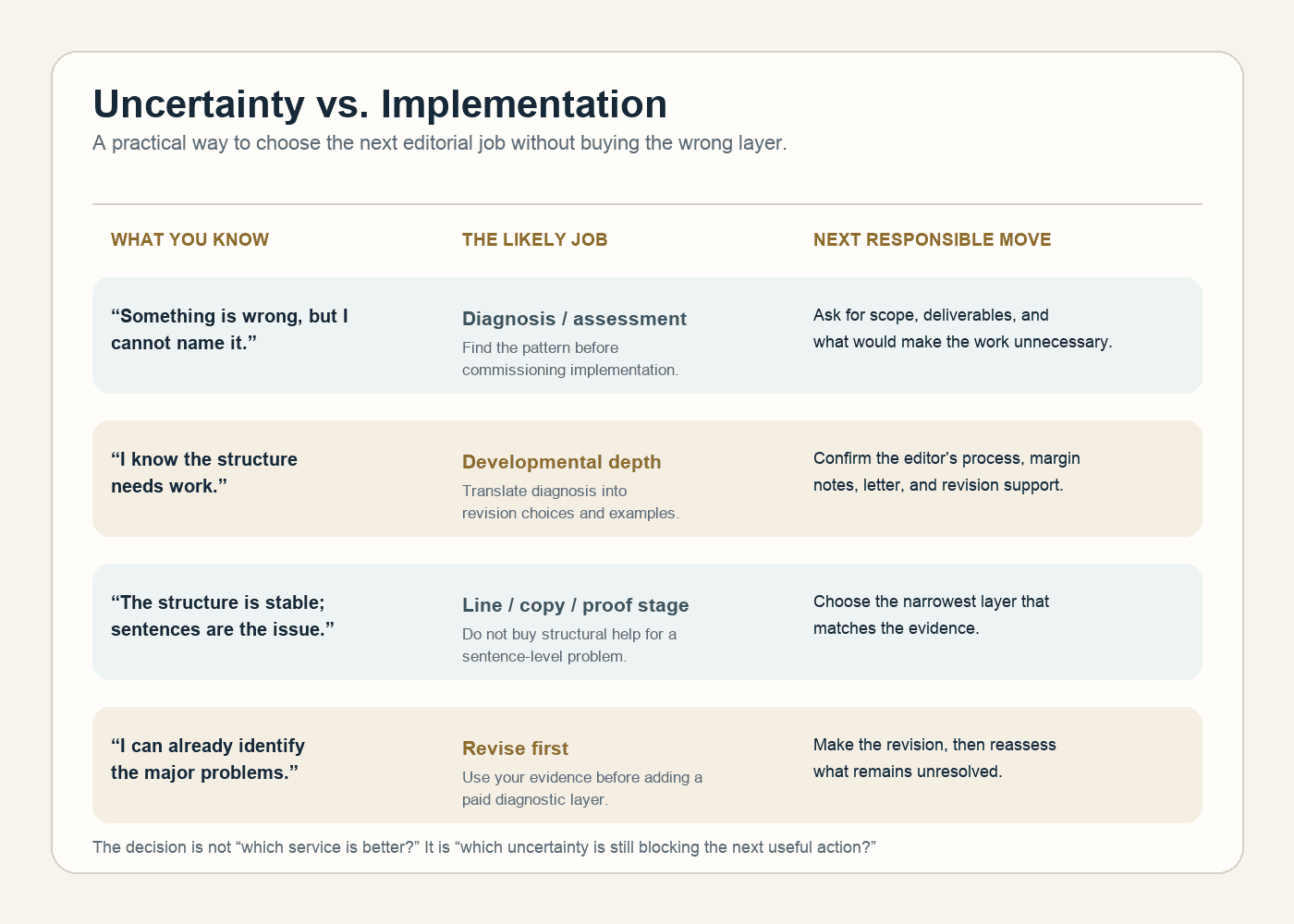
The two services are often described as if one is simply a cheaper version of the other. That framing is too blunt for a real buying decision. The better question is: what uncertainty is blocking the next useful action?
Assessment vs. developmental editing at a glance
| Question | Manuscript assessment | Developmental editing |
|---|---|---|
| Primary job | Diagnose the manuscript’s highest-impact opportunities and sequence. | Work more deeply on structure, narrative, argument, pacing, character, or reader experience. |
| Best fit | You need an informed map before choosing what to revise or buy next. | You understand the broad problem and want close editorial guidance during revision. |
| Typical output | A report or editorial letter, sometimes with limited examples or sample notes. | A more involved editorial process that may combine a report, margin notes, calls, examples, or iterative revision support. |
| What it is not | Not a line edit, copyedit, proofread, rewrite, or guarantee of publication. | Not permission for an editor to replace your voice or promise an agent, sale, or publishing outcome. |
What a manuscript assessment is designed to do
An assessment is a structured read of the manuscript as a whole. It should help you see what is working, where the reader’s experience breaks down, which issues matter most, and what order of operations is likely to produce the most useful revision.
The deliverable is commonly a written report or editorial letter. The exact scope varies: some assessors include a short sample, a few high-level comments, or a follow-up call; others provide a report only. Read the scope before comparing prices. An assessment is valuable when it reduces uncertainty about the manuscript and prevents you from commissioning the wrong editing layer.
Reedsy describes an editorial assessment as a way to decide what to address and in what order, and presents it as a popular early-revision alternative to a full developmental edit. Reedsy’s editorial-services FAQ is a useful reminder to compare deliverables, not labels.
What developmental editing is designed to do
Developmental editing is closer and more implementation-oriented. It examines the manuscript’s big-picture experience and helps you make concrete changes: reorganizing chapters or scenes, strengthening an argument, clarifying a throughline, improving pacing, deepening character motivation, or resolving gaps in the reader’s understanding.
The process is not standardized. One editor may provide a report and margin notes; another may use calls, revision rounds, scene-level examples, or a staged plan. Ask what the editor will actually touch, how many passes are included, whether comments are illustrative or exhaustive, and what happens after the report is delivered.
Reedsy’s developmental-editing guide makes the key distinction plainly: developmental editing is big-picture work, while an editorial assessment is shorter and more affordable but does not provide the same depth of margin-level engagement.
The key distinction: uncertainty vs. implementation
Assessment and developmental editing can overlap in subject matter, but they solve different buying problems:
- Assessment reduces uncertainty. You want a reliable view of the manuscript’s condition and the highest-value next steps.
- Developmental editing supports implementation. You know the manuscript needs structural work and want a professional partner to help you execute it.
That distinction also explains why an assessment can be the responsible first purchase even when you eventually need developmental editing. The assessment can prevent a large, premature engagement when the manuscript actually needs more self-revision, a narrower edit, or a different kind of editorial help.
When to choose each option
Choose an assessment first when:
- You have finished a serious draft but cannot agree with yourself about what is wrong.
- Beta-reader feedback is contradictory or too general to turn into a plan.
- You are deciding whether a full developmental engagement is justified.
- You need to compare revision, querying, self-publishing, or further editing with better evidence.
Choose developmental editing first when:
- You already see the structural problem and want sustained editorial collaboration.
- The manuscript has a known pacing, plot, character, argument, or organization problem that requires more than a report.
- You have time and capacity to revise after receiving detailed guidance.
- The editor has shown a clear process and the scope matches the manuscript’s stage and genre.
Choose neither yet when:
- You have not completed a coherent draft or have not taken a first self-revision pass.
- You are asking for proofreading while the structure is still changing.
- You cannot describe the manuscript’s intended reader, category, or publishing goal.
- You are looking for a guarantee of representation, sales, publication, or a particular market outcome.
2026 cost context: compare scope, not a single number
Editorial pricing varies with genre, word count, turnaround, manuscript condition, editor experience, geography, and deliverables. The Editorial Freelancers Association’s 2026 rate chart is guidance based on a late-2025 to early-2026 survey, not a required price list. Its public rate guidance shows fiction developmental editing at a 2026 survey range of roughly 3.0 to 3.5 cents per word and $52.50 to $70 per hour. Those figures are useful context, but they are not an apples-to-apples quote for every assessment or developmental project.
Ask each provider:
- What exactly will I receive: report, letter, sample notes, margin notes, calls, revision rounds, or a combination?
- Is the read complete, representative, or limited to selected pages?
- What is excluded: line editing, copyediting, proofreading, rewriting, research, fact checking, or agent outreach?
- How will the editor handle a manuscript that is not ready for the proposed service?
- What is the revision support after delivery, and what does it cost?
How this affects querying or self-publishing
If your immediate goal is querying, an assessment can help you decide whether the manuscript’s premise, opening, structure, and positioning are ready for outside response. It cannot guarantee requests or representation. If the manuscript already has a clear structural diagnosis, developmental editing may be the more direct investment before you query.
If your immediate goal is self-publishing, the decision is similar. A manuscript should not be pushed into formatting, cover production, or distribution simply because the file is technically complete. First decide whether the reader-facing work is ready, then choose the editing layer that matches the evidence. For the broader path after a finished draft, see what to do after finishing a manuscript. For the publishing-path decision itself, use querying versus self-publishing as the relevant next comparison.
Where Be My Tech fits
Be My Tech’s Manuscript & Publishing Readiness Diagnostic: from $199 is a bounded decision/readiness service, not a full traditional manuscript assessment and not developmental editing. The $199 starting scope includes manuscripts up to 50,000 words. Longer manuscripts require scope review.
It does not include line editing, copyediting, proofreading, markup, rewriting, ghostwriting, agent outreach, representation, or a guarantee of publication, queries, sales, or acceptance. That distinction matters: the diagnostic is intended to help identify fit and readiness before you buy a larger editorial layer.
Bottom line
Buy an assessment when the main problem is uncertainty. Buy developmental editing when the main problem is implementation. Revise first when you already know the major issues, and wait when the manuscript or publishing goal is not yet defined enough for a useful professional engagement.