
Book Writing and Publishing
Book Marketing for Authors: What Actually Works, What to Skip, and What to Fix First
Most authors do not have a shortage of book marketing ideas. They have too many of them.
Search for how to market a book and you will find social media, Amazon Ads, newsletters, BookBub, podcasts, launch teams, reader magnets, giveaways, publicity, Goodreads, websites, metadata, reviews and dozens of other tactics. Many can work. The difficult part is knowing which one matters for your book now.
A useful book marketing strategy should begin with diagnosis, not a checklist. The central question is: what is the biggest constraint between this book and the right reader? Fix that first. Then decide whether more reach is actually the next problem.
What book marketing actually is
Book marketing is the system that helps the right readers discover a book, understand why it is relevant to them, reach a credible place to buy or read it, and stay connected to the author if they want more.
Promotion is part of that system, but it is not the whole system. Positioning, retailer-page conversion, metadata, reviews, an owned audience, distribution and measurement all matter because they determine what happens after somebody sees the book.
More impressions do not repair a confusing cover. More clicks do not repair a weak description. More advertising does not create a clear target reader. Paid reach can amplify a working system, but it can also amplify a broken one.
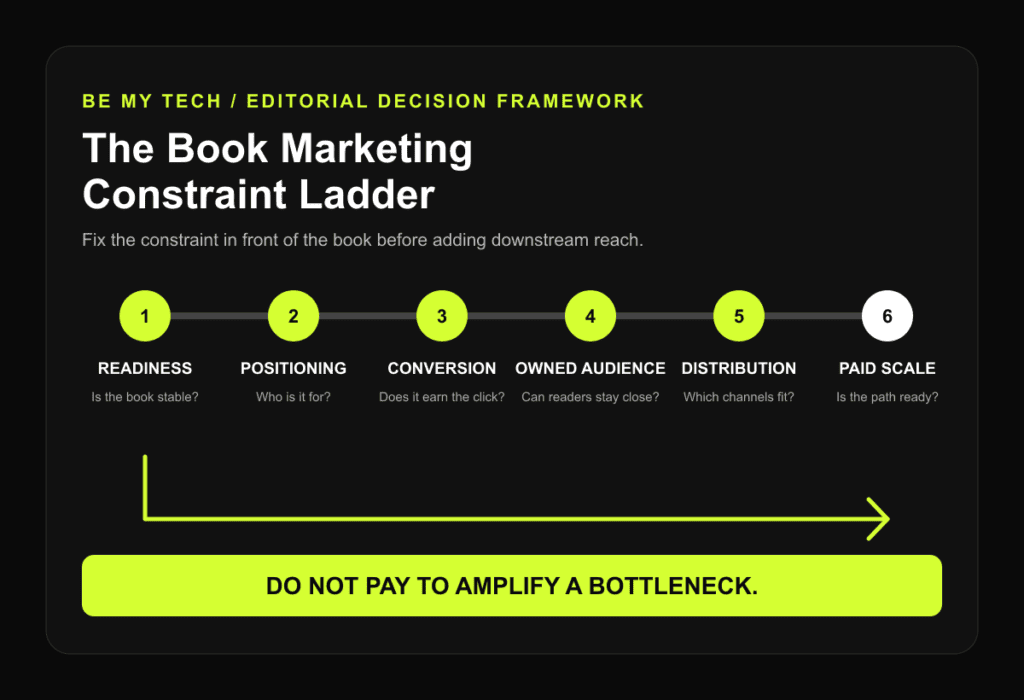
The Book Marketing Constraint Ladder
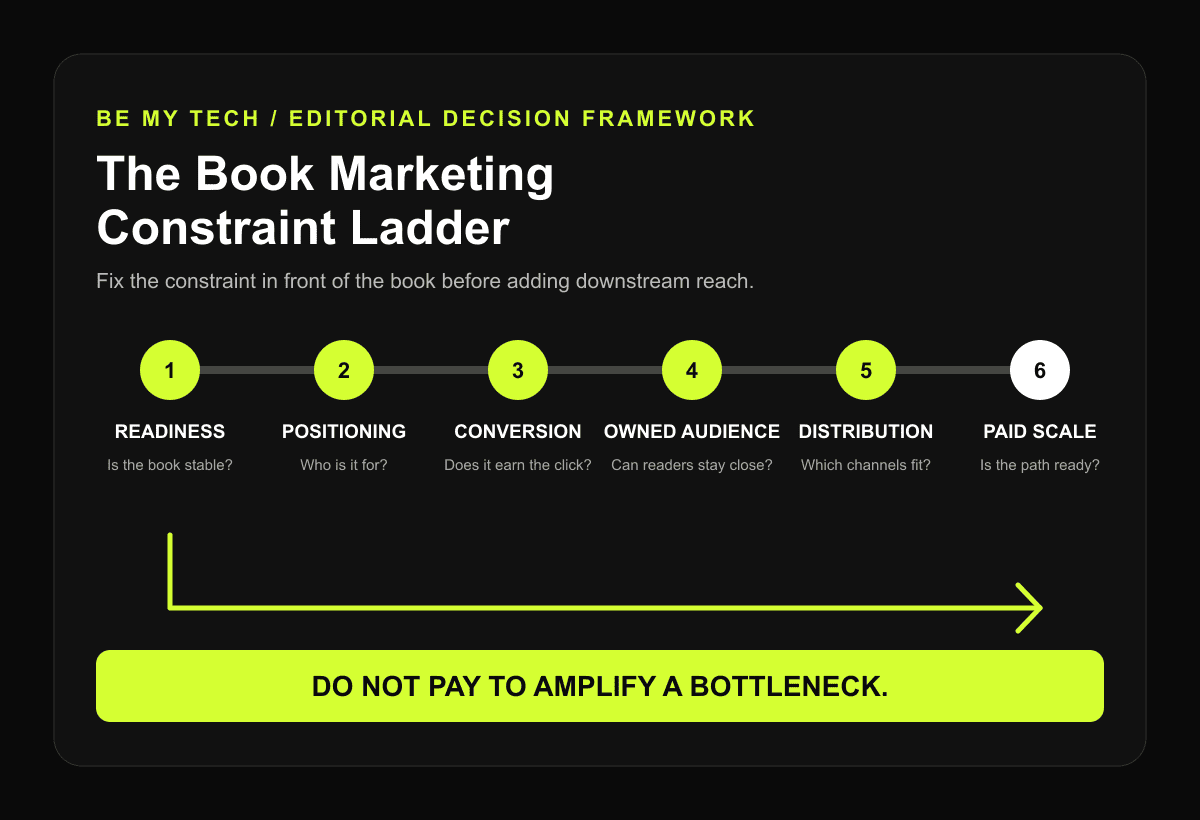
Before choosing channels, locate the constraint. Use this order: Readiness → Reader Positioning → Conversion → Owned Audience → Distribution → Paid Scale.
1. Readiness
Is the book actually ready to be marketed? Planning and audience building can begin before publication. Paid execution is different. If the manuscript is still changing materially, the cover and description are not stable, or the publishing route is unresolved, large promotional spend may be premature.
2. Reader positioning
Do you know who the book is for? A category is not the same thing as a target reader. You need enough clarity to explain who is most likely to value the book, what they already read, what promise or experience they are buying, and where those readers can realistically be reached.
3. Conversion
Does the book earn the next click? Once the right reader sees the book, the cover, title and subtitle, description, pricing, retailer page, reviews, metadata and purchase path do the work. Amazon’s KDP guidance and advertising documentation both make the destination part of the advertising system.
4. Owned audience
Can an interested reader stay connected? Social platforms create discovery, but the platform owns the relationship. An author website and email list give interested readers a direct way to stay connected. A simple home base, clear next step and genuinely useful reason to subscribe are enough to begin.
5. Distribution
Are you consistently reaching relevant readers? Reviews, newsletters, communities, partnerships, promotion sites, podcasts, publicity, social platforms and retailer-native tools can all create discovery. The right mix depends on genre, publishing route, catalogue, budget, available time and existing audience. Choose two or three primary channels rather than attempting every available tactic.
6. Paid scale
Is there evidence worth amplifying? Amazon Ads, Meta Ads and other paid channels should have a defined job and a measurable downstream signal. If an ad earns clicks but the destination does not convert, the answer is not automatically more budget.
The rule is simple: do not pay to amplify a bottleneck.
How to market a book before publication
Pre-publication marketing should focus on foundations that will still matter after launch. Clarify the target reader and comparable books. Decide the publishing route. Build an author home base. Prepare retailer metadata. Plan review and advance-reader activity. Start an email list if there is a real reason for readers to join it. Develop a small number of channels you can sustain.
Early audience building is legitimate. Treating an unfinished or unstable book like a finished advertising product is harder to learn from.
How to market a self-published book
Self-published authors own more of the system. There is no publisher automatically coordinating production, retailer setup, distribution and promotion. That creates work, but it also creates control.
A practical self-published book marketing sequence is: stabilize the product, make the retailer page credible, establish an owned audience path, collect legitimate proof, then choose the few discovery channels most likely to reach the intended reader.
Amazon KDP provides Author Central, Amazon Advertising, KDP Select, promotions, A+ Content and Expanded Distribution among its tools. Those are mechanisms, not a strategy. Strategy is deciding which mechanism solves the current problem.
Book marketing on Amazon: what to fix before ads
Inspect the destination as a buyer would. Does the cover communicate the expected genre at thumbnail size? Does the description explain the book clearly and persuasively? Are the categories and keywords relevant? Is the author profile complete? Is the price sensible for the format and objective? Is there enough credible proof for a stranger to take the next step?
KDP advises authors to use relevant keywords that accurately portray the book and reflect how customers search. Discoverability should be specific and truthful, not an attempt to game a system.
Social media book marketing without becoming a full-time creator
Social media can create awareness and reader relationships. It can also consume every spare hour an author has. The goal is not to be everywhere. Identify the platforms where relevant readers already spend attention and where you can contribute consistently without destroying the time needed to write and publish.
A romance author with strong visual hooks may make different choices from a specialist nonfiction author whose readers spend time on LinkedIn, podcasts or professional newsletters. Choose channels based on audience and capacity, not fashion.
Email marketing for authors
Email turns rented attention into a direct, permission-based relationship. The list is not the strategy, however. A useful newsletter gives readers a reason to remain subscribed and a reason to care about the next book, launch, event or resource. Keep the promise narrow, make the opt-in useful, and do not build a list merely to have a bigger number on a dashboard.
Reviews, ARC activity and social proof
Reviews reduce uncertainty for potential readers, but they do not create demand by themselves. Plan legitimate ARC and review activity early enough for readers to engage with the book. Never buy fabricated reviews, require a positive review in exchange for a copy, or use tactics that violate retailer policies.
When book marketing services are worth paying for
Authors searching for book marketing services should ask: what problem is this provider solving? A legitimate engagement should identify the job: advertising management, publicity, metadata, email, retailer-page optimization, positioning, launch strategy or another bounded problem. “We will market your book” is too vague to evaluate.
Be cautious about guaranteed bestseller status, guaranteed sales, guaranteed rankings, guaranteed media placements or generic packages recommended before the provider understands the book, stage, audience, budget and objective.
How to build a practical book marketing plan
A useful book marketing plan should fit on one page before it becomes a calendar. Start with one commercial or reader objective: launch a debut, generate legitimate reviews, grow an email list, improve a backlist, increase series read-through, build professional authority, or reach libraries and bookstores.
Then name the current constraint. Choose no more than two or three channels that directly address it. Give each channel a measurable job. If you cannot explain the job of a channel, it probably should not be in the plan yet.
What authors should skip
Skip tactics that exist only because somebody said every author must do them. You do not need every social platform. You do not need paid ads before there is a credible destination for the click. You do not need a large launch package just because a release date is approaching. You do not need manufactured urgency, fake reviews or promises that nobody can responsibly guarantee.
Do not confuse activity with progress. Posting more, boosting more and buying more exposure are not automatically evidence that the marketing system is improving.
A five-minute book marketing spend gate
Before spending another dollar, ask: Is the manuscript stable? Is the publishing route clear? Can you identify the primary reader? Does the cover match their expectations? Does the description make the book understandable and desirable? Are the retailer page and metadata ready? Is there credible proof? Can an interested reader stay connected? Do you know what outcome the next marketing spend is supposed to create? Can you measure that outcome without relying on views and likes alone?
Download the Author Marketing Spend Gate (PDF)
What actually works in book marketing?
There is no universal channel mix. The common pattern is stronger: clear reader positioning, a credible product and retailer presentation, an owned relationship path, focused distribution and paid promotion only where it has a defined job.
The more useful question is: what is the smallest marketing action that addresses the biggest constraint in front of this book right now?
Not sure what your book actually needs next?
Before committing to another edit, launch package, website project or advertising spend, identify the decision that is actually unresolved.
Start with the Author readiness path. A responsible outcome may be a BMT fit, or it may be that no paid intervention is warranted yet.