
Marketing
Content Is Not the Strategy: The 2026 Demand Engine for Service Businesses
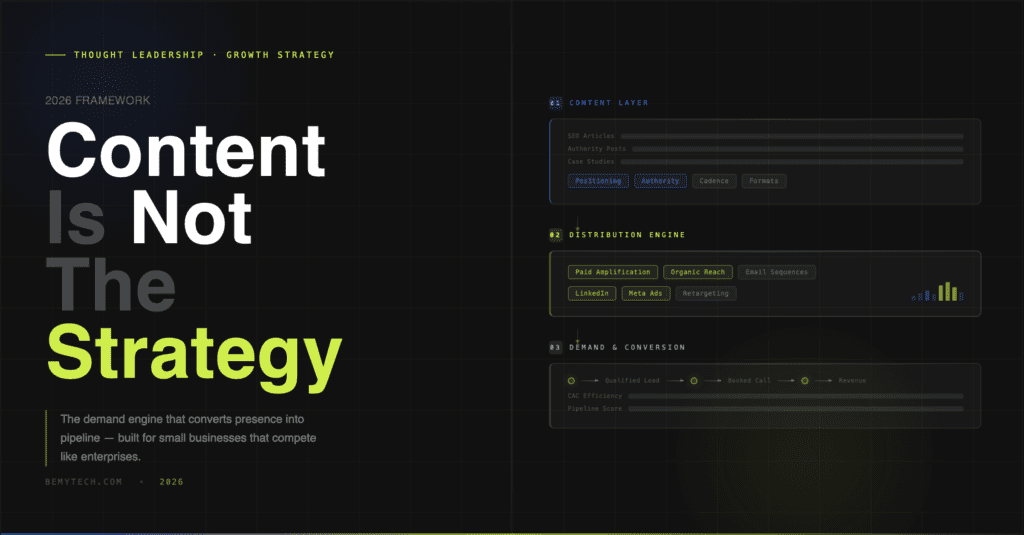
Most service businesses are not losing because they fail to post. They are losing because they confuse publishing with distribution, visibility with trust, and attention with demand.
WHAT THIS GUIDE COVERS
- The real problem — why active businesses still fail to generate demand
- What content marketing and social media actually are
- The Demand Engine — five components that build commercial value
- Where to start — a prioritization framework by stage
- Real costs — what service businesses actually pay
- Scenario model — estimate your potential return
- What to measure — and what to stop reporting
- Platform breakdown — where to show up and why
- By vertical — dental, HVAC, legal, real estate, agencies
- GEO — getting found in AI search
- Where content efforts break down
- 90-day operating plan
- FAQ
01 · THE REAL PROBLEM
Why Active Businesses Still Fail to Generate Demand
Publishing is not the problem. Most service businesses we audit are already posting — blog articles, social content, the occasional video. The problem is that publishing without a system does not produce demand. It produces activity.
There is a meaningful difference between attention, trust, and demand. A business can earn attention with a well-produced reel and still lose the lead to a competitor with a clearer service page. It can earn trust through consistent social presence and still convert at 2% because there is no coherent path from content to inquiry. Demand requires all three layers working together — the right person finding you, believing you, and having a frictionless reason to reach out.
Three structural shifts in 2026 have made this harder to ignore.
AI search changed how buyers discover services. Google now states explicitly that AI features — AI Overviews, AI Mode — use the same fundamental SEO best practices as traditional search, and that there are no additional requirements or special optimizations necessary to appear in those experiences.[1] Content written to catch a short keyword without actually serving the reader is losing ground to content that answers the question completely and clearly.
Brand perception is now being synthesised before anyone visits your site. When a potential client searches “dental practice Morganville NJ” or “HVAC company near me,” they may receive an AI-generated summary of what local businesses offer, how they are reviewed, and what they are known for — before a single click. If the content footprint is thin, inconsistent, or off-message, the AI presents a diluted version of what the business actually does.
Zero-click is the default more often than businesses realise. Research from SparkToro suggests that many informational searches end without a click to any website. The implication is not that SEO is dead. It is that ranking alone is no longer the full win condition. Being the cited source, being present in the answer, and having a strong enough brand footprint that buyers remember the name even without clicking are increasingly where the leverage lives.[12]
The gap that matters. Most service businesses have a content presence. Very few have a content system. The ones that generate consistent demand have both. This guide is about building the system.
02 · DEFINITIONS THAT ACTUALLY MATTER
What Content Marketing and Social Media Actually Are
Content Marketing Institute defines content marketing as a strategic approach built around creating and distributing valuable, relevant, and consistent content to attract a clearly defined audience and drive profitable customer action.[2] The last four words are the ones most businesses quietly drop when they start executing.
That definition immediately excludes most of what passes for content marketing online: motivational posts that teach nothing, recycled tips that could apply to any business in any category, and SEO articles built to game a keyword without answering the reader’s actual question. If the content does not sharpen positioning, create trust, or move a specific type of buyer toward a decision, it may be content, but it is not functioning as marketing.
Social media is a distribution, feedback, and trust mechanism — not a primary lead channel in most service businesses. It answers three useful questions: which messages earn genuine attention, which angles create real replies, and which topics are worth building permanent website assets around. Used correctly, social tells a business what to invest in. Used incorrectly, it becomes a time sink that looks like activity while generating almost no commercial return.
The practical framing: content is the substance, social is the circulation system, and the website is the conversion engine. All three have to be in working order. Fixing one while ignoring the others produces diminishing returns.
03 · THE FRAMEWORK
The Demand Engine: Five Components That Build Commercial Value
A working content and social strategy in 2026 is not a content calendar. It is not a posting schedule. It is a system with five connected components — each one making the others more effective. We call this the Demand Engine.
Who it’s for. What it solves. What you want to be known for.
Flagship guides, service pages, proof pages — built to rank and convert.
One piece becomes posts, clips, email, and sales resources.
Strong CTAs, proof, clear next steps. Content sets conditions; conversion closes them.
One asset ranks, feeds social, earns AI citations, answers objections. Permanent equity.
Positioning: the component most businesses skip entirely
A business cannot content-market its way out of weak positioning. If the offer, the audience, and the differentiation are not clearly defined, content becomes noise at scale — active, consistent, and commercially irrelevant.
The most common failure pattern we see in positioning audits is not a bad message. It is the absence of one. The homepage hero describes what the business does (“We provide HVAC services in New Jersey”) rather than what the buyer gets in a way that matters to them (“Emergency AC repair in under 4 hours — or the service call is free”). Both are true statements. Only one is positioning. Google’s guidance remains direct: focus on real visitors and provide unique, satisfying content that adds value.[1]
Assets: owned pages that deserve to exist
The website is still the centre of gravity. Social platforms change. Organic reach fluctuates. But a well-built service page, a flagship guide that genuinely answers a buyer’s most important pre-decision questions, or a proof page with specific results — these compound in value over time and survive platform changes.
Google Search remains built on crawling, indexing, and serving relevant results, with crawlable structure still foundational to how pages are understood.[1] The strongest businesses do not start with a content calendar. They start with a short list of assets that deserve to exist: one flagship guide, two to three service pages optimised for buyer intent, one proof-rich results page, and a clear conversion path on each.
Social without owned assets is performance art. Owned assets without distribution are a library no one visits.
Distribution: where the investment actually breaks down
In website and content audits across service businesses, the most consistent finding is not poor content quality — it is near-zero distribution effort after publishing. A blog post goes live. No email is sent. No social posts go out. No internal links are added. The article sits in the archive, invisible to the people it was written for.
One well-researched piece should generate at minimum: one email to the existing list, three to five social posts spread over two to three weeks, one short-form video script, and at least two internal links from related pages. The goal is not to be everywhere. It is to make genuinely useful content harder to miss for the specific people it is relevant to.
Conversion: the piece content marketers consistently underestimate
Content does not create revenue. It creates the conditions under which revenue becomes more likely. If a prospective HVAC customer finds a useful guide about when to replace versus repair an ageing system, reads it, trusts the advice — and then lands on a service page with no clear next step, no phone number in view, and no booking option — the lead is lost.
Google advises site owners to evaluate more than raw traffic in AI search contexts, including conversions, visits from higher-quality clicks, and overall business value.[1] The question after every piece of content is not “Did it get traffic?” It is: did it move a specific type of buyer meaningfully closer to an inquiry?
Compounding: where content stops feeling like cost
A seriously built guide — one that answers a high-intent question completely, is structured for AI extractability, has internal links to relevant service pages, and earns a few backlinks over time — can generate qualified leads for years without further investment. That is the compounding curve that makes content economically attractive compared with paid ads, which stop the moment the budget does.
“Content without distribution gets ignored. Social without substance gets forgotten. Visibility without trust does not convert into demand.”
BE MY TECH — THE DEMAND ENGINE FRAMEWORK, 2026
04 · WHERE TO START
A Prioritisation Framework for Service Businesses
One of the most useful things a content strategy can do is tell a business owner what not to do yet. Many small service businesses try to run paid ads, maintain three social platforms, publish weekly blog posts, build a YouTube channel, and manage email — simultaneously, with a part-time effort spread thin across all of them. The result is mediocre execution everywhere and strong results nowhere.
The order below reflects what we have found to produce the most reliable commercial traction for service businesses in the $10K–$100K monthly revenue range, given real constraints of time, budget, and team size. It is a sequence, not a to-do list.
Each step builds the foundation the next step needs:
- Conversion clarity on existing pages: Before producing any new content, check that current service pages have a clear, specific offer, a frictionless contact path, and at least one form of proof. Traffic sent to a weak page is wasted traffic.
- Google Business Profile — fully optimised and actively maintained: For most local service businesses, the GBP is the highest-ROI marketing asset available. It is free, it directly influences local search results, and it is underused by most competitors.
- One flagship content asset targeting a high-intent buyer question: A 2,000–3,500 word guide that completely answers the question the ideal client asks most often before hiring someone. Not ten thin articles — one useful, well-structured, AI-readable piece.
- One primary distribution channel — chosen by audience fit, not preference: Where does the specific buyer actually spend time? Facebook for homeowners over 35. LinkedIn for professional and B2B buyers. Instagram where visual proof drives decisions.
- Email to existing contacts: Past clients, referral sources, and warm leads are almost always under-leveraged. A monthly email that shares something useful costs almost nothing and keeps the business visible with people who already trust it.
- Selective paid amplification of proven organic content: Once there is evidence that a post generated real engagement or enquiries, put a modest budget behind it. Paid amplification of proven content is efficient. Paid amplification of untested content is expensive guessing.
The logic behind this sequence: Each step reduces waste in the next one. Fixing conversion means paid traffic converts. A strong GBP means organic clicks land on a credible business. A flagship asset means social distribution has something worth sharing. Proven organic content means paid spend has evidence behind it.
05 · REAL NUMBERS
Real Costs: What Service Businesses Actually Pay
The right question is not “How much does social media management cost?” It is “What are we actually buying?” A service business is paying for four things: strategic clarity, production quality, distribution reach, and learning speed. Production is the obvious line item. The other three determine whether the investment compounds or evaporates. Small-business website pricing
A cheap post backed by weak positioning is expensive. A well-produced article that gets distributed once and never followed up is under-monetised. A high-performing post that generates no documented learning is a missed asset.
Monthly management cost by approach
| APPROACH | MONTHLY COST | WHAT YOU GET | FITS BEST |
|---|---|---|---|
| DIY + AI tools | $20–$300 | Owner-run with scheduling tools; AI-drafted content reviewed in-house | Under $10K/month revenue |
| Freelancer | $500–$2,500 | 1–2 platforms managed; content created; basic reporting | Under $30K/month revenue |
| Boutique agency | $1,500–$5,000 | Strategy, 2–4 platforms, full content production, monthly reporting | Established businesses scaling |
| Full-service agency | $3,000–$10,000+ | Omnichannel, paid and organic, dedicated account team | Multi-location or high-volume revenue |
The budget mistake most owners make: Agency management fees and ad spend are two separate budget lines. If management costs $1,500/month and ads cost $2,000/month, the real outlay is $3,500. Meta’s own documentation notes that daily budgets can fluctuate up to 75% above the stated daily amount on individual days, while staying within the weekly ceiling.[3] LinkedIn’s ad platform requires a minimum daily budget of $10.[4]
Platform ad cost benchmarks
| PLATFORM | INDICATIVE CPC RANGE | INDICATIVE CPM RANGE | TYPICAL STARTING AD BUDGET |
|---|---|---|---|
| $0.40–$0.80 | $8–$10 | $500–$2,000/month | |
| $0.40–$1.10 | $7–$10 | $500–$2,000/month | |
| $5.00–$7.00 | $18–$25 | $1,000–$4,000/month | |
| TikTok | $0.80–$2.00 | $3–$10 | $300–$1,500/month |
These are indicative ranges from public benchmarks and platform guidance compiled across late 2025 and early 2026. Actual costs in competitive verticals — especially legal and dental — can exceed them materially.
Recommended budget by stage
| STAGE | MONTHLY REVENUE | CONTENT BUDGET | STARTING PRIORITY |
|---|---|---|---|
| Early | < $10K/month | $300–$800 | GBP + 1 platform organic + 1 blog post/month |
| Growth | $10K–$30K/month | $800–$2,500 | 2 platforms + selective paid boost + email |
| Scaling | $30K–$100K/month | $2,500–$7,000 | Specialist team or agency + full content system |
| Established | $100K+/month | $7,000–$20,000+ | Data-driven omnichannel with dedicated measurement |
ESTIMATE YOUR POTENTIAL RETURN
The figures below are a scenario model — not a forecast. They apply directional content performance assumptions to the inputs so a business owner can sense-check budget decisions before committing. Actual results depend on content quality, consistency, competitive density, and the strength of sales follow-up. Use this as a directional tool, not a guarantee.
07 · WHAT TO MEASURE
What to Measure — and What to Stop Reporting
The fastest way to lose confidence in content marketing is to report on the wrong things. Impressions and follower counts look like marketing. They rarely are. The better model separates three distinct layers of signal.
Attention — Did the market notice? Impressions, reach, page visits, video views. These are leading indicators, not outcomes.
Trust — Did the message resonate? Return visits, saves, shares, branded search growth, direct mentions in inbound calls. These indicate whether the content is building familiarity and credibility.
Demand — Did it produce a commercial outcome? Qualified leads sourced from content, booked calls, assisted conversions, revenue influenced, sales cycles shortened. These are the numbers that justify continued investment.
CMI’s current direction[2]: reporting limited to reach and impressions can understate — or misstate — the real business value of content. Reporting what is easy to count when what matters is harder to count is a credibility problem waiting to surface.
| METRIC | LAYER | WHY IT MATTERS |
|---|---|---|
| Cost Per Lead from content | ESSENTIAL | Connects content spend to acquisition cost |
| Lead-to-appointment rate | ESSENTIAL | Shows whether content attracts the right buyers or just noise |
| Organic traffic by page | ESSENTIAL | Shows which assets earn real visibility |
| Revenue attributed to content | ESSENTIAL | Track via UTMs, call tracking, and CRM source tags |
| Branded search volume | TRUST SIGNAL | More people searching for the business name indicates growing reputation |
| Email open and click rate | TRUST SIGNAL | Useful resonance signal with the warm audience already owned |
| Follower count | VANITY | Context only — not a commercial KPI |
| Post impressions | VANITY | Useful for reach benchmarking; not a proxy for demand |
Channel ROI context for 2025–2026
| CHANNEL | COMMERCIAL SIGNAL | KEY CHARACTERISTIC |
|---|---|---|
| Website / Blog / SEO | Blog posts remain among the top content formats marketers plan to invest in and among the highest-ROI formats in HubSpot’s 2026 marketing statistics[5] | Compounds over time; supports AI citations; survives budget cuts |
| Email marketing | Litmus continues to report email as one of the highest-return owned channels, with many programs clustering around 36:1[6] | Best for nurture, retention, and re-engagement |
| Short-form video | HubSpot’s 2026 marketing statistics place it among the strongest-performing formats for marketers[5] | High organic reach potential; builds trust fast |
| Paid social | Fast when optimised; economically fragile when pages and follow-up are weak | Useful for amplification, not a substitute for assets |
| Google Business Profile | Often the highest ROI-per-dollar channel for local service businesses | Free, visible, and still under-managed by many competitors |
08 · PLATFORM INTELLIGENCE
Platform Breakdown: Where to Show Up and Why
Platform choice should follow audience behaviour, not industry trend reports. The expensive mistake is distributing effort across too many platforms before any single one is working well.
| PLATFORM | BEST AUDIENCE | STRONGEST CONTENT TYPE | AD COST SIGNAL | PRIORITY TIER |
|---|---|---|---|---|
| Homeowners 30–65, local B2C | Lead gen ads, before/afters, seasonal offers, local community content | CPC often $0.40–$0.80 | TIER 1 — LOCAL SERVICE B2C | |
| Visual-first audiences, 25–50 | Reels, before/after carousels, testimonial stories | CPC often $0.40–$1.10 | TIER 1 — VISUAL RESULTS | |
| B2B buyers, professionals, referral sources | Thought leadership, case study posts, founder perspective content | $10/day minimum budget[4] | TIER 1 — B2B AND AGENCIES | |
| YouTube | Research-phase buyers across demographics | How-to guides, process walkthroughs, FAQ-style explainers | Often efficient on CPM | TIER 2 — LONG-TERM ASSET |
| TikTok | Under-40, educational content receptive | Raw educational clips, myth-busting, day-in-the-life | Low barrier but variable intent | TIER 2 — AWARENESS |
| Google Business Profile | High-intent local searchers | Weekly posts, offers, Q&A management, photo updates | Free | TIER 1 — ALL LOCAL BUSINESSES |
The execution rule: One platform executed consistently for 90 days will outperform three platforms executed sporadically for 90 days. Pick the one that fits the buyer. Build a rhythm. Then expand.
09 · BY INDUSTRY
Vertical Playbooks: What Works by Service Type
Generic content strategy fails in practice because audience behaviour, trust triggers, and decision timelines differ significantly by vertical. A dental patient makes a very different decision from someone replacing a central HVAC system or hiring an attorney for estate planning. The channel mix and content approach need to follow that difference.
🦷 Dental Practices
Trust trigger: visual proof + anxiety reduction
Patients research procedures extensively before calling. Content that shows real results and answers “what will this feel like?” converts research into booked consultations more effectively than promotional messaging.
- Instagram Reels: treatment results, calm procedure walkthroughs
- Facebook lead ads: local targeting, 28–55, homeowner focus
- Blog: procedure-specific guides
- GBP: weekly posts, before/after photos, active review requests
- Email: quarterly re-engagement for lapsed patients
🔧 HVAC & Plumbing
Trust trigger: speed, reliability, local credibility
Most home service searches are high-intent and time-sensitive. The business that appears credible at the moment of need — in local search, on GBP, and in paid listings — wins the call. Content builds the long-term credibility that converts at lower cost.
- Facebook: homeowner targeting by zip code, age 35–65
- YouTube: maintenance how-to content
- Blog: “repair vs. replace” decision guides
- Local Service Ads + organic SEO in parallel
- Email: seasonal campaigns to existing customers
⚖️ Legal Services
Trust trigger: competence + clarity + credibility
Legal buyers research extensively and need to trust before they call. Educational content that explains process and reduces uncertainty converts far better than promotional language. The business that demystifies the law earns the consultation.
- LinkedIn: B2B referrals, commercial law, professional authority
- Blog: FAQ-format guides answering high-anxiety questions
- Facebook: family law, estate planning, personal injury — local
- Email nurture: follow-up for no-shows and colder consult leads
- YouTube: short explainers on common procedural questions
🏠 Real Estate
Trust trigger: market expertise + local knowledge
Buyers and sellers consume a significant amount of content before committing to representation. Agents who publish honest local market data and specific neighbourhood context build trust before the first conversation happens.
- Instagram: listing content, neighbourhood lifestyle
- YouTube: virtual tours, monthly market updates
- Facebook: hyper-local targeting by zip code and household data
- Blog: neighbourhood guides, market timing content
- Email: monthly local market update to existing contacts
🏢 Consultants & Agencies
Trust trigger: demonstrated thinking + proven results
B2B buyers engage multiple pieces of content before committing to a conversation. The businesses that publish original frameworks, specific case outcomes, and honest strategic perspective earn the first call before competitors do.
- LinkedIn: primary channel — founder-led organic and selective paid
- Blog: original frameworks, specific client outcome patterns
- Case studies: specific before/after with honest context
- Email: weekly or biweekly newsletter to warm audience
- Cold outreach: content-sequenced, not cold-pitch-first
The recurring pattern: The businesses generating the most leads from content are not the ones producing the most content. They are the ones whose content answers the exact question the ideal client is asking at the moment they are closest to a decision. Specificity drives conversion. Volume drives noise.
10 · AI SEARCH VISIBILITY
GEO: Getting Found When AI Answers the Question
Most enterprise marketing teams have started building for Generative Engine Optimization. Most service businesses have not. That gap is currently a first-mover window — and it will close as the practice becomes standard.
What GEO is and what it is not
Generative Engine Optimization (GEO) is structuring content and online presence so that AI-powered platforms — Google AI Overviews, ChatGPT, Perplexity — cite or surface the business when users ask relevant questions. Traditional SEO earns a position in a ranked list of links. GEO earns a mention inside the AI-generated answer that increasingly appears before those links.
Google has stated explicitly that the same fundamentals driving traditional search eligibility also apply to AI features: useful content, good page experience, clear structure, and relevant authority signals.[1] There is no separate secret playbook. There is better execution of the same disciplines — and cleaner structure than many local businesses currently have. Google AI Overviews for small businesses
The numbers that make this urgent
| SIGNAL | DATA POINT | SOURCE |
|---|---|---|
| US population using AI for search | ~31% projected 2026 | EMARKETER forecast[10] |
| YoY growth in AI-referred web sessions | 527% in H1 2025 | Previsible AI Traffic Report, 2025[11] |
| Google AI Overviews prevalence | ~48% of tracked queries, up ~58% YoY | BrightEdge, Q1 2026[13] |
| Searches ending without a site click | Common across informational queries | SparkToro research[12] |
| Median age of AI-cited content | Under 13 weeks | Amsive citation research[14] |
| SMBs with a documented GEO strategy | Still a minority | Industry analysis and market observation[15] |
Six things to address now
- Answer the question directly in the first 200 words. AI retrieval systems evaluate opening content first. Every key page should state its core answer near the top — before backstory or scene-setting.
- Use clear headings and structured organisation throughout. AI systems extract meaning from structured content more reliably than from flowing prose. Use descriptive H2 and H3 headings, comparison tables, and numbered steps where appropriate.
- Add FAQ and Article schema to key pages. Structured data helps search systems understand what the content is, who authored it, and when it was published or updated. It should reflect visible on-page content — not embellish it.[1]
- Include specific, original observations rather than generic summaries. Content that contains attributable insight from real experience is more useful to readers and more citable than pages that paraphrase what every other agency has already said.
- Keep key pages fresh with visible update dates. Research suggests much of the content cited by AI systems is relatively recent.[14] Updating important pages annually at minimum — and visibly signaling that — improves both trust and citation potential.
- Verify AI crawlers can access the site — and actively monitor citations. Review robots.txt for GPTBot, ClaudeBot, PerplexityBot, and Google-Extended access. Then, once a month, test 5–10 real buyer prompts in ChatGPT, Perplexity, and Google AI results. Track whether the brand appears, which page is cited, and which competitors keep getting named. GEO improves faster when it is monitored like an acquisition channel, not treated as abstract theory.
The local-business implication: When an AI engine answers “best HVAC company in [city]” or “recommended dental practice in [area],” the brand appearing in that answer creates trust and recall even if the user does not click through. This is a new form of brand-building that most local service businesses are not yet tracking — or building toward.
11 · WHAT TO AVOID
Where Content Efforts Break Down
The following failure patterns appear consistently across service business content audits. They are listed not as generic warnings but because they are specific, recurring, and fixable.
Service pages written as capability lists, not decision pages
A page that says “We provide emergency HVAC repair and full system installation” is not the same as a decision page that answers what the buyer needs to know to choose. Capability lists describe the business. Decision pages serve the buyer.
Content that is never distributed
In content audits, well-written articles often have never been emailed to contacts, never shared meaningfully on social media, and never linked from related pages on the same site. A piece that exists in an archive without distribution is not a strategy asset. It is a writing exercise.
Platform selection based on comfort, not evidence
A 55-year-old homeowner with a failing boiler is not discovering service businesses on TikTok. A commercial real estate attorney’s best referral sources are not on Instagram. Platform choices should follow audience behaviour, not the owner’s personal habits.
AI used to scale undifferentiated content
AI writing tools can reduce production cost and accelerate first drafts. They do not generate original positioning, specific client insight, or real pattern recognition from experience. Content that reads like a polished summary of public advice creates little competitive advantage and very little citation value.
Quitting before the compounding curve arrives
Organic content often takes four to six months to show meaningful search traction and longer to produce steady inbound leads. Businesses that stop in month three return to paid acquisition and repeat the cycle at higher cost.
Google Business Profile treated as a set-and-forget listing
A fully optimised GBP with regular posts, a managed Q&A section, complete categories, and a review request process is one of the highest ROI-per-hour activities available to a local service business. Many competitors still neglect it.
12 · THE OPERATING PLAN
A 90-Day Plan That Actually Moves Commercial Metrics
The plan below is structured around the prioritisation sequence above. Each month builds the foundation the next one requires. Execute in order.
Month 1 — Foundation
- Define the buyer with specificity. Not “homeowners in the area.” Try: “homeowners aged 38–60 in Bergen County, NJ, whose central AC unit is over 10 years old, who research extensively before calling, and who prioritise response speed over price.”
- Choose three to five content pillars. The narrow topics the business will own over time. Everything published should connect to one of these.
- Audit the homepage and core service pages. Does the hero clearly state who the business serves, what it does, and what outcome the client gets? Are there clear next steps and proof elements?
- Claim and fully optimise Google Business Profile. Complete hours, service areas, categories, photos, Q&A basics, and publish the first weekly post.
- Install Google Analytics 4 and Search Console if not already active. Improvement without measurement turns into opinion.
Month 2 — Asset Creation
- Publish one flagship guide. 2,000–3,500 words. The most complete answer to the question the ideal buyer searches before hiring someone in the category.
- Publish or rewrite one core service page for the most valuable offering. Specific. Proof-forward. One clear next step.
- Repurpose the flagship guide. Five social posts over three weeks. One email to existing contacts. Two short-form video scripts. Repurpose before creating new.
- Send the first email to existing contacts. Share the guide. Ask one good question. Give them a reason to reply.
- Film three short-form videos. Educational, specific, low-production. One real question answered per video.
Month 3 — Distribution and Signal
- Publish consistently. Two blog posts, eight to twelve social posts, one email, four short videos. Rhythm matters more than volume.
- Put $50–$200 behind one post — specifically the organic post that generated the most genuine engagement.
- Read the data, not the gut. Which pages received search traffic? Which posts generated replies, DMs, or calls? Let signal — not opinion — shape month four.
- Improve internal linking. Every new page links to two existing pages. Every existing related page links back to the new one.
- Request five Google reviews from satisfied recent clients. Reviews compound. Build the habit now, not later.
Realistic expectations: Most businesses will not see dramatic inbound lead flow in 90 days from organic content alone. What they will get is clarity on which messages resonate, which platform shows evidence of traction, and whether the core positioning is connecting with the right people. That intelligence is what makes month four more efficient than month one.
FREE STRATEGY AUDIT
See Be My Tech’s Current Work
This article is educational. Be My Tech’s current work is source-cited Prospect Research for businesses and written, context-based recommendations for authors. See Be My Tech’s current services or contact us.
No obligation. Just a practical first step.
13 · DIRECT ANSWERS
Frequently Asked Questions
What is content marketing for service businesses?
Content marketing is a strategic approach built around creating and distributing valuable, relevant, and consistent content to attract a clearly defined audience and drive profitable customer action.[2] For service businesses, that means blog posts, videos, social content, and email that answer real buyer questions and move people toward an inquiry or booking.
How much should a service business spend on content marketing in 2026?
Most service businesses spend $300–$3,000 per month on content and social depending on stage and goals. A useful starting benchmark is 7–8% of revenue to marketing overall, then 15–25% of that specifically to content and social. The exact amount matters less than consistency and sequencing.
What return should I realistically expect from content marketing?
The honest answer is: it depends heavily on execution. Widely cited legacy industry research suggests content can generate more leads at lower long-term cost than traditional outbound, but that benchmark should be treated as directional rather than fresh primary proof. For most service businesses, consistent, high-quality, well-distributed content becomes economically attractive over 12–18 months — not 90 days.
What is GEO and why does it matter for service businesses?
GEO (Generative Engine Optimization) is structuring content so AI-powered platforms — Google AI Overviews, ChatGPT, Perplexity — cite and surface the brand when users ask relevant questions. Google confirms that the same core SEO fundamentals apply to these AI experiences as well.[1] Most service businesses have not started building for GEO yet, which is exactly why it matters now.
Which social media platform should I focus on first?
Follow the buyer, not the trend. Facebook and Instagram lead for B2C service businesses where visual proof and local targeting matter. LinkedIn is strongest for B2B and professional services. The expensive mistake is spreading effort across too many platforms before any single one shows evidence of traction.
REFERENCES
- Google Search Central — AI features and your website; Top ways to ensure your content performs well in Google’s AI experiences on Search; How Search Works.
- Content Marketing Institute — What Is Content Marketing?; B2B Content Marketing Benchmarks, Budgets & Trends: Outlook for 2026 (published 2025).
- Meta — About Daily Budgets; Facebook and Instagram Ads: Budgets, Costs & Schedules.
- LinkedIn — Making the Most of Your Budget; LinkedIn Advertising Costs & Pricing.
- HubSpot — 2026 Marketing Statistics, Trends, & Data; 2026 State of Marketing Report.
- Litmus — Email Marketing ROI: What leads to better returns?. Note: the 36:1 figure is widely cited as an average and should be treated as directional by industry and program maturity.
- ServiceTitan — HVAC Digital Marketing Guide; LocaliQ home services benchmarks.
- DemandGen Report — B2B buyer content consumption studies, 2024–2025.
- Demand Metric — Content Marketing vs. Traditional Outbound Cost Comparison. Note: widely cited legacy benchmark; original methodology is older and best treated as directional context, not current primary research.
- EMARKETER — Generative AI Search Forecast 2026 (via industry reporting).
- Previsible — AI Traffic Report, First Half 2025.
- SparkToro — Zero-click search research.
- BrightEdge — AI Overviews at the One-Year Mark.
- Amsive — AI citation recency research, 2025–2026.
- Enrich Labs — GEO analysis and SMB adoption commentary.
Current Work
Not Sure Where You Stand?
Confirm Fit Before You Commit.
Be My Tech’s current work is source-cited Prospect Research for businesses and written, context-based recommendations for authors — confirmed through a low-friction fit check before any paid scope.
Next step