Authors & Publishing
Holiday Book Marketing for Authors: Choose a Smart Next Step (2026)

A practical guide for independent authors · Updated November 19, 2026
Your book is out, nearly ready, or still taking shape. The right holiday move depends on which one is true. Here is a calm way to choose—and a short plan you can use for this season or your 2027 launch.
With a few weeks left before Christmas, holiday advice can make it sound as if every book needs a big push. That is not true. A finished manuscript may need careful review more than a rushed launch. A published book may need a clearer reader path before it needs another ad.
Start with the book you have today. Choose one useful action. Then decide what would count as a good next step for you.
First, choose your book’s stage
Make the book page easier to trust
Check the cover at thumbnail size, the description, reading format, list price, and whether the page tells the right reader what the book is about. Pick one place where people who already care about your work can find it.
Choose quality before a date
Decide what still needs attention: a focused manuscript read, editing, proofreading, formatting, or a proof copy. If the book is not ready, a 2027 release plan can be the stronger holiday decision.
Make the next launch easier
Write down who the book is for, what kind of story or help it offers, and what remains to finish. You do not need to build every marketing channel before the manuscript is ready.
A simple test: Can a reader quickly see what the book is, who might enjoy it, and how to get it? If not, improve that path before adding more promotion.
If your book is live: help the right reader recognize it
Think of the book page as a small shop window. A reader sees a cover, title, short description, format, price, and sometimes sample pages. Those pieces should tell the same story.
- Cover: Is the title clear at a small size? Does the design signal the right kind of book?
- Description: Does the opening make the reader curious without promising more than the book delivers?
- Format and price: Can a reader choose the format they want? Compare your price with similar books readers might consider, then check your own costs and royalty settings.
- One next action: Share the book with people who have chosen to hear from you, or make one useful post where your intended readers already gather. Do not send bulk messages or ask for a paid or rewarded review.
If you are choosing where to help readers find a published book, our guide to how readers discover books covers the broader path. For proof or author copies, Amazon KDP says the author price is based on printing cost; shipping and taxes may be added at checkout. Those copies are not eligible for Prime, and the available delivery choices and estimates appear at checkout. Check the live estimate before promising a date to anyone. Read KDP’s current holiday copy guidance.
Amazon also says book detail pages can take time to appear. For a standard new paperback or hardcover, KDP estimates up to 72 hours for the Amazon.com detail page and up to five days for other marketplaces. Amazon.ca can take up to 30 days. An account without a previously published book may take up to six days, and low-content book reviews can take three to four weeks. These are estimates, not a delivery guarantee. Check your Bookshelf for your title’s status and the current KDP publishing timelines.
Categories are shelves; keywords are search clues
A category helps place a book on a browsing shelf. A keyword is a phrase that may match what a shopper types. Neither is a shortcut to a bestseller list. The first question is still: does this accurately describe the book a reader will get?

For Amazon KDP, authors can currently select three categories when creating a book. Category choices can differ by format and marketplace, and Amazon may update them. KDP says a category change can take up to 72 hours to show. Review the live options in your own book setup, and do not choose a shelf just because it looks less crowded. KDP explains categories and reading ages.
Try a fictional example: a picture book for ages 6–8 follows a child on a New York City walk, past the Statue of Liberty, Brooklyn Bridge and Central Park. Those details describe this story; they do not prove which KDP category it belongs in. Open the current category choices for the correct format and marketplace, then pick only a shelf that truly fits. Do not assume there is a special “New York City” category.
For a useful comparison, look at how publishers describe real New York books for children. My First Book of New York is listed for ages 3–7, while In New York: Interactive Edition is listed for ages 5–8. Study the readers, format and descriptions to understand how similar subjects can be presented differently. These publisher pages do not confirm Amazon category placement, sales or demand for your book.
KDP currently allows up to seven keywords or short phrases. Think of a reader’s words—such as a true setting, character type, theme, or tone. Keep each phrase accurate. KDP warns against time-sensitive terms, misleading claims, another author’s name, and repeating information already covered by the book’s categories or title. See KDP’s keyword guidance.
What does an Amazon rank actually tell you?
Amazon may show a book’s overall Best Sellers Rank and up to three Best Seller Category ranks. The overall rank is a broad store view; a category rank is a book’s place within one browsing list. Both compare activity on your book with activity on other books. KDP says recent activity weighs more than older activity, so a rank can move even when your book’s own activity stays the same. Ranks update at least daily, and changes can take up to two days to appear.

Each format has its own overall Best Sellers Rank. Category ranks in the Books Best Sellers lists combine the formats for that title, while Kindle and Audible category ranks are format-specific. KDP warns that rankings are not an accurate way to track a book’s activity or compare books in different categories. Use your KDP reports for your own sales and royalties; treat public ranks as limited context. Read KDP’s ranking explanation.
Finished, but not ready? Do not let the calendar rush the book
If you have a complete draft, choose the most important unanswered question. Does the story hold together? Is the writing clear? Does the cover fit the book? Can you format it correctly? These are different jobs, and buying all of them at once may not be the right choice.
If you are not sure what the manuscript needs, start with a bounded sample review before committing to broader work. BMT’s Manuscript & Thesis First Look is an excerpt-only service: up to 5,000 manuscript words or 3,000 thesis words, with a short written report and priorities. It is not a full edit. Read the current scope and enquiry route before sharing files.
If pricing and royalty math is the next question, see our book pricing and copyright guide. For a broader publishing or editing quote, compare what is included, how many words or pages are covered, the number of revision rounds, expected timing, payment steps, rights, and what is excluded. Our guide to comparing editing and publishing quotes gives you a practical list of questions. If the book is still being shaped, our finished-manuscript next-step guide helps separate readiness from publishing decisions.
Planning a 2027 release? Start with the reader and the work
If you are still writing or revising, this season can be a useful planning window—not a deadline to force a launch. Put the steps in an order that protects the book: finish the draft, decide what kind of review it needs, prepare the cover and files, check the listing, then choose how readers might hear about it.
For seasonal campaigns, ask three plain questions:
Name one real reader, age or interest—and what they hope to find. This keeps your cover, description and category choices connected.
List the manuscript, cover, book page, sample, or reader list you already have. This shows what you can use without rushing unfinished work.
Choose one small action, an owner and a date to review it. You can make progress without paying for every tactic at once.
Do not pay for a marketing service based only on a promised rank or sales number. Ask what the provider will do, what you will receive, what you must supply, and what is outside the scope. Avoid anyone who offers to buy or arrange customer reviews; KDP’s review rules prohibit compensation for reviews.
Your 15-minute holiday book plan
Use this short worksheet to turn a vague “I should promote my book” feeling into one clear decision. You can download or print the one-page author holiday planner (PNG), or copy the questions below.
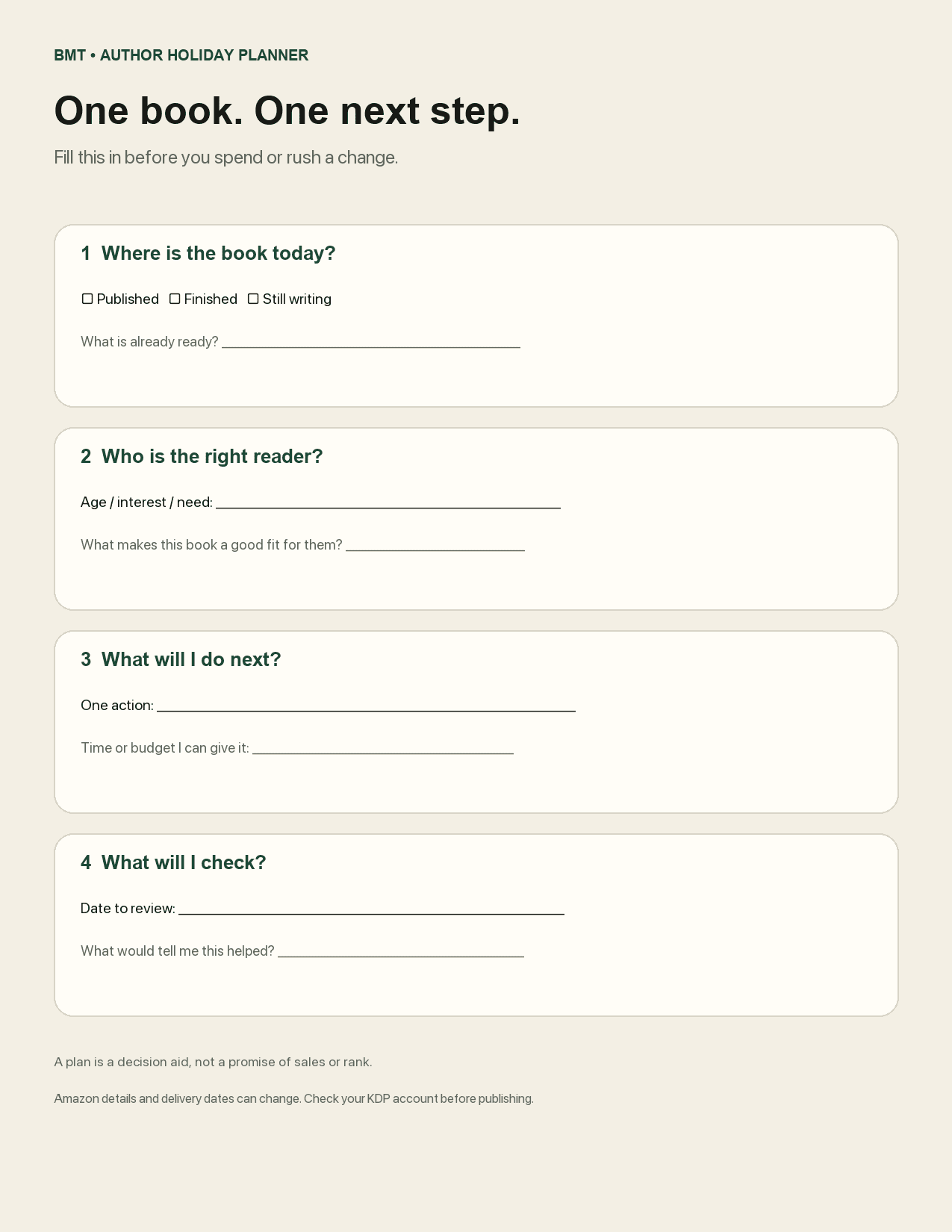
- My book is: published / finished but not published / still being written.
- The reader I want to reach is: one clear person or group, described in ordinary words.
- The page or work that needs attention most is: cover / description / categories / manuscript / format / another specific item.
- One action I can finish next is: write one action that fits the time and budget I have.
- I will review it on: a date I choose. I will look at the action completed and the response I can actually verify—not a rank alone.
Keep the goal small enough to finish. A clear book page or a thoughtful 2027 plan can be more useful than a rushed campaign that does not fit the book or the reader.
Common questions authors ask
Does every book get more readers during the holidays?
No. Readers choose books for many reasons, and a holiday date does not create demand by itself. Start with the book’s reader fit, presentation and your own available time. If the book is not ready, plan the next stage instead of forcing a campaign.
Should I choose a low-competition Amazon category?
Choose categories that truly match the book and its reader. KDP can change the available categories, and it may remove a selection that misleads customers. Check the current options for the right format and marketplace.
Are categories and keywords the same?
No. A category is a browsing shelf. A keyword is a phrase that can help describe what a shopper may search. Both should be accurate, and neither guarantees a rank or sale.
Does a #1 category rank mean I sold a certain number of books?
No. KDP ranks are relative to other books and formats, and the same activity can lead to different rank changes in different categories. Use KDP Reports to see your own sales and royalties.
Can I still publish before Christmas?
Maybe, but first check how much of the book is truly ready. KDP gives current review and page timing estimates, and proof-copy shipping dates are shown at checkout. Those estimates can vary. Do not promise a delivery date to a reader or buyer based only on a general timeline.
What should I ask before hiring a book marketing provider?
Ask what work they will do, what files or plan you will receive, what you need to provide, which costs are separate, and what is not included. Be cautious about guaranteed sales, rankings, media placements or paid reviews.
Want a second set of eyes on your next book step?
Tell Be My Tech where your book is and what you want to do next. The Authors page shows the current paths and enquiry form.
Rules and platform details can change. This guide was checked against the linked KDP help pages on November 19, 2026. It is general publishing information, not legal, tax or financial advice. Check your current KDP setup and any publishing agreement before acting.
Sources: KDP categories · KDP keywords · KDP sales ranking · KDP timelines · KDP holiday season FAQ · KDP customer reviews.