Authors & Publishing
Can You Self-Publish a Book for $500 in 2026? A Realistic Budget, Tools & Tradeoffs
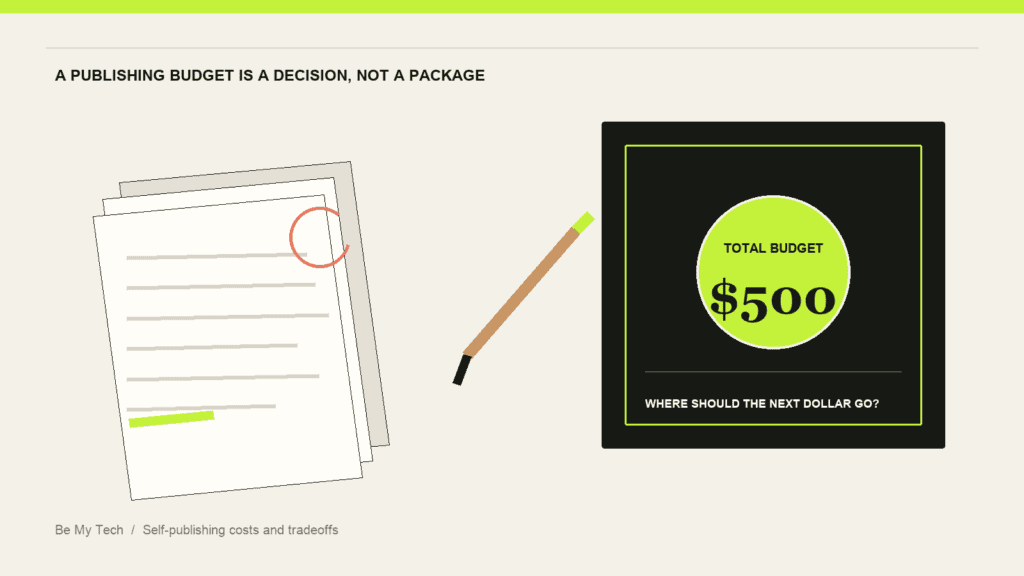
Short answer: Yes, sometimes. If your manuscript is already in good shape, you choose a simple publishing route, and you do much of the production work yourself, $500 can be enough to make a book available. It is not a realistic budget for every professional stage—substantive editing, copyediting, proofreading, cover and interior design, a website, and a launch plan all together.
The useful question is not “How do I spend exactly $500?” It is “What is the most important unresolved job, and what can wait?” The examples below are spending plans, not provider price quotes, service packages, or promises that a particular job will fit a particular amount.
What can be free, and what still costs money?
Amazon Kindle Direct Publishing (KDP) says authors can publish eBooks, paperbacks, and hardcovers without an upfront publishing fee. KDP also provides a free print ISBN for eligible paperbacks and hardcovers; that ISBN is limited to KDP, while a Kindle eBook does not need an ISBN on KDP. Its free Cover Creator is another optional DIY tool. These options can lower setup costs when the author is comfortable doing the work and the platform choices fit the book.
To decide whether a free platform ISBN is enough for your editions, see Do You Need Your Own ISBN? A 2026 Decision Guide for Authors.
“Free to upload” does not mean every part of the project is free. It also does not remove the author’s time, the need to check the final files, printing costs on print sales, or the possible cost of professional help. For KDP print books, the royalty calculation subtracts printing cost from the applicable royalty share; printing cost varies with page count, ink and marketplace. Check the platform’s live calculator and terms for your edition before setting a list price.
For the wider platform and format tradeoffs, see BMT’s practical guide to publishing and selling a book. This article focuses on the narrower budget question: what a $500 limit can—and cannot—do.
Three budget categories to keep separate
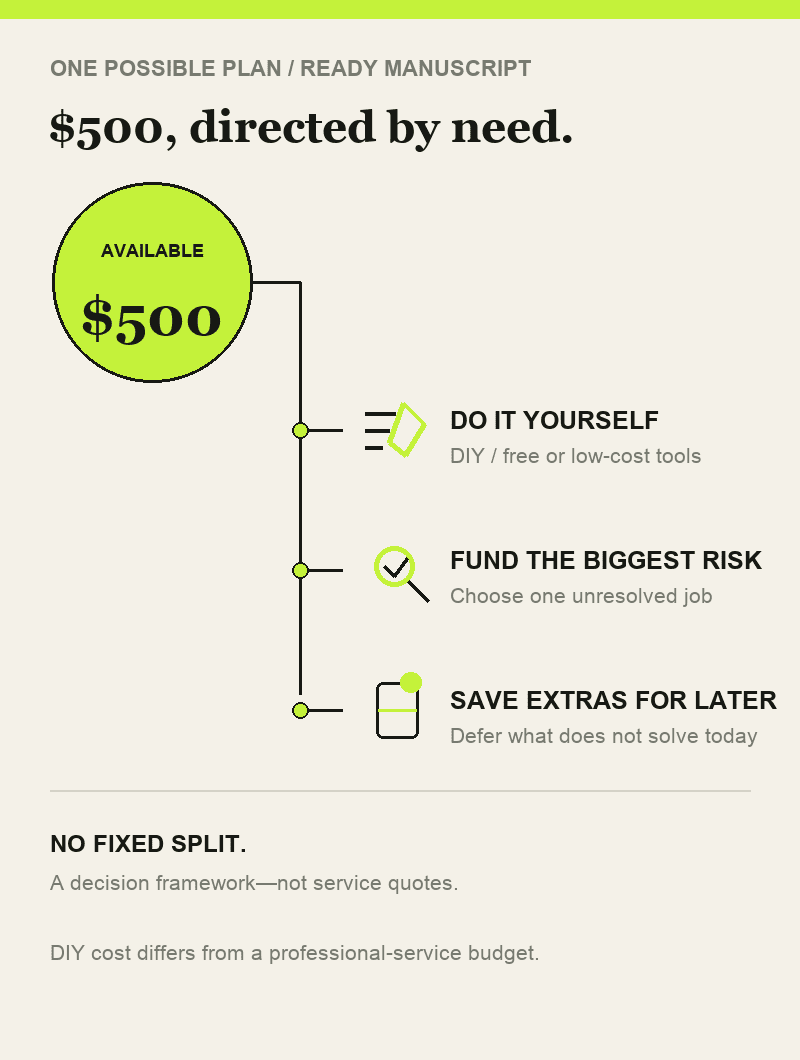
DIY or free/low-cost infrastructure
This can include a platform account and upload, platform-provided ISBN where available and suitable, basic formatting tools, and a DIY cover tool. They save cash by moving work to the author. They do not independently check whether the manuscript, cover, metadata, or interior is ready for readers.
Worth paying for when the manuscript needs it
Editing, cover design, interior layout, file checks, and proofreading solve different problems. A developmental review cannot be replaced by proofreading. A proofreader should normally see the final edited and formatted text, because later structural or sentence-level changes can make early proofreading work obsolete. Ask what is included, what version the provider will use, and what the handoff contains. Get the actual scope and quote before allocating funds; rates depend on length, complexity, schedule, and service definition.
Save for later if it has no job yet
Extra formats, bulk print inventory, an author website, audiobook production, launch advertising, and a broad promotional bundle are not automatic publishing requirements. They may make sense for a particular audience or business model, but first identify the job each one would do. A website can support direct sales, reader capture, events, or an author’s broader work; if none of those is part of the current plan, it may not be the first use of a limited budget.
Example 1: the manuscript is relatively polished
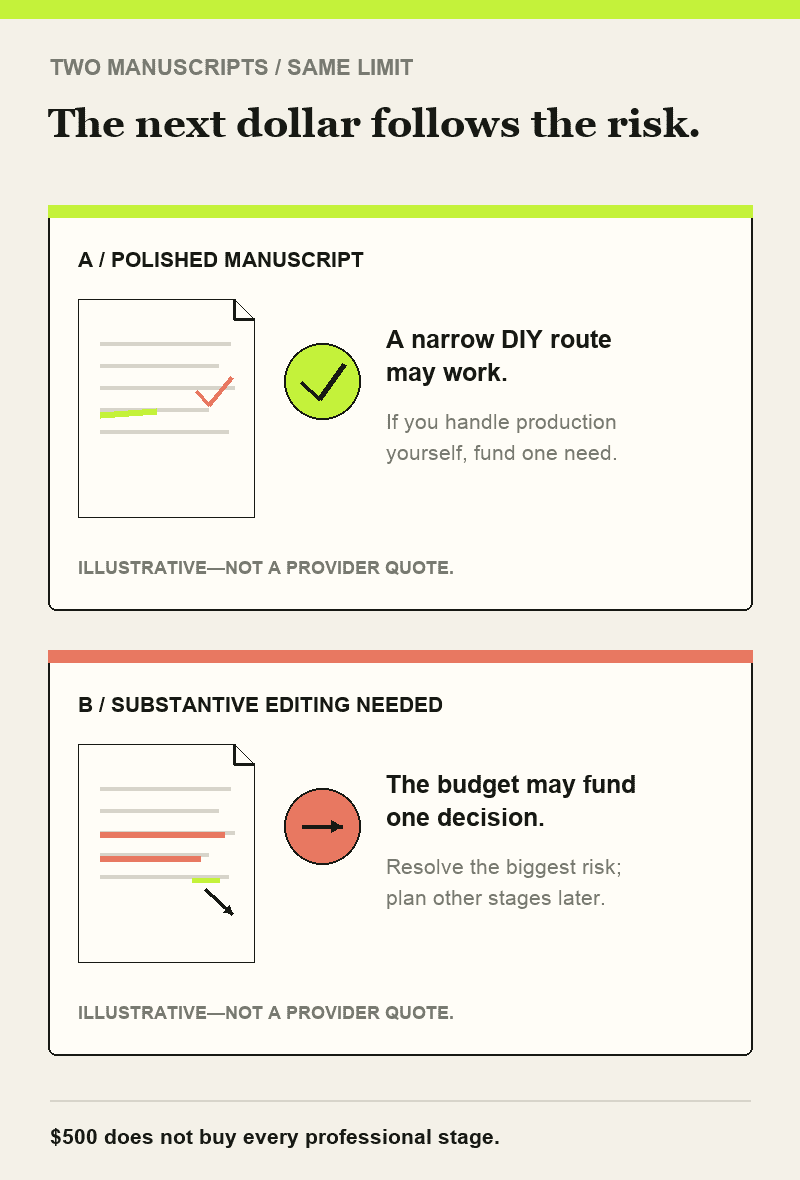
Suppose you have revised the manuscript, checked its structure, and are not expecting major changes. You can handle basic files and want to start with one platform. One possible $500 plan is:
- $0 for the platform upload if you use a platform with no upfront publishing fee, such as KDP, and accept its terms.
- $0 for a KDP print ISBN if your edition qualifies, you are comfortable with an ISBN usable only on KDP, and a Kindle eBook is the format in question that does not require an ISBN there.
- Up to $350 reserved for one final-stage job—for example, a suitable proofread, cover refinement, or interior-file check—only if a real written quote fits and the text is ready for that stage.
- Up to $105 kept for proofing and contingency. Print costs depend on the final file and marketplace; use the current calculator and do not assume this envelope buys a set number of copies.
- Optional $45 for U.S. copyright registration only if that is a deliberate choice. The U.S. Copyright Office says copyright protection begins when an original work is fixed in tangible form; registration is a separate step. Its current fee page lists $45 for an electronic claim by one author, same claimant, one work, not made for hire. Confirm the current fee and eligibility before filing.
This example totals $500 only if the optional registration is chosen and the selected final-stage quote fits within its envelope. The $350 and $105 figures are author-set spending limits, not estimates of current market prices. If the right quote is higher, pause and save rather than buying a narrower service that does not solve the problem.
Example 2: the manuscript still needs substantial editorial work
If the structure, argument, plot, organization, or major content is still changing, do not spend first on a final proof, final layout, extra ISBNs, ads, or launch assets. Those steps may need to be redone after the manuscript changes.
In this case, a sensible $500 plan may be to keep the full amount available for the editorial question—first establishing whether you need structural feedback, a developmental edit, or another defined service, then comparing an actual written scope and quote. The $500 may not cover the full work. That is useful information: it tells you to phase the work, save longer, or continue revision before paying for downstream production. It does not mean you should label an incomplete manuscript “ready” to stay within the budget.
If you have finished a draft but are unsure what remains, BMT’s finished-manuscript decision guide helps separate revision, editing, querying, and self-publishing questions. If editing is the likely job, review the current Book Editing and Proofreading Services page and confirm scope before sharing files or paying.
Where should your next dollar go?
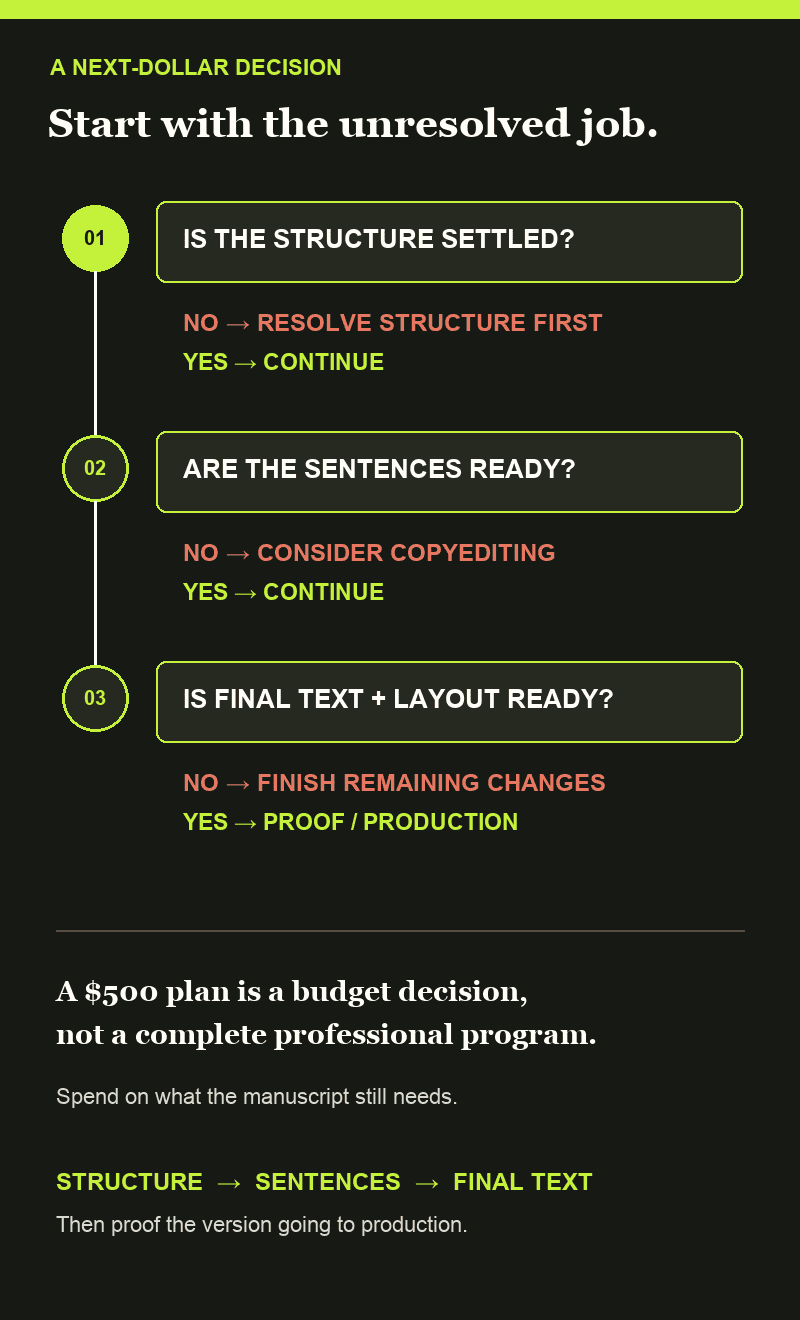
- Major structure or substance remains uncertain: resolve the manuscript-level question before paying for final-stage work.
- The structure is stable but sentences need consistency and clarity: compare a copyediting scope.
- The edited text is final and laid out: proofreading can focus on late-stage surface errors in the actual publication files.
- The words are stable but the cover or interior file is not ready: use a clearly scoped design or production check, not another editing stage by default.
- The book files are ready: choose formats and distribution based on reader and business needs. KDP print costs and royalty math depend on the final edition; an ISBN decision depends on platform and imprint plans.
- The listing is ready: decide whether a website or launch activity has a specific job. Do not treat publishing to a retail platform as the same thing as finding readers.
Before accepting any quote, ask: What exact stage is covered? Which file version will be reviewed? What will be delivered? What is outside scope? Will later changes require another pass? These answers make two quotes comparable and help prevent paying for a step that is premature.
What a $500 budget is—and is not
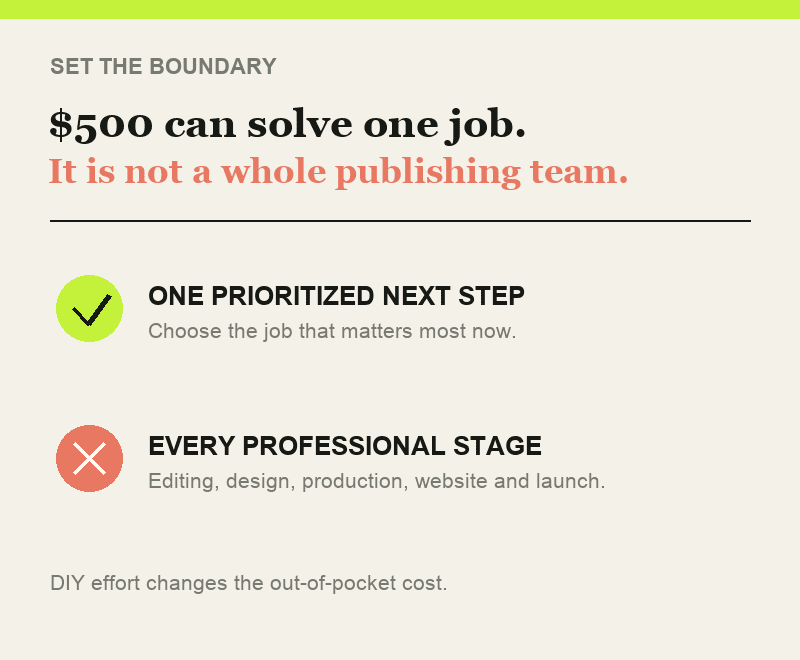
A $500 limit can support a focused, DIY-heavy route when the manuscript is mature and the author can handle most tasks. It can also be a useful starting fund for the one major problem that remains. It is not a complete professional publishing program, a guarantee of quality or sales, or a reason to skip a stage the book actually needs.
Do not buy editing, cover design, formatting, ISBNs, a website, and marketing simply because each item appears on a generic publishing checklist. Put the first dollar toward the current bottleneck. Keep the next decisions conditional on the finished work and the readers you intend to reach.
Sources and current platform details
- Amazon KDP: Start publishing with KDP — platform publishing options and upfront fees.
- Amazon KDP: Get an ISBN — free KDP print ISBN conditions and platform limits.
- Amazon KDP: Cover Creator — current free cover tool details.
- Amazon KDP: Print Book Pricing — current print royalty and cost mechanics.
- U.S. Copyright Office: What is Copyright? and Copyright Office fees.
Platform terms and fees can change. Sources checked October 31, 2026. This is general publishing information, not legal advice.
Choose the next step that fits the book
If you are still deciding, the BMT Author Inquiry asks for your book stage and the help you want. A short description is enough; please do not send manuscript files through the ordinary inquiry form. The next step, if there is a fit, is confirmed from the actual project and scope. If you only need more publishing-path information, start with the guide linked above and keep the $500 for the job that remains unresolved.