
Book Writing and Publishing
Finished Your Manuscript? 7 Questions to Decide What to Do Next
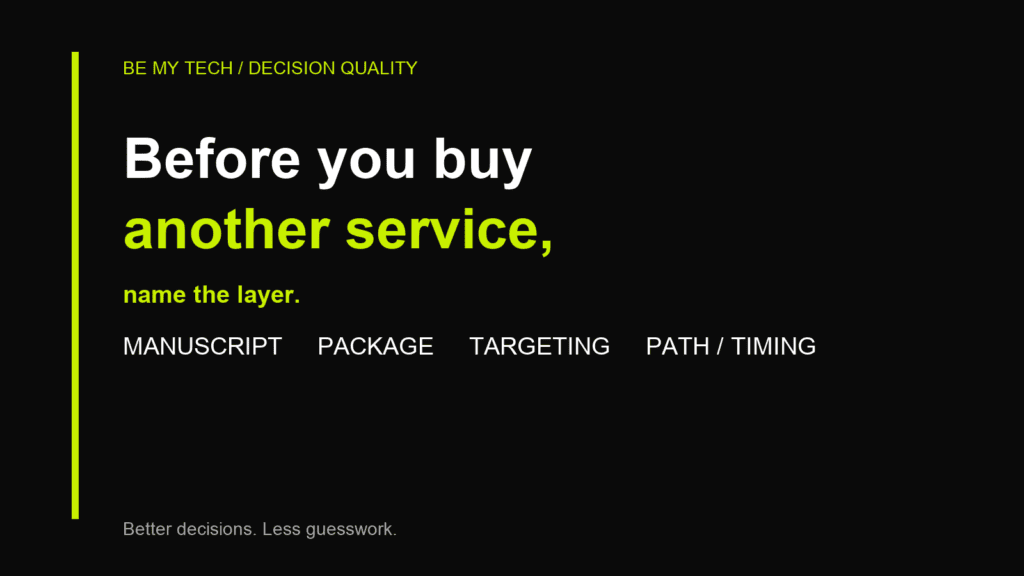
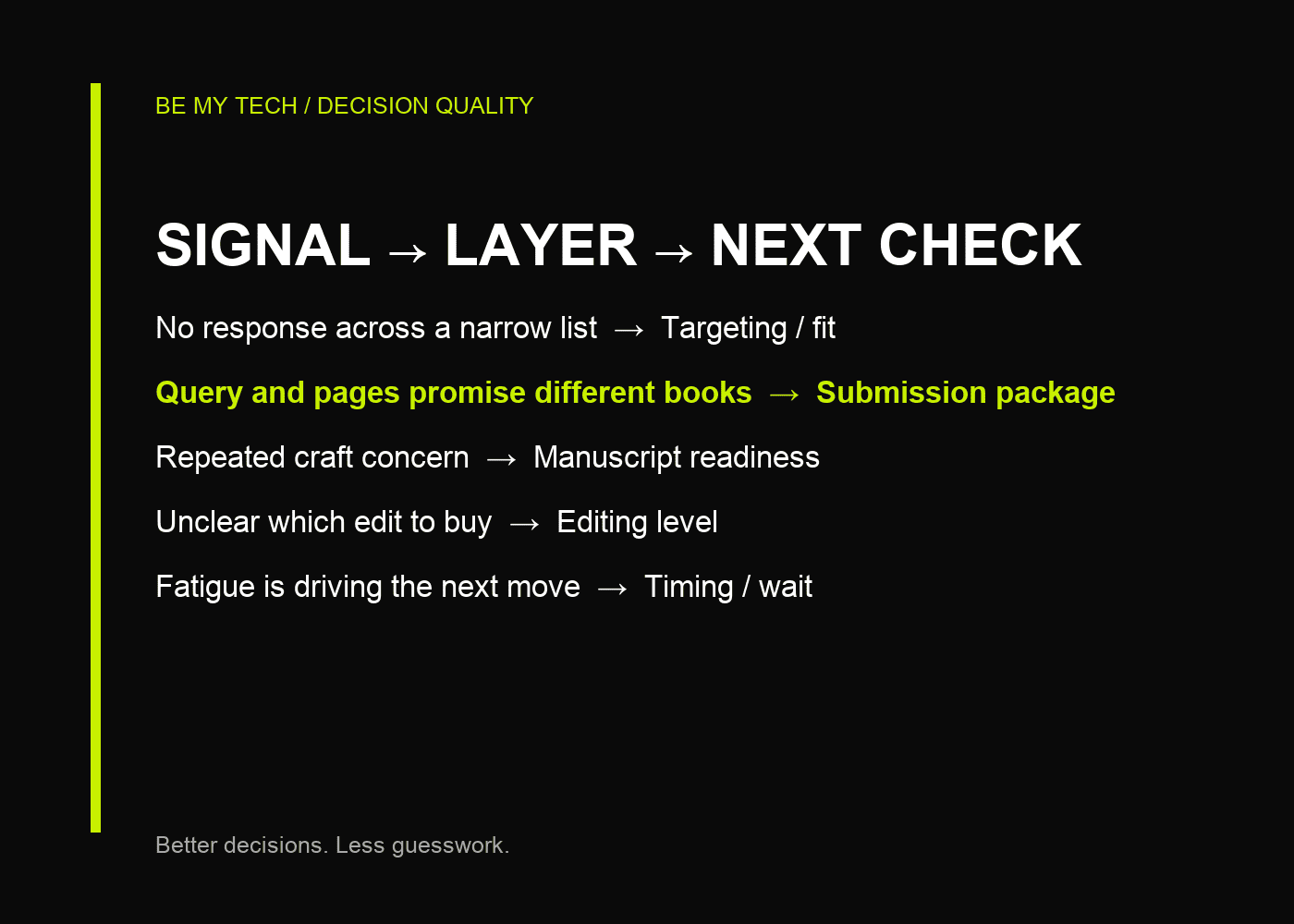
Short answer: before you pay for another edit, send another query, or choose self-publishing, identify the unresolved decision. The useful sequence is SIGNAL → POSSIBLE BOTTLENECK → EVIDENCE TO CHECK → SMALLEST RESPONSIBLE NEXT ACTION. A finished manuscript is not automatically ready for every audience or publishing path.
This decision file helps you separate manuscript readiness, the query package, targeting, editing level, publishing path and timing. It’s a diagnostic starting point. It doesn’t predict an agent’s response, it doesn’t substitute for reading the manuscript, and it doesn’t promise publication or sales.
Start with the signal, not the purchase
| Signal | Possible bottleneck | Evidence to check | Smallest responsible next action |
|---|---|---|---|
| You cannot explain the book’s promise in one sentence. | Positioning or readiness. | Category, intended reader, promise, and opening pages. | Write the unresolved decision before buying a service. |
| The query and pages make different promises. | Query or submission package. | Query, synopsis/proposal, comps, and opening pages side by side. | Repair the package or test a narrow, better-matched list. |
| There are no replies from a narrow, poorly matched list. | Targeting, fit, or timing. | Agent fit, requirements, list quality, and submission dates. | Diagnose the sample before rewriting the manuscript. |
| Credible readers repeat the same craft concern. | Manuscript readiness or editing level. | Repeated feedback and the affected scenes, chapters, or argument. | Choose the smallest review that can clarify the revision. |
| You are unsure what kind of edit you need. | Scope decision. | Whether structure, clarity, consistency, or mechanics are actually unresolved. | Ask for scope before paying for the largest service. |
| You are exhausted and want a new path immediately. | Timing. | Recent feedback, unfinished revisions, and decision fatigue. | Wait if waiting is the evidence-respecting action. |
The seven questions
1. What are you trying to decide right now?
“Make the book better” is too broad. Name the observable decision: revise the opening, repair the query, change the target list, choose an editing level, or select a publishing path. If you cannot state the decision, pause.
2. Is the manuscript ready for the next audience?
Ready does not mean perfect. It means you know the intended reader, category, promise, current stage, and the issues already identified. Fiction and memoir often need a complete manuscript and query package; nonfiction may need a proposal, platform context, or sample chapters.
3. Does the query or submission package make the right promise?
Compare the query, synopsis or proposal, sample pages, and manuscript. Do they describe the same book? Is the category clear? Are the comparable titles plausible? Does the opening deliver the experience the pitch implies?
If the manuscript is stable but the package is not, inspect the package. If the pages contain a known structural problem, a query review is not the right substitute.
4. What does the response pattern actually show?
Separate no response, form rejection, personalized feedback, partial request, and request followed by silence. “No replies” is a signal, not a diagnosis. Check genre fit, agent fit, submission requirements, timing, and whether the list was narrow enough to teach you anything.
For a deeper read of those patterns, see how to read literary-agent query responses and the query-versus-manuscript triage.
5. What level of editing would change the decision?
An assessment maps strengths, risks, and priorities. Developmental editing goes further into structure and revision. Line or copyediting addresses sentence-level clarity and consistency. Proofreading is a final pass after layout. They are not interchangeable purchases. If you cannot say what the service will help you decide or change, ask for scope first.
For the narrower purchase decision, compare manuscript assessment versus developmental editing before choosing a deeper engagement.
Use the editing-level decision guide when the unresolved question is which editorial layer to inspect.
6. Are you choosing a publishing path because of evidence or fatigue?
Traditional querying and self-publishing are different operating paths. Compare your goals, timeline, rights preferences, budget, production and marketing responsibilities, and the evidence that the manuscript is ready. Do not use self-publishing to avoid an unresolved manuscript problem, and do not keep querying only because stopping feels like failure. See the query-versus-self-publish framework.
7. What would make “wait” the correct next action?
Wait if the manuscript is unfinished, material feedback is too recent to evaluate calmly, or you are changing direction faster than you can learn from the evidence. Waiting is not a verdict on the book; it can be the smallest responsible next action.
What not to pay for yet
At the just-finished stage, it may be premature to buy a publicist or launch retainer, paid advertising management, a full-service “publish and market” bundle, extensive branding work, or repeated proofreading before structural questions are settled. These services can be valid later; the question is whether they solve the current bottleneck.
Once the manuscript and publishing path are stable, use this book marketing decision guide to choose the next responsible channel.
Choose the next action by stage
| Current state | Next action | Hold off on |
|---|---|---|
| Complete draft, no outside structural feedback | Beta readers, critique partner, or bounded assessment. | Copyediting, cover design, and ads. |
| Repeated structural feedback, revising | Developmental revision and another evidence check. | Proofreading and locked production files. |
| Text stable and revisions incorporated | Line/copyediting, then lock the text. | Proofreading before layout. |
| Text locked or formatted proof exists | Production setup, then proofreading of the formatted proof. | New structural changes in the release files. |
| Launch-ready and path is chosen | Distribution, audience-building, and marketing appropriate to that path. | Large spend before the destination and assets are stable. |
What a bounded diagnostic can and cannot do
The Manuscript & Publishing Readiness Diagnostic is a written, evidence-backed assessment of the current stage, protected strengths, ranked bottlenecks, next actions, and what not to spend on yet. It is designed to make the next decision clearer; it is not a full edit, rewriting service, agent outreach, representation, or guarantee of publication, sales, or agent responses.
For manuscripts up to and including 50,000 words, the approved baseline is from $199. Longer manuscripts are priced after fit and scope review. If the evidence points to proofreading, copyediting/line-level work, a controlled developmental opportunity, scoped publishing support, or no paid intervention yet, that should be resolved as a separate fit-and-scope decision.
A five-minute check before hiring anyone
- What exact decision is the service meant to help me make?
- What is included and explicitly out of scope?
- What evidence will I receive at the end?
- What would make the service unnecessary or premature?
- What changes if the answer is revise, change the package, or wait?
A low-pressure next step
If you still cannot identify the bottleneck, use the Author readiness path to start a fit-first decision conversation. A responsible outcome may be revision, retargeting, continued querying, a different publishing path, a bounded diagnostic, or waiting. The aim is to make the next decision clearer before you commit to something larger.
Limitations
This framework does not read your specific manuscript or predict market outcomes. Genre norms, budget, publishing path, and the quality of the available evidence all affect the right next step. Do not treat a response pattern, a single opinion, or a service recommendation as proof by itself.