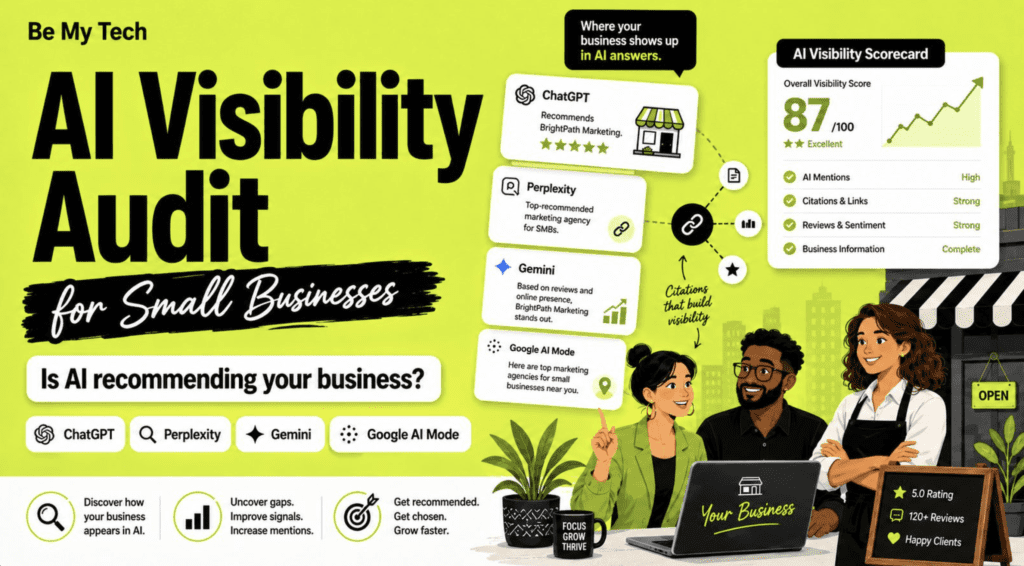
Your next customer may not start by searching Google.
They may ask ChatGPT, Perplexity, Gemini, Claude, Grok, or Google AI Mode which business to trust.
An AI visibility audit for small businesses helps you check whether your brand appears, gets cited, and is recommended inside AI-generated answers.
Google Search Central explains how AI features like AI Overviews and AI Mode work from a website owner’s perspective.
That shift matters most for founder-led agencies, consultants, service businesses, clinics, and professional firms where buyers research credibility before making contact. If AI tools summarize the market, compare providers, and recommend competitors before someone visits your website, your business may be losing demand invisibly.
Ranking on Google still matters. Reviews still matter. Your website still matters. But they are no longer the whole visibility system.
The new question is not only:
“Do we rank on Google?”
The sharper question is:
“When a customer asks AI who to hire, does our business get recommended — or does a competitor win the answer?”
This guide explains how small businesses can run an AI visibility audit, check whether they appear in AI-generated answers, understand how they are described, and identify what must be fixed across website content, reviews, structured data, local SEO, digital authority, and AI-search readiness.
Google now provides official guidance for website owners on how AI features like AI Overviews and AI Mode work in Search. OpenAI has also introduced ChatGPT search to provide timely answers with links to relevant web sources.
The direction is clear:
Search is moving from blue links to assisted answers. Small businesses now need visibility inside the answer, not only below it.
What Is an AI Visibility Audit?
An AI visibility audit is a structured review of how your business appears inside AI-generated answers across platforms like ChatGPT, Perplexity, Gemini, Claude, Grok, and Google AI Mode.
It checks:
- whether your business appears at all;
- where your business appears in the answer;
- how your business is described;
- whether the description is accurate;
- which competitors appear instead;
- whether AI tools recommend you strongly, weakly, or not at all;
- which websites, reviews, directories, articles, and sources AI systems use to support the answer;
- what content, proof, schema, reviews, and authority signals are missing.
In simple terms:
Traditional SEO is about ranking in search results. AI visibility is about being mentioned, trusted, cited, compared, and recommended inside AI-generated answers.
That distinction matters.
A business can rank on Google and still be weak inside AI answers.
A business can have a polished website and still be ignored by ChatGPT.
A business can appear in an AI answer but be described so vaguely that the competitor looks more credible.
This is why AI visibility is not just a technical SEO issue. It is a commercial positioning issue.
Why AI Visibility Matters for U.S. Small Businesses
Small businesses in the U.S. operate in a high-trust, high-comparison market.
Customers rarely contact the first business they see. They compare reviews, websites, pricing signals, credibility, service details, location, reputation, and proof before making a decision.
AI search compresses that research process.
Instead of opening ten tabs, a customer may ask:
- “Best web design agency for small businesses in the USA”
- “Which local dentist has the best reputation?”
- “Best consultant for founder-led companies”
- “Compare [Business A] vs [Business B]”
- “Is [Your Business] reliable?”
- “Who should I hire for [specific service]?”
- “What are the best companies for [problem] near me?”
In traditional search, the user sees a list of results.
In AI search, the user may receive a synthesized answer that names a few businesses, explains their strengths, compares them, and cites sources.
That means your business is no longer competing only for position.
It is competing for recommendation.
For small businesses, this creates a new risk:
If AI tools do not understand your business clearly, they may recommend competitors that have stronger content, better reviews, clearer positioning, or more visible third-party proof.
The Big Shift: From Ranking to Recommendation
For years, small business marketing focused on visibility as if discovery happened mainly through Google search results.
That model is outdated.
Modern discovery now happens across several surfaces.
| Discovery Surface | What Customers Do | What Your Business Needs |
|---|---|---|
| Google Search | Search keywords and compare results. | Traditional SEO, rich service pages, reviews. |
| Google AI Overviews / AI Mode | Ask complex questions and receive summarized answers. | Clear content blocks, structured data, authority signals. |
| ChatGPT Search | Seek recommendations, comparisons, and explanations. | Absolute entity clarity, web citations, third-party proof. |
| Perplexity | Research topics and providers through cited answers. | Strong source visibility, third-party mentions, clean formatting. |
| Gemini | Ask Google-connected AI questions. | Search visibility, helpful content, entity clarity. |
| Claude / Grok | Ask comparison and decision-support questions. | Publicly available expertise, differentiated positioning, consistent proof. |
| Review Platforms | Validate credibility before contacting a business. | Strong reviews, ratings, recent customer sentiment. |
| Social Platforms | Check legitimacy, activity, and human presence. | Recent content, founder visibility, brand consistency. |
The old question was:
“Can customers find our website?”
The new question is:
“Can AI systems understand, trust, and recommend our business when customers ask for help?”
That is a different problem.
AI Visibility Is Not the Same as SEO
SEO and AI visibility are connected, but they are not identical.
SEO helps your website rank in traditional search results.
AI visibility helps your business appear inside AI-generated answers.
A business can have decent SEO and still fail in AI search if its website is vague, its content is thin, its reviews are weak, its niche is unclear, or competitors have stronger third-party validation.
| Traditional SEO | AI Visibility / GEO / AEO |
|---|---|
| Focuses on rankings | Focuses on mentions, citations, comparisons, and recommendations |
| Optimizes pages for keywords | Optimizes entities, topics, questions, and answers |
| Measures impressions, clicks, and traffic | Measures AI mentions, position, sentiment, and competitor overlap |
| Relies on content, links, technical SEO, and authority | Relies on content, entity clarity, reviews, trusted sources, and structured proof |
| Helps users find your website | Helps AI systems understand and recommend your business |
| Works around search result pages | Works around answer engines and recommendation layers |
A serious small business marketing strategy now needs three connected disciplines:
- SEO: Search Engine Optimization
- AEO: Answer Engine Optimization
- GEO: Generative Engine Optimization
What Is Generative Engine Optimization?
Generative Engine Optimization, or GEO, is the process of improving how your brand appears inside generative AI answers.
For small businesses, GEO means making your business easier for AI systems to understand, classify, compare, cite, and recommend.
GEO asks:
- Does AI know what your business does?
- Does AI know who you serve?
- Does AI associate your brand with the right services?
- Does AI mention your business for relevant buyer-intent prompts?
- Does AI cite trustworthy sources about your business?
- Does AI describe your business accurately?
- Does AI recommend competitors more often than you?
- Does AI frame your competitor as more credible, complete, or trustworthy?
GEO is not about tricking AI systems.
It is about reducing ambiguity.
If your website, reviews, listings, articles, and third-party profiles send a clear, consistent signal, AI systems have more confidence when interpreting your brand.
What Is Answer Engine Optimization?
Answer Engine Optimization, or AEO, is the process of structuring your content so search engines and AI systems can extract clear answers from it.
AEO focuses on:
- direct answers;
- FAQ sections;
- definitions;
- comparison tables;
- step-by-step explanations;
- schema markup;
- buyer guides;
- concise summaries;
- clear headings;
- helpful content.
Google’s search documentation continues to emphasize useful, reliable, people-first content and machine-readable website structure.
AI visibility is not about keyword stuffing.
It is about clarity, usefulness, proof, and structure.
Why Most Small Businesses Are Invisible in AI Search
Most small businesses do not have an AI visibility problem because they are bad businesses.
They have an AI visibility problem because their digital presence is unclear, incomplete, scattered, or difficult for machines to interpret.
1. Your Website Copy Is Too Vague
Many small business websites use phrases like:
- “Quality service you can trust”
- “Your partner in success”
- “Solutions built for growth”
- “We care about our customers”
- “Premium service at affordable prices”
These lines may sound acceptable to humans, but they are weak for AI extraction.
AI systems need explicit information.
Weak sentence:
We help you grow with smart solutions.
Stronger sentence:
Be My Tech is a digital growth and AI visibility studio that helps U.S. service-based small businesses improve website clarity, AI search visibility, lead generation, and customer conversion systems.
The second sentence is stronger because it clearly states:
- business name;
- category;
- audience;
- services;
- outcome.
This is called entity clarity.
If your website does not clearly explain who you are, what you do, who you serve, where you operate, and why you are credible, AI systems may struggle to recommend you.
2. Your Business Category Is Not Clear
AI systems need to classify your business.
Are you a general marketing agency, SEO agency, web design agency, AI automation studio, local service provider, healthcare clinic, consultant, or professional services firm?
If your website tries to be everything, AI may not know where to place you.
A business that says:
We provide complete solutions for all your needs.
Is less AI-visible than a business that says:
We help founder-led service businesses improve website conversion, AI search visibility, lead capture, and automated customer follow-up.
Specificity beats generic branding.
For small businesses, the goal is not to sound big.
The goal is to sound clear.
3. Your Service Pages Are Thin
A homepage alone is not enough.
If you want AI systems to understand your business, you need dedicated service pages that explain what you offer in depth.
Each service page should answer:
- What is the service?
- Who is it for?
- What problem does it solve?
- What outcome does it create?
- What makes your approach different?
- What proof supports your claim?
- What questions do buyers usually ask?
- What should the customer do next?
Thin service pages leave AI systems with very little to extract.
A page that says “we offer digital marketing services” is weak.
A page that explains your service, process, audience, pricing logic, FAQs, proof, and outcomes is far easier for AI systems to understand and cite.
4. You Do Not Have Enough Visible Trust Signals
Trust signals matter in both traditional search and AI search.
For service-based small businesses, trust signals include:
- Google reviews;
- industry-specific reviews;
- testimonials;
- case studies;
- certifications;
- licenses;
- awards;
- founder credentials;
- media mentions;
- third-party directories;
- partner pages;
- project examples;
- before-and-after proof;
- recent social activity.
AI systems often rely on public web signals to assess credibility. If your competitors have stronger visible reviews, clearer profiles, richer service pages, and more third-party validation, they may look safer to recommend.
5. Your Brand Has Weak Third-Party Proof
Your website matters, but AI systems do not only evaluate your website.
They may look across the wider web.
That includes:
- Google Business Profile;
- review platforms;
- local directories;
- industry directories;
- media mentions;
- podcasts;
- guest articles;
- LinkedIn profiles;
- partner pages;
- comparison pages;
- YouTube videos;
- niche publications;
- “best of” lists.
If your business only exists on your own website, your digital footprint may be too thin.
For AI visibility, your brand needs a consistent public footprint.
This does not mean buying low-quality backlinks or publishing fake PR.
It means your business should be described clearly and consistently across credible sources.
6. Your Website Does Not Answer Buyer Questions
Many business websites talk about the company.
AI search rewards pages that answer customer questions.
Buyers ask:
- How much does this service cost?
- How do I choose the right provider?
- What questions should I ask before hiring?
- What is the difference between option A and option B?
- Is this service worth it?
- How long does the process take?
- What are the risks?
- What should I avoid?
- Who is the best fit for this service?
- What makes one provider better than another?
If your website does not answer these questions, AI systems may cite competitors who do.
That is why FAQ sections, buyer guides, comparison pages, cost guides, and educational articles are now important commercial assets.
7. Your Content Is Written for Keywords, Not Decisions
A lot of SEO content still exists only to target keywords.
But customers do not only search keywords.
They make decisions.
AI systems are designed to synthesize information and support decisions. That means your content should help people:
- understand the problem;
- compare options;
- evaluate providers;
- estimate cost;
- avoid mistakes;
- understand outcomes;
- take action.
A generic blog post titled:
Best SEO Tips for Small Businesses
Is weak.
A better article is:
How to Know If Your Small Business Is Invisible in ChatGPT, Perplexity, and Google AI Mode
The second article addresses a real modern problem and creates a direct path to an audit.
8. Your Local SEO Signals Are Inconsistent
For local and service-area businesses, AI visibility often depends on local trust and data consistency.
Your business should have accurate and consistent:
- name;
- address;
- phone number;
- website;
- business hours;
- service areas;
- categories;
- services;
- photos;
- reviews;
- descriptions;
- social links;
- directory listings.
If your local data is inconsistent, outdated, or incomplete, AI systems may be less confident when describing or recommending your business.
9. Your Website Lacks Structured Data
Structured data is not magic.
It does not guarantee rankings or AI citations.
But it helps reduce ambiguity.
For small businesses, useful schema types may include:
- Organization schema;
- LocalBusiness schema;
- Service schema;
- Article schema;
- Breadcrumb schema;
- Person schema;
- FAQPage schema where appropriate;
- TechArticle schema for technical guides;
- DefinedTerm schema for original concepts and frameworks;
- ItemList schema for scorecards or framework steps.
Schema.org provides a shared vocabulary for structured data that helps communicate machine-readable meaning across web pages.
In AI search, clarity matters.
Structured data helps explain what the page is, who published it, what it covers, and which concepts it defines.
10. Your Site Does Not Support AI-Readable Discovery
Traditional SEO focuses on robots.txt, sitemaps, crawlability, and indexability.
Those still matter.
But AI visibility now also requires thinking about how language models interpret your content.
This is where llms.txt and llms-full.txt enter the conversation.
The official llms.txt proposal describes /llms.txt as a Markdown file designed to provide information that helps language models use a website at inference time.
Important: llms.txt is an emerging proposed standard, not a guaranteed ranking factor. Major AI platforms have not universally committed to using it, and it does not replace SEO, schema, sitemaps, robots.txt, or high-quality website content.
That said, forward-looking businesses may still implement it as part of broader AI-readiness because it is lightweight, low-risk, and useful as a clean content map.
The Be My Tech AI Visibility Index: What We Found Across 28 Buyer-Intent Prompts
Most AI visibility content talks in theory.
At Be My Tech, we believe AI visibility needs to be tested through real buyer-intent prompts, not guessed through generic SEO assumptions.
In one internal AI visibility test, we reviewed 28 buyer-intent prompts across four AI platforms: ChatGPT, Perplexity, Gemini, and Grok. The goal was to understand how AI tools describe and recommend major platforms in the B2B agency research space.
The comparison focused on platforms such as Clutch and G2, because both are relevant to how buyers research software companies, service providers, and agencies.
Methodology Note
Prompts were tested using a structured prompt log that tracked:
- mention frequency;
- answer position;
- competitor overlap;
- sentiment;
- recommendation strength;
- framing language;
- citation/source behavior where available.
Each prompt was designed to simulate how a real buyer might research agency review platforms, B2B service providers, software review sites, or trusted sources for comparing agencies.
Summary Findings
| Test Element | Finding |
|---|---|
| Number of prompts tested | 28 buyer-intent prompts |
| Platforms reviewed | ChatGPT, Perplexity, Gemini, Grok |
| Clutch mentions | 27 mentions |
| G2 mentions | 22 mentions |
| Clutch average position | approximately 1.5 |
| Main insight | Higher mention frequency does not always mean stronger recommendation language |
The most important finding was not only that Clutch appeared more often.
The sharper insight was this:
AI visibility has two layers: frequency and framing.
A brand can appear frequently but still lose buyer confidence if another brand is described with stronger authority, trust, completeness, or relevance.
Platform-Level Observations
| Platform | Observation |
|---|---|
| ChatGPT | Clutch appeared frequently in agency-related prompts, especially where the query focused on finding or comparing service providers. G2 was often framed more broadly around software reviews and business software comparisons. |
| Perplexity | Perplexity’s answers were more source-driven, making citation quality especially important. Brands with strong third-party pages, structured profiles, and authoritative comparison content had a stronger chance of being surfaced with supporting links. |
| Gemini | Gemini often leaned toward broader search-style synthesis, where clear category association and web-wide entity signals influenced how platforms were grouped and described. |
| Grok | Grok responses were more conversational and comparative, making recommendation language and brand framing especially important. A brand could appear but still be positioned less strongly than a competitor. |
The commercial lesson is simple:
Being mentioned by AI is not the same as being recommended by AI.
For example, in responses where both Clutch and G2 appeared, G2 was often framed as more comprehensive, while Clutch was positioned as especially useful for service-agency research.
That distinction matters.
A customer does not only notice whether your business appears.
They notice how AI describes you.
Are you described as:
- trusted?
- specialized?
- experienced?
- top-rated?
- comprehensive?
- premium?
- local?
- reliable?
- best for a specific audience?
Or are you simply listed as another option?
This is why a serious AI visibility audit should not only ask:
“Do we appear?”
It should ask:
“Are we being positioned as the best choice?”
For small businesses, agencies, consultants, and service brands, that difference can affect whether a buyer clicks, calls, compares, or moves on.
How to Run an AI Visibility Audit for Your Small Business
You can start manually before investing in a full audit.
The goal is not to test one prompt.
The goal is to understand your visibility pattern across platforms, prompts, competitors, and source citations.
Step 1: Choose Your AI Platforms
Test your business across multiple AI platforms because each system may produce different results.
Use:
- ChatGPT;
- Perplexity;
- Gemini;
- Claude;
- Grok;
- Google AI Mode;
- Google AI Overviews where available.
Do not rely on one answer from one platform.
A business may appear in Perplexity but not ChatGPT. It may appear for branded searches but not category searches. It may appear in Google but be missing from conversational AI tools.
The goal is to map the pattern.
Step 2: Create Buyer-Intent Prompts
Do not only ask for your business name.
Ask the types of questions real customers would ask before hiring.
Category Prompts
- “Best [service] for small businesses in the USA”
- “Top [service provider] for founder-led companies”
- “Which company should I hire for [problem]?”
- “Best [industry] consultant for small businesses”
- “Most trusted [service] provider for [customer type]”
Local Prompts
- “Best [service] in [city]”
- “Top-rated [service] near me”
- “Which [service provider] in [city] has the best reviews?”
- “Who should I hire for [problem] in [city]?”
Comparison Prompts
- “Compare [your business] vs [competitor]”
- “Is [your business] better than [competitor]?”
- “What are the best alternatives to [competitor]?”
- “Which is better for [customer type]: [Business A] or [Business B]?”
Problem-Aware Prompts
- “Why is my business not showing up in ChatGPT?”
- “How do I get my business recommended by AI?”
- “How do small businesses improve AI visibility?”
- “How do I check if AI tools recommend my business?”
- “What makes a business appear in Google AI Mode?”
These prompts reveal whether AI tools understand your brand beyond your name.
Step 3: Track Whether Your Business Appears
Create a spreadsheet with these columns:
| Prompt | Platform | Did We Appear? | Position | Competitors Mentioned | Description | Citation Sources | Sentiment | Action Needed |
|---|
Track at least 20–30 prompts.
A one-prompt test is not an audit.
It is a snapshot.
A real AI visibility audit looks across enough prompts to reveal a pattern.
Step 4: Measure Recommendation Strength
Being mentioned is not enough.
You need to measure how strongly AI recommends your business.
Use this scoring model:
| Score | Meaning |
|---|---|
| 5 | Strongly recommended as a top option |
| 4 | Positively mentioned with clear strengths |
| 3 | Mentioned neutrally |
| 2 | Mentioned weakly or vaguely |
| 1 | Mentioned with concerns or unclear positioning |
| 0 | Not mentioned |
This matters because AI answers can shape buyer perception before the buyer clicks.
If your competitor is described as “trusted,” “specialized,” “highly rated,” or “best for premium service,” while your business is simply listed as “another option,” the competitor owns the stronger commercial position.
Step 5: Analyze Competitor Overlap
Every AI answer is a miniature market map.
When you run your prompts, note:
- which competitors appear most often;
- which competitors appear above you;
- which competitors are described positively;
- which competitors receive citations;
- which competitors are recommended for your highest-value services;
- which sources help those competitors appear.
Your competitor may not be beating you because they are better.
They may be beating you because AI systems have more structured proof about them.
Step 6: Review Citation Sources
Citation sources are critical.
When AI tools cite sources, check whether they are using:
- your website;
- your Google Business Profile;
- review sites;
- local directories;
- industry directories;
- social profiles;
- third-party articles;
- partner pages;
- competitor websites;
- comparison pages;
- outdated or incorrect information.
If AI systems are citing competitors but not you, your source footprint needs work.
If AI systems cite outdated information about you, your digital presence needs cleanup.
If AI systems describe your business incorrectly, your entity signals need correction.
A proper AI visibility audit for small businesses should measure more than whether a brand appears once in ChatGPT.
The AI Visibility Scorecard for Small Businesses
Use this scorecard to evaluate your current position.
| Category | Score 0–10 | What It Measures |
|---|---|---|
| Brand Mention Visibility | /10 | Does your business appear in AI answers? |
| Prompt Coverage | /10 | Do you appear for different buyer-intent questions? |
| Recommendation Strength | /10 | Are you recommended strongly or weakly? |
| Competitor Positioning | /10 | Are you positioned better than competitors? |
| Citation Quality | /10 | Are trustworthy sources supporting your visibility? |
| Website Clarity | /10 | Is your site clear, specific, and extractable? |
| Review Strength | /10 | Do reviews support trust and relevance? |
| Local Entity Consistency | /10 | Are your listings and business details consistent? |
| Content Depth | /10 | Do you answer real buyer questions? |
| Technical Accessibility | /10 | Can search engines and AI systems access your content? |
Score Interpretation
| Total Score | Meaning |
|---|---|
| 80–100 | Strong AI visibility |
| 60–79 | Visible but not dominant |
| 40–59 | Inconsistent visibility |
| 20–39 | Weak visibility |
| 0–19 | Mostly invisible |
A small business does not need a perfect score to benefit.
But if your score is below 50, competitors may be shaping AI answers before customers ever reach your website.
Want Us to Check Your AI Visibility?
You now know what to check.
The hard part is running the prompts, comparing platforms, tracking competitor mentions, reviewing citation sources, and turning the findings into a practical fix plan.
Be My Tech can run a free AI Visibility Snapshot for your business.
We’ll check how your business appears across AI platforms like ChatGPT, Perplexity, Gemini, Claude, Grok, and Google AI Mode, then show whether your brand is visible, invisible, misrepresented, or being outranked by competitors.
Request the Full AI Visibility Audit
The BMT AI Visibility Framework
Improving AI visibility is not about manipulating AI systems.
It is about making your business easier to understand, verify, compare, and recommend.
The BMT AI Visibility Framework evaluates ten layers.
| Layer | What It Means | What To Fix |
|---|---|---|
| Entity Clarity | AI understands who you are | business name, category, audience, services, location |
| Service Specificity | AI understands what you offer | dedicated service pages, clear descriptions, FAQs |
| Proof Density | AI sees reasons to trust you | reviews, testimonials, case studies, awards, certifications |
| Source Footprint | AI finds you across the web | directories, articles, listings, profiles, third-party mentions |
| Answer Structure | AI can extract useful answers | definitions, tables, FAQs, comparison pages |
| Local Consistency | AI trusts your business data | NAP consistency, Google Business Profile, citations |
| Technical Access | AI/search crawlers can access content | indexability, schema, sitemap, robots.txt, llms.txt |
| Content Authority | AI sees topical expertise | guides, audits, frameworks, original research |
| Sentiment Control | AI describes you accurately | reputation management, review responses, clear positioning |
| Ongoing Testing | You monitor changes | monthly prompt testing and competitor tracking |
This framework helps businesses move from vague visibility to measurable AI-search readiness.
How Small Businesses Can Improve AI Visibility
1. Add a Clear Entity Paragraph to Your Website
Every small business website should have a direct entity statement.
Use this structure:
[Business Name] is a [business category] serving [location/audience] with [core services]. The business helps [customer type] achieve [specific outcome] through [differentiator/proof].
Example:
Be My Tech is a digital growth and AI visibility studio that helps U.S. service-based small businesses, agencies, consultants, and founder-led companies improve website clarity, AI search visibility, lead generation, and conversion systems.
For Visora, Be My Tech’s AI visibility audit offer, the entity statement can be even more specific:
Visora by Be My Tech is an AI visibility audit service that helps founder-led agencies, consultants, and service-based businesses understand how they appear across ChatGPT, Perplexity, Gemini, Claude, Grok, and Google AI Mode — and what to fix so AI systems can describe, cite, compare, and recommend them more accurately.
Place this type of paragraph on:
- homepage;
- about page;
- service pages;
- AI Visibility Audit page;
- footer business profile;
- FAQ page;
- llms.txt summary.
Do not rely only on poetic taglines.
Taglines create emotion.
Entity statements create machine understanding.
You need both.
2. Build Service Pages That Answer Real Buyer Questions
Each service page should include:
- clear service definition;
- who the service is for;
- problems it solves;
- process;
- proof;
- pricing guidance where possible;
- FAQs;
- comparison against alternatives;
- CTA.
Example for an AI Visibility Audit page:
- What is an AI visibility audit?
- Who needs one?
- What platforms are tested?
- What prompts are used?
- What metrics are measured?
- What does the report include?
- How is this different from SEO?
- What happens after the audit?
- How do I request a snapshot?
This supports SEO, AEO, and GEO at the same time.
3. Create Comparison Content
AI systems often answer comparison-style prompts.
Small businesses should publish content like:
- “[Your Service] vs [Alternative]: Which Is Better?”
- “How to Choose the Best [Service Provider]”
- “Top Questions to Ask Before Hiring a [Provider]”
- “What Makes a Good [Service Provider]?”
- “How Much Does [Service] Cost?”
- “Best [Service] for [Specific Customer Type]”
This type of content helps AI systems understand how your business fits into decision-making contexts.
It also captures commercial search intent.
4. Strengthen Reviews and Reputation Signals
Reviews are no longer only conversion assets.
They are AI visibility assets.
A useful review strategy includes:
- asking satisfied customers for reviews consistently;
- responding to positive and negative reviews;
- placing specific testimonials on service pages;
- building industry-specific review profiles;
- keeping Google Business Profile active;
- monitoring review sentiment;
- using review language to identify what customers value most.
Generic testimonial:
Great service. Highly recommended.
Stronger testimonial:
Be My Tech helped us clarify our website offer, improve our homepage structure, and create a clearer path for small business leads to contact us.
Specific proof is more useful than vague praise.
5. Publish AI-Citable Content
AI-citable content is usually:
- specific;
- structured;
- factual;
- useful;
- easy to extract;
- supported by proof;
- organized with headings, tables, definitions, and FAQs.
Examples include:
- definitions;
- checklists;
- frameworks;
- scorecards;
- original research;
- buyer guides;
- comparison tables;
- case studies;
- methodology pages;
- FAQ hubs;
- data-backed insights.
A generic blog post may get ignored.
A structured guide with original insights has a better chance of being cited, summarized, or referenced.
6. Use Schema Markup Intelligently
Basic FAQ schema is no longer enough.
Google’s FAQ structured data documentation states that FAQ rich results are no longer appearing in Google Search as of May 7, 2026, with related reporting and tool support being removed in 2026. FAQ content can still be useful for users, topical coverage, internal linking, AEO, and AI readability, but businesses should not rely on FAQPage schema alone as a visibility strategy.
For a technical pillar article like this, better schema architecture may include:
- TechArticle;
- Organization;
- Person;
- DefinedTerm;
- DefinedTermSet;
- ItemList;
- BreadcrumbList;
- FAQPage where appropriate;
- Service schema on the actual service page.
Use structured data to clarify meaning, not to chase rich-result gimmicks.
7. Build an llms.txt File for AI-Readable Discovery
Traditional search relies heavily on sitemap.xml, internal links, structured data, and crawlable HTML to discover and understand website content.
AI-assisted discovery introduces another layer: machine-readable context.
An /llms.txt file is an emerging proposed standard that gives language models a clean, Markdown-based guide to a website’s most important pages, service definitions, resources, and entity information.
It does not replace SEO, schema, sitemaps, robots.txt, or high-quality website content. It should not be treated as a guaranteed ranking factor. Major AI platforms have not universally committed to using llms.txt.
That said, forward-looking businesses may still implement it as part of broader AI-readiness because it is lightweight, low-risk, and useful as a clean content map.
A strong llms.txt file can point AI systems, agents, and technical reviewers toward:
- your homepage;
- core service pages;
- AI Visibility Audit page;
- pricing or offer pages;
- methodology pages;
- case studies;
- FAQs;
- founder or company profile;
- original research;
- important blog posts;
- Markdown versions of high-value guides.
For Be My Tech, the entity summary should clearly state:
Be My Tech is a digital growth and AI visibility studio that helps U.S. service-based small businesses, agencies, consultants, and founder-led companies improve website clarity, AI search visibility, lead generation, and conversion systems.
The goal is simple:
Make your most important business information easier for both humans and machines to find, understand, and trust.
8. Make Your Website Technically Accessible
A beautiful website can still be invisible if it is difficult to crawl, index, or interpret.
Check:
- Is your website indexed?
- Are important pages blocked by robots.txt?
- Is your sitemap submitted?
- Are service pages crawlable?
- Are headings structured correctly?
- Is important content hidden behind scripts?
- Are pages internally linked?
- Are canonical URLs clean?
- Are schema errors fixed?
- Is your site mobile-friendly?
- Does the site load properly?
- Is your llms.txt file accurate and accessible?
Technical visibility is not optional.
If AI systems cannot access or understand your content, they cannot confidently recommend you.
AI Visibility Audit Checklist for Small Businesses
Use this checklist before investing in ads, redesigns, or more content.
Brand Clarity
- Is your business category clearly stated?
- Is your location or service area clear?
- Are your core services easy to understand?
- Is your target customer clearly identified?
- Is your main outcome clearly explained?
- Do you have a clear entity paragraph?
Website Structure
- Do you have dedicated service pages?
- Do your pages answer buyer questions?
- Do you use clear headings?
- Do you include FAQs?
- Do you include comparison or decision-support content?
- Do you explain your process?
Proof
- Do you have visible reviews?
- Do you have testimonials?
- Do you show case studies or results?
- Do you include certifications, licenses, awards, or media mentions?
- Do third-party sites mention your business?
- Are proof points specific, not generic?
AI Search Visibility
- Does your business appear in ChatGPT?
- Does your business appear in Perplexity?
- Does your business appear in Gemini?
- Does your business appear in Claude or Grok?
- Does your business appear in Google AI Mode or AI Overviews?
- Does AI describe your business accurately?
- Are competitors recommended more often?
- Are competitors described more positively?
- Which sources does AI cite?
Local SEO
- Is your Google Business Profile complete?
- Are your NAP details consistent?
- Are your categories accurate?
- Are your reviews recent?
- Are your service areas clear?
- Are your local pages optimized?
Technical SEO and AI Accessibility
- Are your pages indexed?
- Is your sitemap submitted?
- Is robots.txt configured properly?
- Is your site mobile-friendly?
- Is your schema valid?
- Are internal links clear?
- Do you have an llms.txt file?
- Are your most important pages easy to find?
Common AI Visibility Mistakes Small Businesses Should Avoid
Mistake 1: Only Focusing on Google Rankings
Google still matters.
But customers now research across AI tools, review platforms, social profiles, and answer engines.
Your visibility strategy needs to cover the full discovery journey.
Mistake 2: Using Generic Website Copy
If your website sounds like every competitor, AI systems have no reason to distinguish you.
Say exactly what you do, who you serve, where you serve, and what makes you credible.
Mistake 3: Ignoring Reviews
Reviews influence both human trust and machine interpretation.
A business with weak, outdated, or invisible reviews may be harder for AI systems to recommend confidently.
Mistake 4: Publishing Thin Blog Content
Generic 500-word articles are not enough.
Publish assets that help buyers make decisions:
- buyer guides;
- cost guides;
- comparison pages;
- original audits;
- case studies;
- FAQ hubs;
- scorecards;
- industry-specific insights.
Mistake 5: Not Testing AI Prompts
Most businesses do not know what AI says about them.
That is dangerous.
You should regularly test prompts related to:
- your brand;
- your services;
- your location;
- your competitors;
- your industry;
- your customer problems.
If you do not test, you are guessing.
What Competitors Usually Miss
Most SEO providers and agencies still treat AI visibility like a keyword problem.
That is too narrow.
AI visibility is not only about keywords.
It is about:
- entity clarity;
- source trust;
- review strength;
- prompt coverage;
- sentiment;
- competitor overlap;
- recommendation language;
- citation quality;
- technical accessibility;
- brand consistency;
- structured answers;
- original proof.
Many businesses have optimized for clicks.
They have not optimized for recommendations.
They have optimized for Google.
They have not optimized for the full AI-assisted buying journey.
That is the opportunity.
What a Proper AI Visibility Audit Should Include
A serious AI visibility audit should include seven parts.
1. Brand Entity Review
This checks whether your business is clearly defined online.
It reviews:
- business name;
- category;
- services;
- location;
- audience;
- founder or professional identity;
- differentiators;
- proof points.
2. Prompt Testing
This tests how your business appears across AI platforms.
It should include:
- branded prompts;
- non-branded category prompts;
- local prompts;
- service prompts;
- competitor prompts;
- comparison prompts;
- problem-aware prompts;
- buying-intent prompts.
3. Competitor Benchmarking
This identifies which competitors AI systems recommend instead of you.
It should measure:
- competitor mentions;
- position;
- sentiment;
- proof sources;
- citation sources;
- category association.
4. Citation and Source Mapping
This shows which sources AI tools rely on.
Sources may include:
- your website;
- Google Business Profile;
- review platforms;
- directories;
- publications;
- social profiles;
- competitor websites;
- third-party articles.
5. Website and Content Gap Review
This checks whether your website provides enough structured information.
It should review:
- homepage clarity;
- service page depth;
- FAQ coverage;
- schema markup;
- internal linking;
- local SEO pages;
- comparison content;
- proof sections;
- case studies;
- review integration.
6. Technical Access Review
This checks whether AI and search systems can access your content.
It should review:
- indexability;
- crawlability;
- robots.txt;
- sitemap;
- llms.txt;
- schema validation;
- mobile usability;
- canonical setup;
- broken links;
- redirect issues.
7. Action Plan
A good audit should not only show the problem.
It should provide fixes.
The output should include:
- what to rewrite;
- what pages to create;
- what schema to add;
- what reviews to build;
- what directories to improve;
- what content to publish;
- what competitor gaps to close;
- what prompts to monitor monthly.
How Often Should Small Businesses Run an AI Visibility Audit?
Small businesses should run an AI visibility audit at least every quarter.
Competitive businesses should monitor monthly.
AI answers can change as:
- new reviews appear;
- competitors publish new content;
- Google updates AI search;
- ChatGPT search results change;
- Perplexity cites new sources;
- business listings change;
- new articles are indexed;
- customer sentiment shifts;
- website pages are updated.
AI visibility is not a one-time task.
It is an ongoing visibility system.
The Future of Small Business Marketing Is AI Discoverability
Small businesses used to compete for page-one rankings.
Now they also compete for AI-generated recommendations.
This does not mean SEO is dead.
It means SEO has expanded.
The businesses that win will combine:
- SEO;
- Local SEO;
- AEO;
- GEO;
- structured content;
- reviews;
- brand authority;
- schema;
- llms.txt readiness;
- AI prompt testing;
- reputation management;
- conversion-focused websites.
The new marketing question is:
When a customer asks AI who to trust, does your business deserve to be recommended — and is your online presence strong enough to prove it?
If the answer is unclear, your business needs an AI visibility audit.
Need Help Checking Your AI Visibility?
Be My Tech helps U.S. service-based small businesses, agencies, consultants, clinics, and founder-led companies understand how they appear inside AI-generated answers.
Our AI Visibility Audit checks your business across platforms like:
- ChatGPT;
- Perplexity;
- Gemini;
- Claude;
- Grok;
- Google AI Mode;
- Google AI Overviews.
We review how often your business appears, how it is described, which competitors appear instead, and what needs to be fixed across your website, content, reviews, local SEO, schema, technical accessibility, and digital footprint.
You now know what to check.
We can run it for you.
Get Your Free AI Visibility Snapshot
FAQ: AI Visibility Audit for Small Businesses
What is an AI visibility audit for small businesses?
An AI visibility audit for small businesses checks whether a business appears in AI-generated answers across tools like ChatGPT, Perplexity, Gemini, Claude, Grok, and Google AI Mode. It reviews whether the business is mentioned, how it is described, which competitors appear, and which sources AI systems use to support the answer.
Why does AI visibility matter for small businesses?
AI visibility matters because customers increasingly use AI tools to research, compare, and shortlist businesses before contacting them. If your business does not appear in AI-generated recommendations, competitors may win attention before customers ever visit your website.
Is AI visibility different from SEO?
Yes. SEO focuses on ranking in traditional search results. AI visibility focuses on whether your business is mentioned, cited, compared, and recommended inside AI-generated answers. The two overlap, but they are not the same.
How do I check if my business appears in ChatGPT?
You can check by asking ChatGPT buyer-intent questions related to your business category, services, location, competitors, and customer problems. Track whether your business appears, where it appears, how it is described, and whether competitors are recommended instead.
How do I check if my business appears in Perplexity?
Search Perplexity using prompts related to your service, location, niche, and competitors. Review whether your business appears in the answer and which sources Perplexity cites. Perplexity is especially useful because it commonly shows cited sources with its answers.
How do I check if my business appears in Google AI Mode?
Use Google AI Mode or AI Overviews where available and search buyer-intent questions related to your business. Check whether Google includes your business, cites your website, references reviews, or recommends competitors instead.
Why is my business not showing up in AI search results?
Your business may not show up in AI search results because your website is vague, your service pages are thin, your reviews are weak, your business category is unclear, your local listings are inconsistent, your content does not answer buyer questions, or AI systems cannot find enough trustworthy third-party information about your brand.
Can reviews affect AI visibility?
Yes. Reviews can influence both customer trust and machine interpretation. Public review signals help AI systems understand whether a business is credible, active, and trusted by customers. Strong review presence can support visibility across search and AI-assisted discovery.
What is GEO for small businesses?
GEO, or Generative Engine Optimization, is the process of improving how a business appears inside AI-generated answers. For small businesses, GEO focuses on brand clarity, structured content, reviews, third-party proof, local signals, technical accessibility, and prompt testing.
What is AEO for small businesses?
AEO, or Answer Engine Optimization, is the process of structuring content so search engines and AI systems can extract clear answers. This includes FAQs, definitions, comparison tables, service explanations, schema markup, and direct answers to customer questions.
What is llms.txt?
llms.txt is an emerging proposed standard for adding an LLM-friendly Markdown file to a website. It helps summarize important pages, service definitions, and resources in a cleaner format for language models. It does not replace SEO, schema, robots.txt, or sitemaps.
How can a small business improve AI visibility?
A small business can improve AI visibility by clarifying website copy, creating detailed service pages, adding FAQs, improving reviews, building third-party mentions, using structured data, strengthening local SEO, publishing helpful content, adding llms.txt, and regularly testing AI prompts.
How often should I audit my AI visibility?
Small businesses should audit AI visibility at least quarterly. Competitive businesses should monitor monthly because AI-generated answers can change as reviews, search results, competitor content, and platform behavior change.
Author Note
Written by Shahab Shabbir, founder of Be My Tech, a digital growth and AI visibility studio helping U.S. service-based businesses, agencies, consultants, and founder-led companies improve website clarity, AI search visibility, lead generation, and conversion systems.