
Prospect Research
How to Prioritize Target Accounts Before Outreach
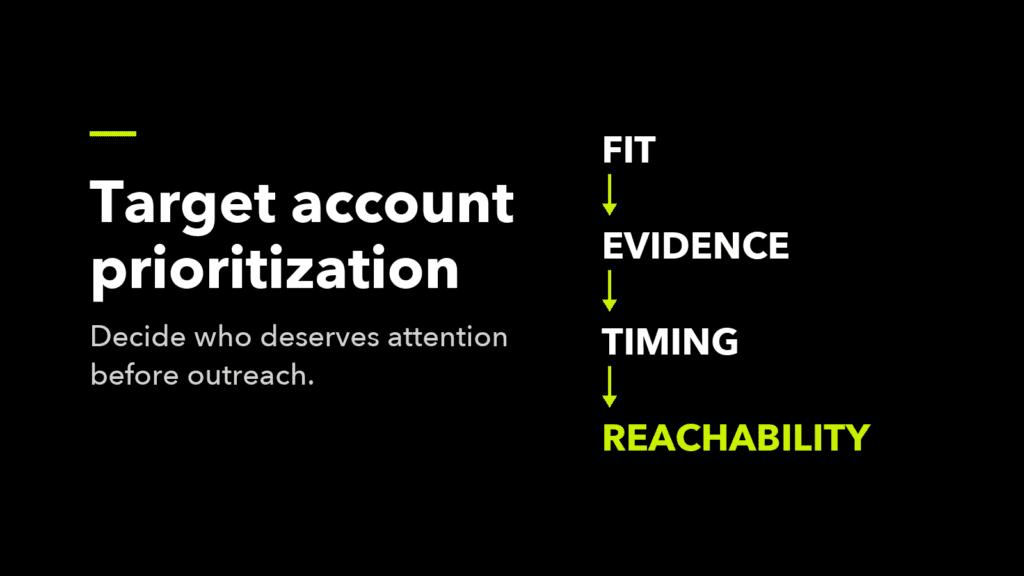
Before your team spends time writing outreach, decide which accounts are actually worth that effort. A useful priority list does more than filter companies by industry or size. It shows why an account fits, what evidence supports that judgment, what could count against it, and what should happen next.
This guide gives you a practical way to do that using fit, evidence, timing, reachability and counter-evidence. You can also use the worksheet near the end with your own target-account list.
Written by Shahab Shabbir, founder of Be My Tech. The method here supports your own judgment. It doesn’t rely on proprietary intent data, and it doesn’t predict replies, meetings or revenue.
What is account prioritization?
Account prioritization means deciding, before anyone writes a message, which accounts get sales effort first, which can wait, and which should be left out. The result is a ranked list where every account carries its reasoning: why it fits, what supports that view, what argues against it, and the next step.
Most wasted prospecting effort happens before the first email goes out. A team picks a segment, pulls records and starts writing, without stopping to ask whether those companies deserve the time. Prioritization fills that gap. If you’re still choosing between a purchased list, a database subscription, in-house research or custom research, start with B2B Lead Lists vs. Custom Prospect Research, then come back here once you have records to rank.
Why a database is not a targeting strategy
A database tells you which companies exist. A targeting strategy tells you which of them deserve your effort, and why. Filtering by industry, size and location narrows the market, but every company that survives the filter still looks equally important on screen. Volume hides the judgment step.
That’s why having 5,000 accounts isn’t a plan. A record only becomes useful for decisions when it says why the account fits, what that’s based on, what might be wrong with it, and what to do next. The rest of this guide turns those questions into a repeatable method. If you’re weighing the cost side of the same decision, see How Much Does Prospect Research Cost?
ICP versus account fit
Your ideal customer profile describes a type of company. Account fit asks whether one particular company matches that description once you look at the evidence. The ICP is a hypothesis about a segment, and fit is the test you run on each account.
Two companies can both be mid-size logistics firms in the U.S. and still be very different prospects. One runs the operation your offer improves, and the other outsources it. Category is easy to buy, but fit means reading something about the company. Score it from things you can point to, such as a product page, a public filing, a job posting or a description of how the business works. An industry label on its own shouldn’t earn a high score.
Fit, timing and reachability
These three questions are easy to blur together. Fit asks whether the account is right for your offer. Timing asks whether now is a sensible moment. Reachability asks whether you can legitimately reach the right person or role. When they get folded into a single score, good-fit accounts that nobody can reach end up at the top of the list next to reachable accounts that don’t fit.
| Question | What it asks | Evidence that counts | Evidence that doesn’t |
|---|---|---|---|
| Fit | Does this account match the buyer job we defined? | Product or service pages, public filings, job postings, descriptions of how the business operates | Industry code alone, headcount alone |
| Timing | Is there a dated, relevant reason to act now? | A dated public announcement or hiring change, with the source and check date | “Growing company,” undated news, guesses |
| Reachability | Is there a legitimate public route to a relevant role? | A published contact page or a named role on an official page, with the source | Guessed email patterns, scraped personal details |
If there’s no evidence of timing, write “none evidenced.” That’s a perfectly good answer, and it’s far more useful than an invented trigger. The same standard applies to contacts. The No-Guessed-Contacts Review Framework and our guide to checking whether a B2B contact is verified or guessed explain what a legitimate contact route looks like.
Evidence versus assumption
Evidence is something a colleague could open and check. An assumption is a belief with no source behind it. You’ll have plenty of both, and that’s normal. The mistake is scoring an assumption as if it were evidence.
A quick test helps. For each claim in your “why this account” column, ask whether someone else could find the same thing in under two minutes. If they couldn’t, label it an assumption, score it lower, and note what would confirm it. Record the date you checked too, because a source you read a year ago describes the company a year ago.
What counts against an account
Counter-evidence is anything you find that makes an account a poorer use of your time. Looking for it on purpose is what separates prioritization from list building. Before an account earns a high tier, check it for these:
- A business model that looks like your segment but doesn’t involve the thing your offer addresses.
- An exclusion you set at the start, such as size band, geography or ownership, that the account fails on closer inspection.
- Public signs that the need is already met, or that a decision just went the other way.
- No legitimate public route to a relevant role.
- Supporting evidence so old that the company may have changed.
Counter-evidence doesn’t always rule an account out. Sometimes it just lowers your confidence or changes the next step. What matters is that it gets written down.
How to tier accounts
Tiers turn scores into decisions about effort. Tier 1 accounts get attention now, Tier 2 accounts are queued, Tier 3 accounts are held, and anything without checkable evidence goes back to research. A tier only helps if it forces a trade-off. If every account is Tier 1, none of them is.
| Tier | Meaning | Typical action |
|---|---|---|
| Tier 1 | Strong, evidenced fit, no material counter-evidence, a legitimate route, and either evidenced timing or a clear reason to go first | Start outreach planning now |
| Tier 2 | Good fit with gaps, such as timing that isn’t evidenced or a route that needs checking | Queue for the next batch and fill the specific gap |
| Tier 3 | Weak or doubtful fit, or material counter-evidence | Hold, and don’t spend research effort yet |
| Research more | No evidence you can check, however the account looks | Find sources, then score again |
What information changes the decision
Only collect information that could move an account to a different tier or a different next step. For each field, ask whether you’d do something different if the answer came back the other way. Useful examples include:
- Whether the account does the specific thing your offer improves.
- Whether the relevant buying role exists and can be reached through a public route.
- Whether there’s a dated reason to act now, or an honest “none evidenced.”
- Whether anything public suggests the account is a poor fit or has already decided.
What research is wasted effort
Research is wasted when it fills a cell but can’t change a decision. Common examples are collecting more contacts at an account whose fit is still unproven, adding company details nobody uses to rank, polishing records for Tier 3 accounts, and researching every account to the same depth before the first five have been checked.
Good research is proportionate. Spend a little on every account to decide its tier, then spend more only where the tier justifies it.
Calibrate on five accounts first
Before you score a whole list, score five accounts and see whether the ranking matches your own judgment. Five is enough to test your criteria without committing to the full effort.
- Choose five accounts, including one you feel good about and one you doubt.
- Score them with the worksheet and note the sources.
- Compare the result with your gut ranking. Where the two disagree, one of them is wrong.
- If the criteria are the problem, change the criteria and score again. Leave the accounts alone.
- Once the ranking makes sense, extend it to the rest of the list.
Calibrating first is cheap. Calibrating after fifty accounts have been researched against the wrong definition of fit is expensive. It’s also how Be My Tech runs its own research, with a five-account calibration before full-scale work.
Keeping the list fresh
A prioritized list is a dated snapshot, so record when each account was checked and re-verify before you act on it. As a rule of thumb, re-check evidence that’s more than about twelve months old. Re-check timing evidence before every outreach batch, because that’s the field that goes stale fastest. Keep the check date in the record itself rather than in someone’s memory.
A worked example with synthetic accounts
The example below uses fictional accounts to show how the method works. It doesn’t describe any real company and it isn’t client data. Assume the buyer job is a logistics operations leader responsible for carrier onboarding.
| Account (synthetic) | Fit | Evidence | Counter-evidence | Timing | Reach | Score | Tier | Next action |
|---|---|---|---|---|---|---|---|---|
| Example Co. A | 3 | 3 | 0 | 2 | 2 | 13 | Tier 1 | Start outreach planning |
| Example Co. B | 3 | 2 | 1 | 1 | 1 | 9 | Tier 2 | Check the vendor-consolidation signal first |
| Example Co. C | 2 | 3 | 0 | 0 | 2 | 9 | Tier 2 | Queue it, since timing isn’t evidenced |
| Example Co. D | 1 | 1 | 2 | 0 | 0 | 1 | Tier 3 | Hold, because fit itself is unsupported |
| Example Co. E | 2 | 1 | 1 | 1 | 1 | 6 | Tier 2 | Refresh the outdated source, then score again |
Look at what the method does here. Example Co. C scores the same as B, but the reasons differ, so the next actions differ. Example Co. D looks like the others on industry alone, and the evidence column is what exposes it. Only one account lands in Tier 1, which is the point.
A practical scoring worksheet
The scoring is deliberately simple so anyone can audit it. The formula is ICP Fit × 2, plus Evidence, Timing and Reachability, minus Counter-evidence. Score fit, evidence and counter-evidence from 0 to 3, and timing and reachability from 0 to 2. A score of 10 or more is Tier 1, 6 to 9 is Tier 2, and 5 or lower is Tier 3. An account with no checkable evidence is marked “research more” whatever its score.
| Field | 0 | 1 | 2 | 3 |
|---|---|---|---|---|
| ICP Fit | Does not match | Same industry only | Matches on some evidence | Matches segment, buyer job and exclusions on evidence |
| Evidence | Nothing checkable | One weak or outdated source | Two sources, one current | Multiple current sources |
| Counter-evidence | None found after looking | Minor doubt | Material doubt | Likely disqualifying |
| Timing | None evidenced | Weak or unclear | Dated, relevant trigger | Not scored |
| Reachability | No public route | General or unverified route | Named or relevant public route, with source | Not scored |
Treat the score as an aid to judgment. It isn’t a predictive model. You can download the free worksheet as an Excel file or as a blank CSV template. Both include the nine fields (Account, ICP Fit, Evidence, Counter-evidence, Timing Context, Reachability, Priority, Uncertainty and Next Action), and the Excel file includes the synthetic example above.
Where Be My Tech fits
You can run this method yourself with the worksheet. If you’d rather have the research done for you, the Be My Tech Target Account Intelligence Sprint covers 50 researched U.S. B2B accounts for $499, with a five-account calibration before full-scale research. Each accepted account comes with a source-backed fit rationale, dated timing evidence where it exists (and “none evidenced” where it doesn’t), a legitimate public contact route, and the main uncertainty.
The Business prospect research page lists the scope and boundaries. You can also read how it works or start a Business fit check. If you’re comparing providers first, what makes a prospect list trustworthy is a good place to begin.
Frequently asked questions
How many accounts should I prioritize at once?
Start with five to calibrate your criteria, then extend the method to the rest of the list. There’s no fixed number. The real limit is how many accounts your team can work well in the next cycle.
Is this the same as lead scoring?
No. Lead scoring usually ranks inbound leads by their behavior. Account prioritization ranks outbound target accounts before any contact, using fit, evidence, timing and reachability. Teams often use both.
Do I need intent data to prioritize accounts?
No. Dated public evidence can support timing, and “none evidenced” is an acceptable answer. This method doesn’t rely on proprietary intent data.
What if every account scores high?
Usually the criteria are too loose or the counter-evidence step got skipped. Recheck your exclusions and force a trade-off, so that only the accounts you’d start with this week land in Tier 1.
How often should I refresh the scores?
Re-verify evidence that’s more than about twelve months old, and re-check timing evidence before each outreach batch. Keep the check date in the record itself.
Does Be My Tech guarantee meetings or revenue?
No. Be My Tech delivers researched accounts with evidence and a clear next decision. It doesn’t guarantee replies, meetings, pipeline or revenue.