Marketing & Demand
Late-Start Holiday Plan for Small Businesses: A 30-Day Readiness Check
Short answer: if you are starting holiday marketing now, do not begin with promotions. Begin with two questions: does holiday demand actually change how many people look for what you sell, and can a first-time visitor on a phone reach you in two taps? Most late-start plans fail on the second question, not the first.
What the 2026 holiday forecasts do and do not tell you
Two forecasts are widely quoted this season, and both describe retail:
- The National Retail Federation forecasts U.S. holiday retail sales of $1.013 trillion, up 4.2% from 2025, for November 1 to December 31. It excludes auto dealers, gas stations and restaurants. NRF also says shoppers will stay budget-minded.
- Adobe forecasts $275.1 billion in U.S. online holiday spending, up 6.7%, and expects visits to retail sites that come from AI assistants to grow sharply.
Treat these as context for stores and online shops. They do not measure demand for a plumber, an accountant, a cleaner or a web designer, and they do not predict your results. Your own last November and December are better evidence than any national figure.
Sources: NRF press release, Oct 15, 2026; Adobe holiday forecast release, Sep 28, 2026. Both are forecasts, not measured results.
Step 1: does holiday demand reach your business?
Answer this from your own records: enquiries, bookings or sales for November and December of last year compared with September and October. No records? Treat demand as unknown rather than guessing.
Should I run a holiday campaign at all?
Did enquiries or sales change in Nov–Dec last year?
No records: treat demand as unknown and do only the first two phases below.
Step 2: your 30-day plan
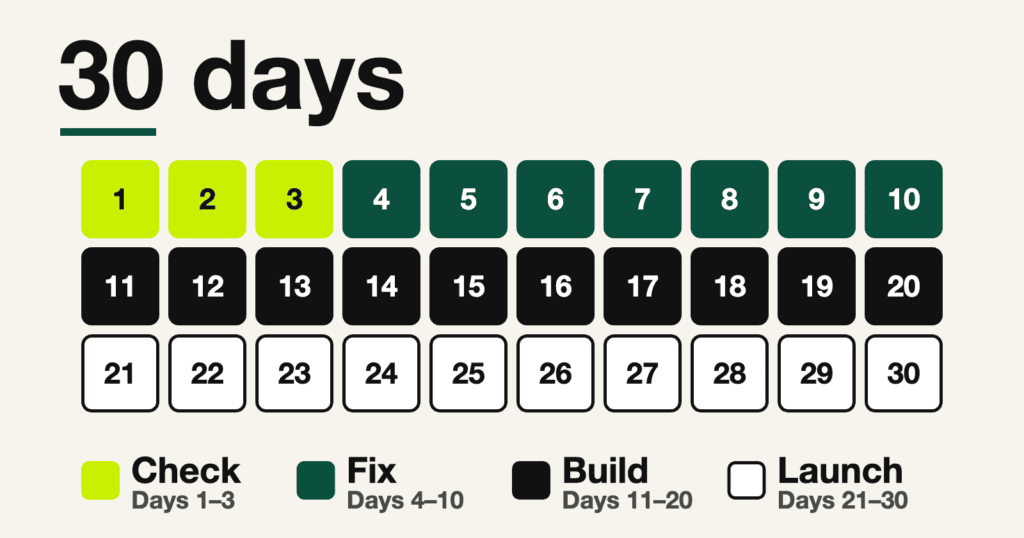
The calendar at the top of this page shows the four phases. This is what happens inside each one.
- CheckDays 1–3
Phone-test your own site. Confirm hours and holiday hours. Look at last year’s enquiries to decide whether demand reaches you.
- FixDays 4–10
Repair what failed the phone test. One clear action per page. Submit your own form and confirm you receive it. Name who owns replies.
- BuildDays 11–20
Write one email to past customers. Prepare one offer you can honour without hurting margin. Set up a simple count of enquiries by source.
- LaunchDays 21–30
Send, post, and answer the same day. Count enquiries by source. Note what to repeat next year.
Step 3: the website path, checked on a phone
Holiday visitors arrive on phones, often distracted and impatient. Open your own site on a phone, on mobile data, and try to contact yourself as a stranger would. If the path breaks, our guide on why websites don’t convert explains the usual causes, and the home-service website checklist gives a longer list for service businesses.
Where visitors leak out between search and enquiry
- Phone tap. Your number opens the dialer from the first screen.
- Form on mobile. It submits, shows a thank-you message, and you receive it.
- Hours. Holiday hours are accurate on the site and on your Google Business Profile.
- One offer, one action. The current offer is visible without scrolling through menus.
- Speed and layout. The page is usable within a few seconds on mobile data and nothing jumps.
Step 4: search and AI discovery, without the hype
Google’s own guidance for its AI features says you do not need special markup, an llms.txt file or other AI-specific files to appear. It points to the usual fundamentals: let search engines crawl your pages, link important pages to each other, keep key content as text, keep business information current, and publish helpful, reliable content written for people. Appearing is never guaranteed.
So the readiness work is plain: one clear page for each service you sell, accurate business details everywhere you are listed, and answers a customer would actually ask, written on the page in normal language. For what a deeper check of this kind covers, see what an AI visibility audit for a small business looks at.
Source: Google Search Central, “AI features and your website” (read Nov 3, 2026).
Step 5: offers, margin and email
NRF’s own commentary says buyers are watching budgets, and a discount you cannot afford to honour costs more than a quiet week. Pick the offer from this grid instead of defaulting to a percentage off.
Which offer, if any?
- Use what you own first. A short, useful email to people who already bought from you usually costs less than reaching strangers. Offer something specific, with an end date you will actually keep.
- Post for usefulness. One practical post a week (a checklist, a deadline, a how-to) is enough; do not repeat the same promotion everywhere.
Step 6: when not to spend on ads
Hold the budget if any of these are true: the phone test failed and is not yet fixed, nobody can reply within a day, you cannot say which offer you are promoting, or you have no way to tell which enquiries came from the ad. Ads send more people to the same path; they do not repair it.
And a few things to leave alone: do not copy a retail Black Friday playbook if you sell services, do not promise results you cannot deliver, do not add an AI-specific file or markup expecting a ranking boost, and do not change five things at once.
Score yourself before you spend
Website
- My phone number opens the dialer on the first screen.
- My contact form submits on a phone and I receive it.
- My current offer is visible without hunting.
Search and listings
- Holiday hours are correct on my site and listing.
- Each service has its own clear page.
Email and offer
- I have one email ready for past customers.
- I have one offer I can honour without hurting margin.
Tracking and replies
- I can tell where each enquiry came from.
- Someone owns replies during the holidays.
- I know if last Nov–Dec enquiries rose, held or fell.
Not sure which checks you would fail?
The Website Revenue Diagnostic reviews up to 10 key pages of your site and gives you a written verdict on what is stopping visitors from contacting you. It is $129 and does not promise holiday revenue or rankings.