
Prospect Research
How Much Does Prospect Research Cost? Pricing, Deliverables, and Tradeoffs
Prospect research is priced in four main ways: per record in a static list, per subscription credit in a database, per hour or per project in custom research, or absorbed as internal staff time. Prices vary widely with volume, research depth, geography and how strict the contact requirements are, and the number on the label matters less than what it buys. Current fit, scope and pricing for Be My Tech’s work are confirmed through the prospect research path before you commit.
Written by Shahab Shabbir, founder of Be My Tech.
What are you actually paying for?
Prospect-research pricing pays for the work between “a list of companies” and “a list you can act on today.” That work has several distinct steps, whether or not a provider itemizes them:
- Targeting interpretation, which turns what you sell and who you sell to into criteria that someone can actually search against.
- Discovery, which finds candidate companies that plausibly match.
- Source checking, which confirms from a public source that each company is real, active and a match, rather than guessing.
- Date checking, which records when that confirmation happened, not just when the list was assembled.
- Fit reasoning, which writes a specific reason each record matches your criteria instead of pasting the same line everywhere.
- Contact-status review, which marks what’s publicly available and leaves the rest blank instead of guessing.
- Exclusions, which remove companies that don’t really qualify, even if that shrinks the count.
- QA and delivery, which means a final review pass and a usable format rather than a raw export.
A cheap price usually means several of those steps were skipped, automated without review, or never happened. A high price doesn’t prove they did happen. It only means you’re entitled to ask.
Why are some prospect lists so cheap?
A list is cheap when most of the work above was done once, in bulk, a long time ago, and not for you specifically this week. Large self-serve databases spread the cost of one big crawl and match across millions of records sold to thousands of buyers, so the per-record price can drop to a fraction of a cent or under a dollar. Large providers publish their pricing. Per-contact costs run on credit systems, and subscription tiers range from a few hundred dollars a month for small teams to tens of thousands a year for larger seat and credit allowances. Exact figures vary by provider and change often enough that a single blended number would mislead, so check current pricing on the provider’s own site before comparing.
That isn’t inherently a bad deal. It’s a different deal. You’re paying for access to a large, pre-built pool, and you do the targeting, fit review and freshness check yourself at your own labor cost. Custom research flips that arrangement. Someone does the targeting and fit review before you receive anything, for fewer records, at a higher price per record.
Four common pricing models
Prospect data is generally sold in four ways: a database subscription, a purchased static list, custom research, or work done internally. None of the four is right for everyone. Each fits a different mix of volume need, internal capacity and how much the targeting criteria matter.
Database subscription
This is ongoing access to a searchable database, usually billed monthly or annually and often metered by “credits” per contact unlocked.
It may fit: teams that need broad, ongoing access, users with the time and skill to filter and validate internally, and organizations exploring large or shifting markets.
Tradeoffs: you get a broad match rather than a custom fit, the filtering work lands on you, record freshness depends on the provider’s own refresh cycle, credit systems can run out mid-project, and it’s usually a recurring commitment even in slow months.
Purchased static list
This is a one-time export against loosely stated criteria such as industry, size band and region, delivered as a spreadsheet with no ongoing relationship.
It may fit: simple criteria, a one-time starting point, and buyers who don’t need documented fit reasoning.
Tradeoffs: you get limited transparency into how records were selected, the list ages the moment it’s delivered, the methodology is often undocumented, and there’s little to no customization once it’s purchased.
Custom prospect research
Here a provider researches and reviews a specific, smaller batch of companies against criteria you supply, before you receive anything.
It may fit: specific or narrow targeting criteria, buyers who need documented fit reasoning and respected exclusions, and anyone who values a focused list over maximum raw volume.
Tradeoffs: you get lower volume per dollar than bulk data, the research takes real time, it’s still limited to what’s publicly available, and the price per record is typically higher than a database credit.
Internal research
This is staff time, whether a founder, an SDR or a marketer, spent building and qualifying the list in-house.
It may fit: companies with trained staff and institutional market knowledge, continuous ongoing prospecting, and teams with existing internal tooling and process.
Tradeoffs: there’s a real labor cost even when no invoice is issued, consistency depends on who does the work and how carefully, it needs its own QA, and it carries an opportunity cost against whatever else that person could be doing.
What actually changes the price?
Ten factors move prospect-research pricing more than a provider’s brand name does: the volume requested, how narrow the niche is, how specific the geography is, how much evidence is documented per record, how strict the contact requirements are, the seniority or role required for named contacts, how recent each record must be, how many exclusions have to be tracked and respected, whether the list is one-time or refreshed on a schedule, and the delivery format. A request for “500 companies anywhere in the US that sell software” is cheap to fill. A request for “12 independent dental practices in three specific ZIP codes with an owner’s name publicly listed” takes real time per record, even though the second list is shorter.
Cost per row versus cost per useful record
The cheapest price per row isn’t necessarily the lowest cost per useful prospect. A 1,000-row list at $0.05 a row looks like a $50 bargain next to a smaller custom list priced at Be My Tech’s current one-time offer, until you count what it costs to turn either one into outreach you’d stand behind.
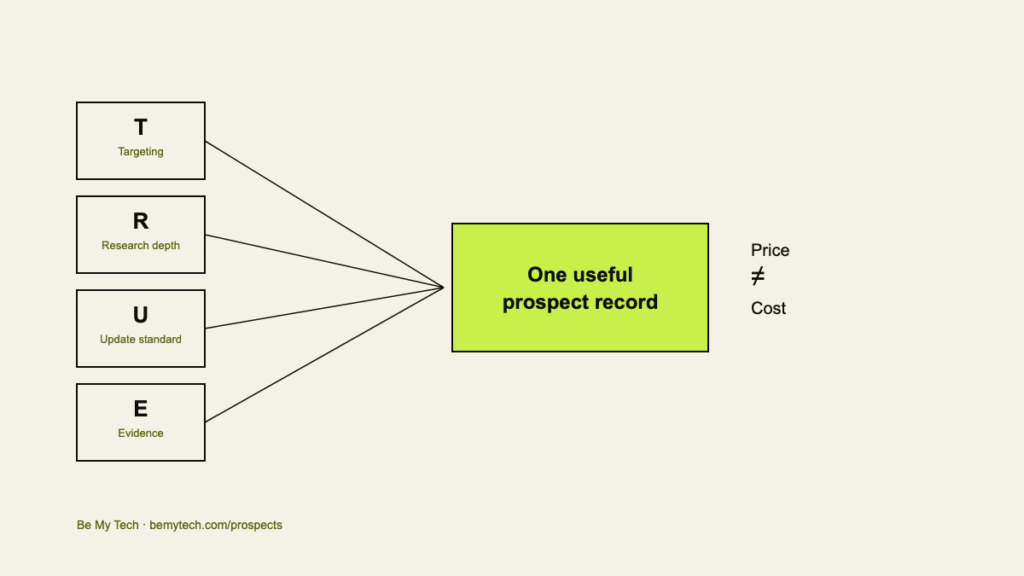
Call this the TRUE Cost view of prospect-research pricing. It isn’t a formula that produces a single verified number, since actual internal costs vary by team and market. It’s a way to ask the right question before you buy.
What actually drives cost per useful prospect, not just cost per row
T
Targeting complexity: how narrow is the market?
R
Research depth: how much evidence is required per record?
U
Update standard: how recently must each record be checked?
E
Evidence & exclusions: what’s documented, what’s disqualified?
Cheap price per row + high T-R-U-E burden = expensive per useful prospect.
Be My Tech · bemytech.com/prospects
As a decision concept rather than a financial guarantee:
Useful research cost = purchase price + internal cleanup time + poor-fit review time + correction effort
A cheap list with a heavy T-R-U-E burden can end up costing more of your own time than a smaller, pricier list that arrives already filtered. The reverse is also true. If your criteria are broad and you have the capacity to filter thousands of rows yourself, a database subscription’s low per-row price really is the better deal. HubSpot’s analysis of database decay, built on the widely cited MarketingSherpa research into B2B contact turnover, puts typical annual accuracy loss for a static database at roughly 22.5%. That’s one reason the “U” factor matters as much as the sticker price, because a record that was accurate a year ago may not be accurate now.
What should be included in a paid record?
This article covers pricing. The full evaluation standard, meaning what separates a trustworthy record from a padded one, is in What Makes a Prospect List Worth Trusting? 7 Checks Before You Buy. In short, a paid record should be able to show its source, a checked date, a specific fit reason, honestly marked contact availability and disclosed exclusions, whichever pricing model produced it. Price tells you what you spent. Those fields tell you what you got.
If you’re deciding whether a purchased list, a database subscription, internal research or custom research is the right fit for your situation, and not just what each costs, see B2B Lead Lists vs. Custom Prospect Research: Which One Should You Use? Once you have records in hand, How to Prioritize Target Accounts Before Outreach covers how to rank them.
Comparing the options
| Option | Typical use case | Customization | Evidence transparency | Your cleanup burden | Recurring commitment | Principal tradeoff |
|---|---|---|---|---|---|---|
| Database subscription | Broad, ongoing outbound at volume | Filter-based, after export | Varies by provider | High, because you filter and validate | Usually yes | Volume over fit |
| Purchased static list | One-time, simple criteria | Low | Often undocumented | Medium to high | No | Ages immediately, little transparency |
| Custom research | Specific criteria, fit matters more than volume | High, set before delivery | Documented per record when the provider publishes it | Low, since fit is decided before you receive it | Optional (one-time or refill) | Lower volume per dollar |
| Internal research | Continuous, institutional-knowledge-driven prospecting | Highest | Depends entirely on your own process | Not applicable, since the labor is the cost | Ongoing staff time | Real cost even without an invoice |
What does Be My Tech charge?
Research is built against the target criteria you provide. Delivered records include source evidence, a checked date, public contact information where available and a fit rationale. The Target Account Intelligence Sprint covers 50 researched U.S. B2B accounts for $499, with a five-account calibration before full-scale research. The Business prospect research page lists the scope and boundaries, and current fit, scope and pricing are confirmed before you commit.
What changes the price on Be My Tech’s side is what changes it everywhere: how narrow and specific the criteria are. If a market needs extra research time, that’s communicated before delivery, not discovered after payment.
What is not guaranteed
No prospect-research provider, Be My Tech included, can price in a guaranteed outcome, because outcomes happen after delivery and not during research. Be My Tech’s pricing doesn’t include or promise replies, meetings or sales, complete private contact details (personal cell numbers or direct emails that aren’t publicly listed), perfectly complete public information (some businesses simply don’t publish a phone number or owner name), permanent accuracy after the checked date, or fitness for outreach methods that violate the calling and email regulations that apply in your region. If a delivered record materially fails the stated criteria, whether it’s a closed business, a dead website, the wrong location, a clear mismatch, a duplicate or an unusable source, Be My Tech’s current published policy is a free replacement within 14 days, and a refund review if the issue can’t be resolved fairly.
The hidden cost of a cheap list
A low sticker price doesn’t make the work disappear. It moves the work onto you. A cheap or loosely targeted list still has to be reviewed by hand for duplicates, checked for businesses that closed or moved, filtered for poor fit and cross-checked for accuracy before it’s safe to act on. None of that shows up on the invoice, which is exactly why it’s easy to underestimate. The 1,000-row, $50 list and the smaller custom list can end up costing about the same once review time is counted. The difference is who does the review, and when.
Who should buy
This tends to suit businesses that already know what they sell, can describe their target criteria in a sentence or two, and would rather review a smaller, evidence-backed list than sift through a large export themselves, where fit and documentation matter more than raw volume.
Who should not buy
Be direct with yourself here. Custom research at this scale isn’t the right fit if you need thousands of contacts immediately, require guaranteed personal cell numbers or private emails as a baseline, want a self-serve searchable database you can query yourself, or are looking for guaranteed replies, meetings or sales. A database subscription or internal research is likely the better tool in those cases, for anyone and not just for Be My Tech.
How can you test quality before paying?
Before ordering, review how the research works and what each delivered record contains. Be My Tech confirms your targeting criteria before payment so both sides are clear about what counts as a useful prospect.
Review the standard before you pay for it
Price tells you what something costs. It doesn’t tell you what you’re getting for it. Run the TRUE Cost view (targeting complexity, research depth, update standard, evidence and exclusions) against any list before you buy it, including this one.
See how prospect research works
Frequently asked questions
Is pricing usually per record, per project, subscription or retained research?
All four exist in the market. Database access is typically subscription or credit-based, static lists are usually a flat one-time fee, custom research is priced per project or per batch (as Be My Tech’s packages are), and internal research is paid as staff time rather than as an invoice.
Is a larger list automatically better value?
No. A larger list is better value only if you have the capacity to filter and validate it. Otherwise the extra rows are unreviewed risk, not extra value.
What makes a record more expensive to research?
Narrow or unusual targeting criteria, strict contact requirements, small or hard-to-find markets and documented fit reasoning per record all add research time, and time is most of what custom research pricing reflects.
What’s the difference between buying database access and commissioning custom research?
Database access gives you a large pool and the filtering work. Custom research gives you a smaller, pre-filtered set with the fit decision already made against your stated criteria.
Are direct email addresses and phone numbers always included?
No, only where a business has made that information public. A trustworthy provider leaves the field blank rather than guessing.
Sources: the B2B contact-database decay figure (about 22.5% annually) is drawn from HubSpot’s Database Decay analysis, which states that its methodology is built on MarketingSherpa’s original research into B2B contact turnover, linked above. No blended per-contact pricing figure is cited in this article, since provider pricing changes often enough that a single number would go stale. Check each provider’s own current pricing page directly. Be My Tech’s own pricing is verified against the live site at the time of writing.