
Prospect Research
B2B Lead Lists vs. Custom Prospect Research: Which One Should You Use?
The right way to get a B2B prospect list depends on how narrow your targeting is and how much you need to trust the list before anyone touches it. A purchased list suits broad criteria when you have staff time to filter and verify. A database subscription suits ongoing, high-volume access if you can absorb the filtering yourself. Building the list in-house makes sense when the targeting logic depends on institutional knowledge no outside vendor has. Custom prospect research fits when the criteria are narrow, the fit reasoning has to be right before you spend outreach time, and nobody on your team has spare hours to do that filtering. None of the four is the universally correct choice.
Written by Shahab Shabbir, founder of Be My Tech.
What’s the difference between a lead list and prospect research?
A lead list is a static export pulled from a broad database against loosely stated criteria. Prospect research is a smaller batch of companies that someone has reviewed individually against your specific criteria before you receive anything. The list gives you volume and speed, and the research gives you fit and evidence. They aren’t two versions of the same product. They sit at different points between “fast and broad” and “slow and specific,” and a database subscription falls in the middle, trading a static export for continuous access at the cost of filtering the results yourself indefinitely.
Building the list internally isn’t a purchase at all. It swaps a vendor invoice for staff hours, which is a real cost even though it never shows up as a line item.
Executive comparison
| Option | Speed to first list | Targeting precision | Source transparency | Data recency | Your cleanup effort | Typical cost shape |
|---|---|---|---|---|---|---|
| Purchased static list | Fast, hours to days | Low, broad criteria only | Often undocumented | Fixed at export and ages immediately | High | Low per row, one-time |
| Database subscription | Fast, self-serve | Medium, filterable but not custom | Varies by provider | Depends on the provider’s refresh cycle | High | Recurring, credit-metered |
| Internal research | Slow, depends on staff bandwidth | Highest, if the researcher is skilled | Depends entirely on your own process | As current as your last research pass | Not applicable, since the labor is the cost | Ongoing staff time with no invoice |
| Custom prospect research | Slower than self-serve because it takes real research time | High, set before delivery | Documented per record when the provider publishes it | Checked at delivery and dated per record | Low, since fit is decided before you receive it | Higher per record, lower volume |
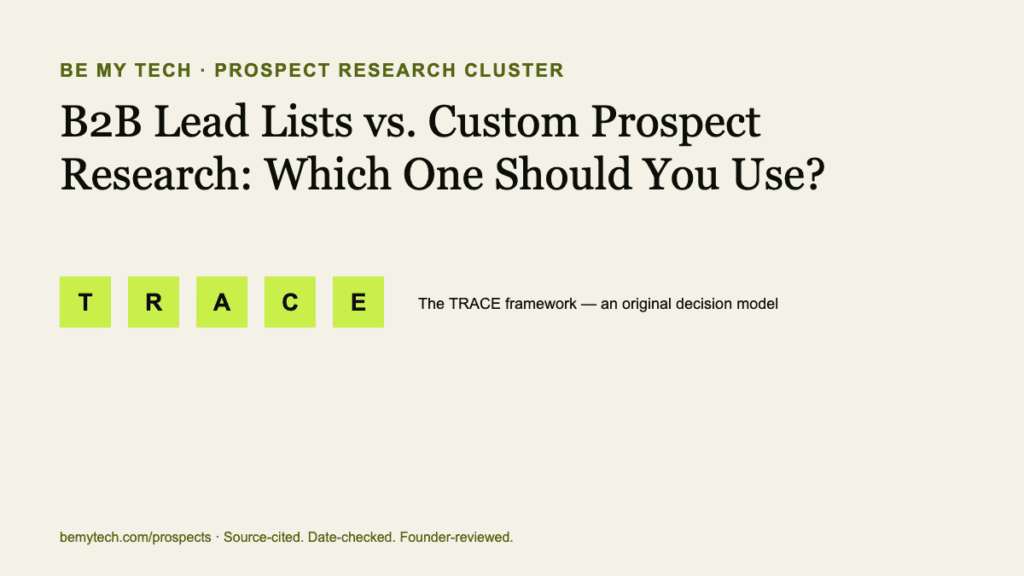
The TRACE framework: five questions to ask before you choose
Cost is only one of the questions that matter. TRACE is a decision framework for comparing lead-sourcing options on the five dimensions that decide whether a list is usable, not just cheap.
Score any option you’re considering against these five before you look at price. A list that scores low on research transparency and accuracy isn’t really cheap, because the missing work lands on your team later, usually after a wasted outreach attempt.
Purchased static lists: what they are and where they break down
A purchased static list is a one-time export against broadly stated criteria, such as industry, employee-count band and region, sold as a spreadsheet with no ongoing relationship to the seller. It’s the fastest option to get and usually the cheapest per row.
It holds up when the criteria are simple and broad, when you need a one-time starting point for a new campaign, or when you’ve budgeted staff time to verify and segment before anything is sent. It breaks down once the criteria get specific. A named role, a narrow geography or a particular business condition will trip up a list built for broad matching, and there’s usually no way to see why a given company was included. Methodology is often undocumented, so a wrong record and a right record look identical on the page.
Database subscriptions: continuous access, continuous filtering
A database subscription replaces the one-time export with ongoing, searchable access. It’s usually billed monthly or annually and often metered by “credits” that unlock a contact record when you view it. Most self-serve sales-intelligence platforms work this way.
It suits teams that need broad, recurring access across shifting markets, people with the skill and time to build and refine their own filters, and organizations running enough outbound volume that a large searchable pool is worth more than a smaller curated one. The weak point is recency. The database’s own refresh cycle sets the ceiling on how fresh your data can be, so a provider that recrawls quarterly can’t give you anything newer, however polished the interface looks. A broad match also isn’t the same as a fit reason. The platform surfaces candidates, but confirming that each one qualifies is still your team’s job, record by record, every time you pull a new batch.
Internal research: the cost that never appears on an invoice
Internal research replaces a vendor with staff time. A founder, an SDR or a marketer finds and qualifies companies by hand, drawing on what they know about the market. Done well, it can beat any outside option on precision, because the researcher understands nuances that a vendor’s criteria fields can’t capture.
It works in narrow or unusual markets where institutional knowledge matters more than data volume, on teams that already run a disciplined and repeatable research process, and for ongoing prospecting where the same person refines the criteria over time. It falls short because the labor cost is easy to underestimate when there’s no invoice to remind you of it. Quality depends entirely on who does the work and how carefully, with no outside QA step unless you build one. There’s also an opportunity cost, since every hour spent researching is an hour not spent on outreach, product or whatever else that person’s time is worth.
Custom prospect research: what it trades away and what it buys
With custom prospect research, a provider reviews a specific, smaller batch of companies against criteria you supply and confirms and documents fit before you receive anything. It reverses the static-list model. Instead of filtering a large export after delivery, the filtering happens before delivery, against your stated criteria.
It fits when your criteria are narrow enough that a broad database can’t filter for them reliably, when you need a documented reason for each record and confidence that excluded companies really were excluded, and when a smaller, higher-confidence list is worth more than maximum volume. The trade-offs are real. You get less volume per dollar than a bulk database or static list because you’re paying for review time, the research takes time between request and delivery, and it’s still bounded by what’s publicly available. No ethical research process can produce a private phone number or email that was never published anywhere.
Cost isn’t the whole picture, but it isn’t nothing
For a full breakdown of what prospect-research pricing buys, why some lists are so cheap, and how to compare cost per row with cost per usable record, see What Does Prospect Research Cost? This article is about which option fits a given situation, not about pricing mechanics. The short version is that the cheapest list per row isn’t always the cheapest list per record you can act on, once your own review and cleanup time is counted.
Accuracy and recency: the clock starts when a record is finalized
Every option here faces the same underlying problem. B2B contact and company data degrades over time as people change roles, companies are acquired and businesses close. HubSpot’s published Database Decay research puts average B2B data decay at roughly 2.1% per month, which compounds into a meaningful share of a database going stale within a year. That figure describes a general trend across static, unrefreshed data. It isn’t any single vendor’s accuracy rate, and none of the four options can guarantee accuracy past the moment a record was last checked.
What differs is how visible the decay risk is. A static list gives you one snapshot with no view of when it was last verified. A database subscription’s freshness depends on the provider’s refresh cadence, which is rarely published in detail. Custom research and disciplined internal research can attach a specific checked date to each record. That doesn’t stop decay, but it tells you how much of it to expect.
Research transparency: can you see how a record was produced?
The “They Ask, You Answer” principle applies directly here. The honest answer to “how was this record produced?” should be available before you pay, not discovered afterward. Ask any provider, Be My Tech included, to show you rather than tell you: a source for each company record, the date the source was checked, a specific reason it matches your criteria, and an honest note of what contact information is and isn’t publicly available. A provider that can’t answer those four questions for each record is selling you a guess with a professional layout.
Compliance and responsible outreach
None of the four sourcing options exempts you from the outreach laws that apply once you use the list. Cold email in the US falls under the CAN-SPAM Act, which requires accurate headers, a working opt-out and a physical address. Cold calling and texting can fall under the Telephone Consumer Protection Act, depending on the method and any prior relationship. Purchased lists and self-serve databases don’t check consent or opt-out status for you, so that check is yours to run wherever the contact came from. If a vendor or article quotes a specific per-email penalty, treat it as a rough guide. The FTC adjusts civil penalty amounts for inflation from time to time, so a number from last year’s blog post may already be out of date. Check current maximums at ftc.gov before relying on one.
Operating effort: where does the work land?
Every option takes some effort after you acquire the list. What varies is how much and where. A purchased list has a low upfront cost and a heavy cleanup bill afterward, because you’ll spend real time deduplicating, checking for closed or moved businesses, and filtering for fit before it’s safe to act on. A database subscription spreads the same effort across every batch you pull, for as long as the subscription runs. Internal research concentrates the effort into staff hours up front, with quality depending on process discipline. Custom research moves most of that effort to the provider, before delivery, which is why it costs more per record and returns fewer records per dollar.
A worked example
Say a business needs 50 companies that plausibly buy commercial HVAC maintenance contracts in a three-county region, with an owner or facilities-manager name listed publicly where available.
- With a purchased static list, a broad “HVAC contractors, three counties” export might return 200 rows in a day for a low one-time price. It probably mixes residential and commercial contractors, includes closed businesses, and rarely has an owner name filled in. Expect several hours of manual review to get to a usable 50.
- With a database subscription, you can run the same filtering inside the platform’s search, narrowing by NAICS code and employee count. That’s faster than a static list, but the owner-name field is still filled in inconsistently, and working out which listings really focus on commercial work is still on you.
- With internal research, a staff member who knows the local commercial-service market could produce a tighter, more accurate 50. The cost is however many hours it takes them away from other work, and nobody independent checks their judgment unless someone else reviews it.
- With custom prospect research, a provider researches against the exact three-county, owner-name-where-available criteria before delivery and documents why each of the 50 qualifies. Where no owner name is public, the field stays blank rather than guessed. The price per record is higher and the turnaround is days rather than same-day.
This example is illustrative, not a benchmark. Real results depend on the market, the provider and how narrow the actual criteria are.
When to choose each option
| Option | Choose it when |
|---|---|
| Purchased static list | Criteria are broad, speed matters more than fit, and you have staff time budgeted for cleanup |
| Database subscription | You need ongoing, high-volume access and have the internal skill to filter and verify continuously |
| Internal research | The market is narrow or unusual and institutional knowledge outweighs raw data access |
| Custom prospect research | Criteria are specific, fit has to be right before outreach, and internal staff hours are the scarce resource |
When to avoid each option
| Option | Avoid it when |
|---|---|
| Purchased static list | Your criteria are narrow or unusual, since broad exports will mostly return poor fits |
| Database subscription | You don’t have the staff time to filter and validate every batch you pull, indefinitely |
| Internal research | No one on staff has the market knowledge or the time to do it carefully and repeatedly |
| Custom prospect research | You need thousands of contacts immediately and volume matters more than documented fit |
For a fuller standard of what a trustworthy record should show, beyond the four questions above, see What Makes a Prospect List Worth Trusting? 7 Checks Before You Buy.
Vendor-evaluation checklist
Before you pay any provider for a list, a subscription or custom research, ask for these:
- A sample record showing source, checked date and fit reasoning, before you pay for the full batch
- A plain-language answer to how contact information is verified, and what’s left blank when it isn’t publicly available
- The provider’s stated refresh or re-check cadence, in writing, and not just “regularly updated”
- A written policy for what happens when a delivered record is wrong: replacement, refund or neither
- Clarity on what’s excluded and why, not only what’s included
Buyer decision matrix
| Your situation | Best-fit option |
|---|---|
| Need thousands of contacts fast, broad criteria, have cleanup staff | Database subscription |
| One-time campaign, simple criteria, limited budget | Purchased static list |
| Ongoing, narrow, institutional-knowledge-dependent market | Internal research |
| Specific criteria, no spare staff hours, fit matters more than volume | Custom prospect research |
Recommended next step
If you’re not sure which of the four fits your situation, decide how you’ll rank the accounts first. How to Prioritize Target Accounts Before Outreach walks through a scoring method and includes a free worksheet. If custom research is the right fit, the Be My Tech Target Account Intelligence Sprint covers 50 researched U.S. B2B accounts for $499, with a five-account calibration before full-scale research. The Business prospect research page lists the scope and boundaries, or you can start a Business fit check.
Frequently asked questions
Is a lead list the same thing as a prospect list?
Not exactly. The terms overlap in practice, but a “lead” often implies some inbound signal, such as a form fill or a download, while a “prospect” is usually an outbound target identified before any contact has happened. A purchased “lead list” is frequently a prospect list in substance, whatever the label says.
Can I mix these four options?
Yes. Many teams use a database subscription for broad, ongoing volume and commission custom research for their highest-priority or hardest-to-find segments. The options aren’t mutually exclusive. They’re tools suited to different slices of the same overall need.
Which option is cheapest?
Per row, a purchased static list or a database subscription is usually cheapest. Per usable, verified record, after you count your own cleanup time, the ranking often reverses. What Does Prospect Research Cost? has the full cost breakdown.
How do I know if a provider’s data is actually accurate?
Ask for a source and a checked date on individual records instead of an aggregate accuracy percentage. An aggregate claim describes the whole database on average and tells you nothing about the specific 50 or 100 records you’re about to receive.
Does Be My Tech sell a database subscription?
No. Be My Tech provides custom prospect research: a smaller, researched batch reviewed against your stated criteria and delivered with source, checked date and fit reasoning for each record. If you need a large, ongoing self-serve database, that’s a different category of product from what Be My Tech offers.